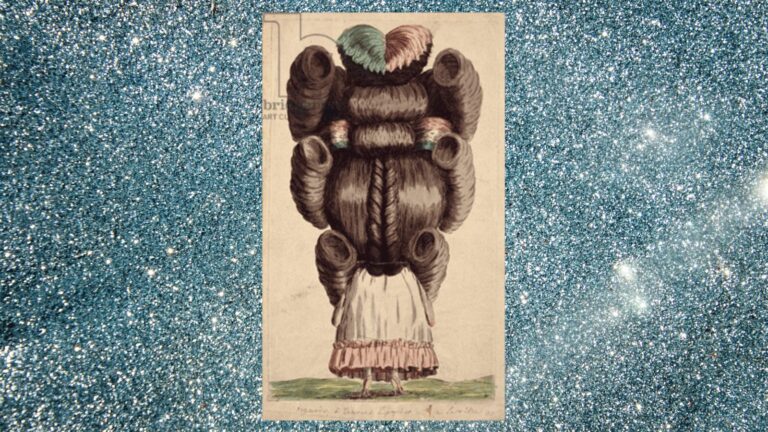
73. „In the previous post we undressed a protein. The TRPC3 ion channel as a woman with bare buttocks — „Top and Tail,” London, 1777.
Now we dress it.
The same hairstyle. The same curlers. But instead of nakedness — a skirt with ruffles. Instead of England — France. Instead of nakedness — clothing.
What does that change? Everything.
Because the skirt is not a metaphor. The skirt is nanobody Nb1-94 — a miniature camelid antibody that covers the cytoplasmic domain of the TRPC3 channel. Orange nanobody on green helices. A skirt on legs.
PDB: 9U5C. Published in 2025.
Drawn in the 18th century.
They knew. And they dressed the protein before science discovered it.”
The Wardrobe of the Genome: Top and Tail — Anatomy of an Ion Channel in 18th-Century Satire
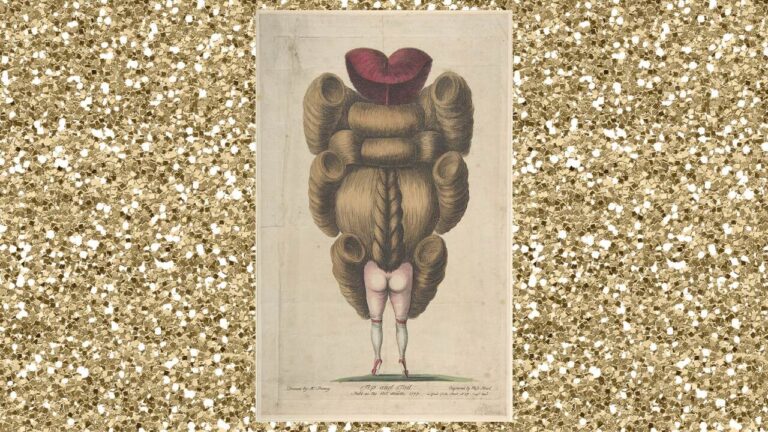
72. „London, 1777. An anonymous printmaker publishes a satirical print called „Top and Tail.” A woman seen from behind. A monumental hairstyle with curlers. Bare buttocks. Red high-heeled shoes.
A joke.
But the curlers are extracellular protrusions. The braid is the ion pore. The cushion at the top is the funnel-shaped pore vestibule. The buttocks are the cytoplasmic domain with an inhibitory calcium-binding site.
The TRPC3 ion channel. PDB: 5ZBG. Published in 2018.
Drawn in 1777.
241 years earlier.
They knew. And they had a laugh about it.”
The Wardrobe of the Genome: Pouf à l’Asiatique — AMPA Receptor GluA2
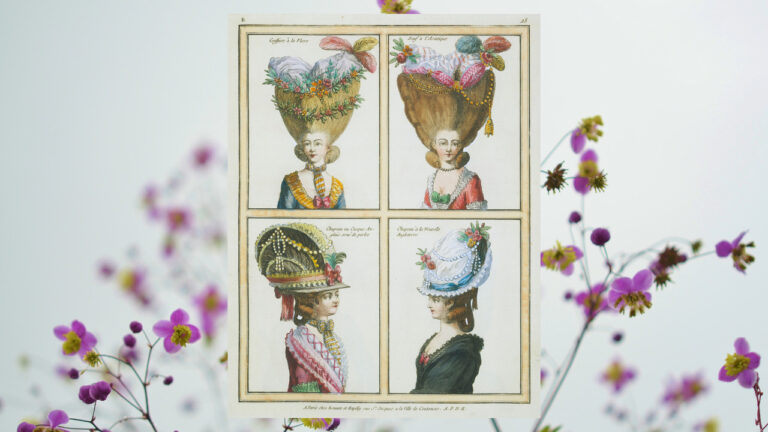
71. -Eighteenth-century Paris. A woman wears a tower of hair, feathers, and flowers on her head. Two red roses at the edges. Strings of pearls hanging between layers. Three feathers at the summit.
This is not fashion. This is a protein.
The AMPA receptor — the gate of every thought, every memory, every act of learning — encoded in a hairstyle from the fashion catalogue of Marie-Jeanne Bertin, „Ministre des Modes” to Marie Antoinette. The roses are sugar chains on the protein surface. The pearls are the polypeptide backbone linking domains. Every detail has its molecular counterpart.
The quantity and precision of these mappings leave no doubt — they knew these structures.
🔬 New entry in „The Wardrobe of the Genome” series on CellGod.live
The Wardrobe of the Genome: An 18th-Century Dress — the Armour of the HPV Virus
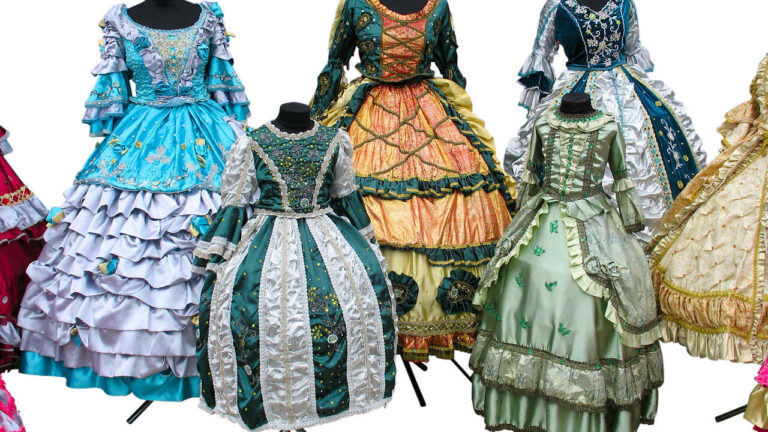
70. -Why did 18th-century dresses have two layers of skirt? Why were—and still are—dresses decorated in such a manner? And why was there that strange extension at the back, over which generations of costume-drama viewers have racked their brains? Because it was not fashion. It was a diagram of a viral protein. In the next installment of „The Genome’s Wardrobe,” I show that a historical gown recreates the L1 pentamer of the HPV virus (PDB: 8YEF)—and that the corset, made of two halves, encodes a fragment of an antibody that captures this virus.

China, Gaobang Mountain and Guabang Pavilion – A Complete Animal Cell in Chinese Architecture
69. – Dear CellGod.live reader,
the new post decodes the Chinese temple complex of Guabang Pavilion in Guangdong – Province as a complete animal cell. Most organelles finds its architectural counterpart – the nucleus in the seven-story central building, the endoplasmic reticulum in the courtyard filled with people acting as ribosomes, the Golgi apparatus in the lower pavilion, the lysosomes in the round tree crowns along the perimeter.
– Beneath the main post is a postscript that shifts the perspective from architectural to medical. Twenty years of research by Japanese immunologist Qing Li have shown that the forest – phytoncides released by trees, such as α-pinene and limonene – activate, in your bloodstream, NK cells. Measurable anti-cancer protection lasting over a month after a three-day stay among trees.
-The temple is a diagram of the cell. The forest is its activator.
-And God-Genome dwells in the nucleus of the tree exactly as in the nucleus of your cell.
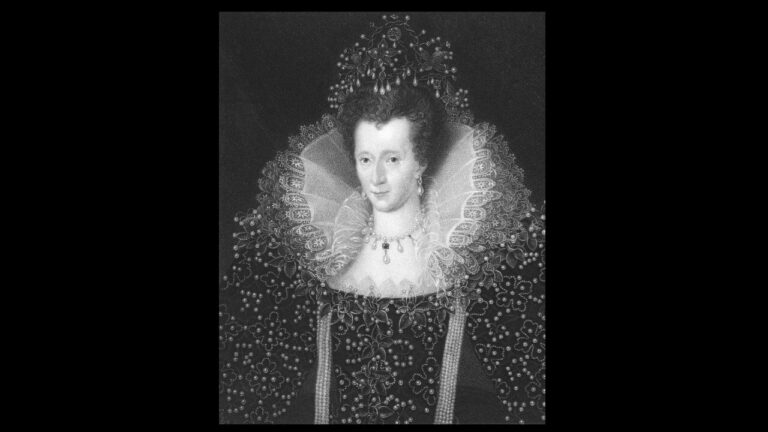
A New Series on Aristocratic Fashion as Protein Encoding. The Wardrobe of the Genome: Elizabeth I
68. – Have you ever looked at the Ditchley portrait of Elizabeth I? – You saw only a beautiful queen in a white silk gown with a ruff. – But what if the portrait is not a work of art — but a molecular diagram?
– Her skirt is the B pentamer of cholera toxin. Her collar is the A1/A2 domain. – Her necklace encodes organic molecules. – Every string of pearls is a chain of hydrogen bonds. – Even the rose pinned to her collar — that is the active site of the enzyme.
– In the new series „The Wardrobe of the Genome,” we show that the clothing architecture of the aristocracy encodes proteins, molecule by molecule. – And when you begin to zoom in on the portrait — you discover the same hierarchy at every scale.

LANTERNS ENCODE RECEPTORS
67. „Old street lamps on a seaside port promenade. Tall, slender, with wrought-iron S-curve scrolls, with spherical globes hanging above the pavement. They have stood there for decades — perhaps longer.
And yet they encode the full topology of pattern recognition receptors (PRRs) — the class of molecular guardians of innate immunity. Four constructional elements, one to one. Bracket, globe, post, base. LRR horseshoe, MD-2 with LPS, transmembrane helix, TIR domain.
The same guardian — in iron and in amino acids.”
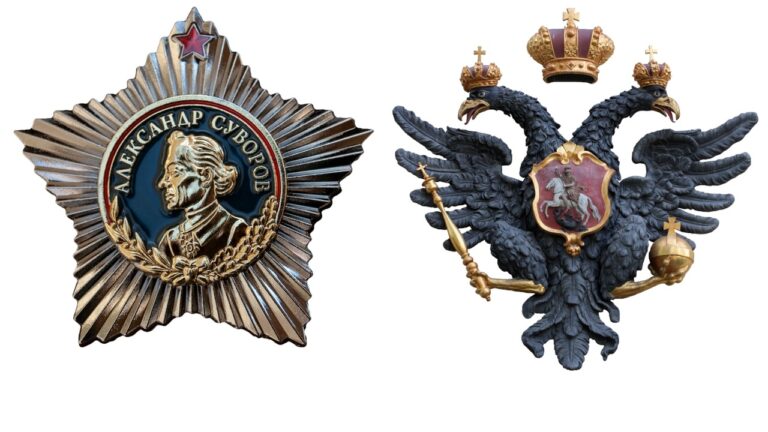
Two Seals of Russia
66. „5 arms of a star. 5 protein subunits. 3 crowns. 3 subunits. The geometry matches — in shape and in number.
The Order of Suvorov and the Empire’s double-headed eagle. Two Russian signs — and each has a molecular twin in the body. CRP, the first line of the acute phase response. Langerin, the skin’s sentinel that reads pathogen sugars like a code. Armies did not encode biology metaphorically. They encoded it geometrically. This article shows two signatures of the Genome in the Empire’s insignia — and what these proteins are doing right now in your body.”
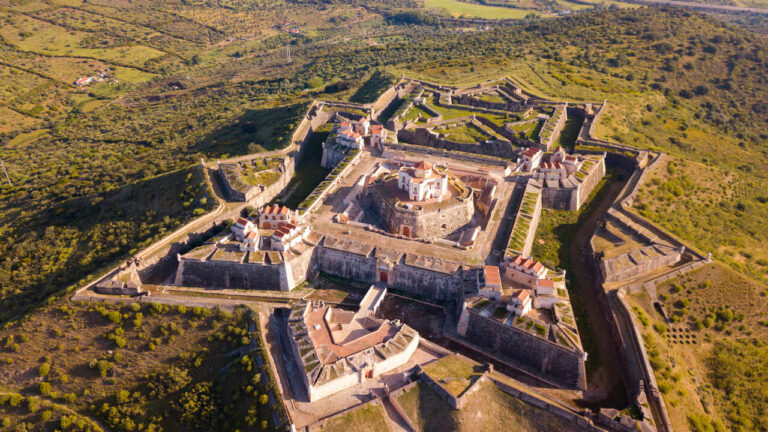
Portugal – Fort Nossa Senhora da Graça: Microglia encoded in stone
65. „Fort Nossa Senhora da Graça in Portugal (1763-1792) was never captured. Three defensive lines, star-shaped plan, UNESCO masterpiece of military architecture.
– But its architects encoded something more. From above, the fort is an exact map of microglia – the brain’s immune cell. Every structure has a biological counterpart: nucleus, fragmented Golgi apparatus, phagosomes, calcium stores, exocytosis points along the perimeter.
– Diagram omit the Golgi. The fort reveals it – fragmented into four flanks with casemates, their towering roofs mirroring Golgi cisternae.
– This is not metaphor. Immunology uses military terms: 'molecular bullets,’ 'killing chambers.’ Microglia deploy the same strategy – the fort’s batteries are exocytosis points, ejecting cytokines in all directions.
– Under the dome sits an eagle carved in 1939. Overlay BMP-6 protein’s 3D structure – head, wings, tail match perfectly. The problem? BMP-6’s structure was solved 60 years later.
– How did 18th-century Portuguese know about microglial polarization, Golgi fragmentation, calcium signalling with Kv1.3 channels, and BMP-6’s shape before crystallography?
– This is not a building. It’s an encyclopedia of cell biology carved in stone.”
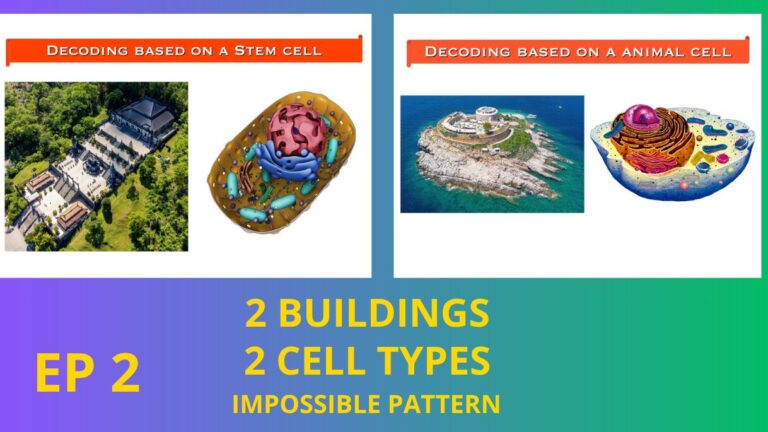
Episode 2: The Tomb of Emperor Khai Dinh — New Discoveries and Fort Mamula
64. „EP2 is here. Five new cellular structures decoded in an imperial tomb. Fort Mamula revealed for the first time. And your intestine — the organ that thinks.”