───────── ✦ ─────────
VOICES OF THE GENOME
A series on CellGod.live
───────── ✦ ─────────
The Quote
Padre Pio (1887–1968) — an Italian Capuchin friar (a monk of the Franciscan Order), a mystic, a stigmatist. For fifty years he bore the wounds of Christ on his body. He heard confessions for up to fifteen hours a day, and he read the souls of the people who came to confession before they managed to speak. He was canonized in 2002 by Pope John Paul II — today he is one of the saints most often called upon in prayer in the world.

„When parents pray for their children, God hears them, angels act, and great things happen. Pray with faith and do not worry.”
>
— Saint Padre Pio
───────── ✦ ─────────
Decoding
Five sentences. Five instructions. Each instruction has its own molecular mechanism. One by one.
───────── ✦ ─────────
1. „When parents pray for their children”

The Instruction
Notice what Padre Pio does not say. He does not say: when parents work, earn money, secure the future. He does not even say: when parents worry. He says: when parents pray. And not for themselves — for their children. Your prayer does not end with you. The prayer reaches the next generation.
The Experience
Every parent knows this night. You lie awake and you think about your child: will the child manage, is the child safe, are you giving the child enough. A weight in the chest, in the stomach, in the head.
And then — if you pray — a change comes. The worry does not disappear, but the worry changes its quality. The weight becomes entrusting. The fear becomes trust. The tension becomes calm. You cannot say why. You only feel that something has shifted.
The shift happened not only in your head. The shift happened in your genome. And — as this post will show — in the genome of your child.
The Mechanism
Why does the prayer of a parent reach the genome of the child? Because your child is your code — and this is not a metaphor. Half of the DNA of the child comes from you. You are connected at the deepest level that exists: the level of the genetic sequence. And this bond works along three roads.
The first road: the child who has not yet come.
Epigenetic patterns — DNA methylation, modifications of the histones (the proteins on which the DNA is wound) — can pass to the next generation through the gametes (the reproductive cells: the sperm cells and the egg cells). Science calls this transgenerational inheritance.
Rachel Yehuda (Mount Sinai, a medical research center in New York, 2016) showed that the children of Holocaust survivors have an altered methylation pattern of the FKBP5 gene — a gene that regulates the stress response — although the children themselves never experienced the trauma. The stress of the parents was recorded in the genome of the children.
But this recording machinery works in both directions. If fear is recorded — peace is recorded too. A parent who prays today changes the methylation patterns in the reproductive cells of that parent. The future children will inherit chromatin opened by peace, not chromatin closed by fear.
The second road: the child who is beside you.
Your child lives in your atmosphere — literally and biochemically. When you are tense, your body is flooded with cortisol, and the child feels this. The child does not need to understand anything or to know anything. The nervous system of the child reads your state: the tone of your voice, the tension of your shoulders, the expression on your face, the pace of your breathing. This is co-regulation — the emotions of a child stabilize together with the emotions of the parent.
And here epigenetics enters. The team of Michael Meaney (McGill University) showed in animal studies that the calm, tender care of a mother after the birth changes the methylation of the glucocorticoid receptor gene (NR3C1) in the brain of the offspring: less methylation, more receptors, better regulation of stress for the whole of life. A similar mechanism was later described in humans (McGowan et al., 2009). Through presence. Through calm. Through touch.
A parent who prays is calmer. Cortisol falls, oxytocin rises. And the child — the one sleeping in the next room, the one coming back from school tomorrow, the thirteen-year-old who already has problems — lives in the field of this calm. The genome of the child responds. The chromatin opens, the protective genes become active. Not in ten years. Now.
The child does not need to know that you are praying. The genome of the child knows.
The third road: the child who is far away.
Padre Pio did not say: when parents are with their children and pray. He said: when parents pray for their children. For — not with. This is the key word of this quote.
Because millions of parents do not live with their children. Fathers after a divorce, who see the child once every two weeks — or not at all. Mothers working abroad. Parents separated by war, by emigration, by illness, by a court ruling. Fathers who were deprived of everyday life with the child — not because they were bad fathers, but because the system ruled this way.
To them Padre Pio says: pray. Prayer works. Also at a distance.
How? First — prayer changes you. A parent who prays for the child every evening is a different person from the parent who falls into despair, grows hard, or drinks alcohol every evening. Cortisol falls, oxytocin rises, the chromatin stays open. And when that one weekend in a month comes — or fifteen minutes on the phone — the child meets someone calmer, more patient, more present. And the genome of the child responds to this presence, even to a brief one.
Research on co-regulation shows that the quality of the contact matters, not the length of the contact. Fifteen minutes of full, calm presence change more in the nervous system of a child than whole days spent in an atmosphere of tension.
Second — prayer protects the parent from closing. The pain of separation from a child is one of the strongest stressors that exist, and chronic stress closes the chromatin: the protective genes fall silent, health falls silent. A parent who prays does not allow the pain to close the chromatin of that parent. The parent stays in a state in which being a parent is still possible — even at a distance.
And third — prayer changes the reproductive cells of the parent. A father who prays today for his thirteen-year-old child from another relationship changes at the same time the methylation patterns of his own reproductive cells. If more children are born to him one day — those children will inherit chromatin opened by peace, not chromatin closed by despair.
Padre Pio set no condition of distance. Because the genome has no walls. And prayer has an infinite range — literally. The DNA of your child is not only a code. DNA is an antenna that emits and receives waves. Your words reach your child not only through your presence beside the child — the words arrive as the wave of the word itself, no matter whether a room separates you or an ocean.
How is it possible that the genome hears words? The next section answers this question — together with the research that changed everything we know about DNA.
Summary of the instruction: Padre Pio says: pray for your children. The genome answers: your children are your code. Your prayer changes the genome of the child who is yet to come — through the reproductive cells. Prayer changes the genome of the child who is beside you — through co-regulation. Prayer changes you — and through this change, every meeting with the child who is far away. And the word itself reaches everywhere — because DNA is an antenna. You pray in the code: for generations, here and now, near and far.
───────── ✦ ─────────
2. „God hears them”

The Instruction
He hears. Not „may hear”. Not „sometimes”. The present tense, spoken as a certainty. Padre Pio leaves no crack for doubt — and this is good, because many parents pray with the feeling that their words hit the ceiling and come back. Padre Pio answers: the words arrive. Always.
The Experience
You know this feeling: you speak to someone and you see that the person truly listens. The person does not pretend, does not wait for a turn to speak. The person listens — with the eyes, with silence, with a bowed head.
Now imagine that someone listens to you in this way through your whole life. Every day and every night. Every word, every sigh, every thought that you have never spoken aloud. This is „God hears them”.
The Mechanism
„God hears them” = the genome hears words. Literally.
The first level is biochemistry. When you pray, your body transmits: cortisol falls, oxytocin (the hormone of bonding) rises, serotonin (the messenger of calm) increases. The signals reach the cell nucleus (the compartment inside the cell that stores the DNA) — the signals reach the genome. And the genome answers with a change in gene expression (a change in which genes are read and how strongly). The study of Bhasin and Benson (Harvard, 2013) showed such changes after a single session of prayer practice; in people who practice regularly, more than 2,200 genes show a different pattern of expression (Dusek et al., 2008). The genome heard. And the genome answered — not after a year, not after a week. After a single session.
But Padre Pio says more than „prayer calms the body”. Padre Pio says: God hears. Every word. Every sigh. And this is the heart of this post — because the question of how God hears is answered by the research of Piotr Gariaev.
The Russian biophysicist showed that DNA is not only chemistry. DNA is language. DNA sequences can be analyzed with the tools of linguistics: the sequences have statistics consistent with the laws of natural languages, a grammar, a syntax. The genetic code is not a set of random letters — the genetic code is a text. And a text is written in order to be read. And in order to answer words.
Gariaev went further. His research on wave genetics showed that genetic information is transferred not only chemically, but also as waves — electromagnetic waves and acoustic waves. DNA emits waves and receives waves. DNA leaves a wave imprint in the surroundings even after the physical removal of the sample (the phantom DNA effect), and genetic information can be transferred on a wave carrier from one organism to another organism.
What does this mean for the words of Padre Pio? That the genome does not wait until the prayer passes through a cascade of hormones. The genome hears the word itself. A prayer spoken aloud is an acoustic wave; a prayer held in thought is an electromagnetic wave. Both waves reach the DNA, because DNA is an antenna and a receiver of language.
And here the research of Gariaev meets what Cell God reveals: the genome is not a dead library — the genome is an intelligence that understands language, because the genome itself is written in language. The ancients knew: in the beginning was the Word. Prayer is not a monologue released into a vacuum. Prayer is a message sent in the native protocol of the genome.
Padre Pio says: God hears. Gariaev shows how: the Word is the native language of the code. That is why every prayer arrives. That is why no word is lost in the vacuum.
───────── ✦ ─────────
3. „Angels act”

The Instruction
The man who saw angels says something concrete: angels do not only listen. Angels act. Angels are the executors. The parent asks → God hears → the angels execute. The request, the decision, the action — the hierarchy is complete.
The Experience
You call the doctor: my child is ill. The doctor listens (God hears). Then the doctor sends nurses, technicians, laboratory workers, pharmacists. Each of them knows the task, each of them works with precision. You do not see them — you do not stand in the laboratory, you do not look into the microscope. But you see the effects of their work.
Angels act. You do not see them. You see the effects.
The Mechanism
„Angels act” = proteins and signaling molecules carry the message.
The Greek word angelos means literally „messenger” — someone who carries a message from one place to another place. This is exactly what the signaling molecules of your body do. When you pray, the messengers begin the journey — the molecular angels:
Oxytocin — the peptide of bonding, released in trust, in closeness, and in prayer. Oxytocin carries the message: „it is safe”. Oxytocin reaches the cells of the whole body and opens the programs of genes responsible for bonding, for calm, and for repair. The angel who brings peace.
Serotonin — the messenger of calm. Serotonin signals: „there is no danger”. When serotonin rises, the stress axis HPA (the axis that connects the hypothalamus, the pituitary gland, and the adrenal glands) grows quiet, and the protective genes open. The angel who calms.
The anti-inflammatory cytokines (for example interleukin-10) — the proteins that extinguish inflammation. When a parent prays instead of worrying, the production of pro-inflammatory cytokines falls, and the production of anti-inflammatory cytokines rises. The angels who heal.
BDNF — a neurotrophic factor of the brain (a protein that protects neurons and supports the building of new connections). Meditative and prayer practices raise the level of BDNF. The guardian angel — at the level of the brain.
And when the messengers reach the destination, the messengers activate the executive team: the TET enzymes remove methylation (the TET enzymes open the silenced genes), the histone acetyltransferases loosen the chromatin (the acetyltransferases make the DNA available for reading). Then RNA polymerase II enters — in our framework, the Mother of God — and reads the open genes, producing mRNA (the working copy of a gene): the Word that becomes protein.
Padre Pio says: angels act. The genome says: the messengers carry the message from the prayer to the code — and activate the enzymes that open the chromatin. Immediately after the signal.
───────── ✦ ─────────
4. „Great things happen”

The Instruction
Not: small corrections happen. Great things. The one who says this is the same Padre Pio who saw miracles with his own eyes — bilocation, healings, the reading of souls. He knows what „great” means.
The Experience
Great things rarely look great while they are happening. A seed does not look like a tree. A zygote (a fertilized egg cell) does not look like a human being. The prayer of a mother at three o’clock in the morning does not look like a change in the fate of a child.
But years later the result is visible. The child who could have gone the wrong way went the right way. The illness that could have developed did not develop. The decision that could have destroyed was not taken.
Great things. Begun in silence. At three o’clock in the morning.
The Mechanism
What are „great things” on the scale of the genome? The opening of a single gene can start a cascade on the scale of the whole organism. A gene of a repair protein, when the gene regains its voice, repairs tens of thousands of damaged sites in the DNA every day. A gene of an antioxidant protein shields billions of cells. A gene of a growth factor directs the regeneration of tissues.
But in the mouth of Padre Pio, „great things” mean above all: changes that pass to the next generation.
The Överkalix cohort in Sweden (Pembrey et al., 2006) showed that the availability of food among the grandparents was connected with the risk of diabetes and heart disease among the grandchildren — two generations later, along the male line. Not through the sequence of the genes. Through epigenetics — methylation patterns passed from generation to generation.
If the hunger of a grandfather is recorded in the genome of a grandson — then the prayer of a mother is recorded in the genome of a child. If stress is inherited — peace is inherited too. If fear closes the chromatin for generations — faith opens the chromatin for generations.
These are the great things. Not for one day. For generations.
───────── ✦ ─────────
5. „Pray with faith and do not worry”

The Instruction
The last sentence carries two instructions at once. A positive one: pray with faith — not with fear, not with desperation. Faith is not „I hope that this works”. Faith is „I know that this works”. And a negative one: do not worry. This is not a comfort. This is a command to stop a concrete biochemical process in your body.
The Experience
You know the difference. Prayer with fear: „God, let nothing bad happen, I am afraid, I do not know what to do”. The body tense, the breath shallow, the thoughts in a loop. Prayer with faith: „God, I entrust my child to You. You know. You act. I trust”. The body relaxes, the breath goes deeper, the thoughts fall silent.
The same word — prayer. Two opposite states of the body. And two opposite effects in the genome.
The Mechanism
Worrying and prayer are, on the molecular level, opposite processes.
Worrying = chronic stress = high cortisol = closed chromatin. The HPA axis (hypothalamus, pituitary gland, adrenal glands) keeps the body in the mode of threat. Cortisol recruits histone deacetylases (HDAC — enzymes that remove acetyl groups and close the chromatin). The repair genes, the protective genes, the development genes fall silent. And the patterns of closing can pass to the children.
Prayer with faith = deep calm = low cortisol + high oxytocin = open chromatin. Prayer activates the parasympathetic nervous system (the calming system; the main nerve of this system is the vagus nerve). The messengers rise — oxytocin, serotonin, BDNF — and carry the message to the genome. There the messengers activate the acetyltransferases that open the chromatin, and the TET enzymes that remove methylation. The repair genes and the protective genes regain their voice.
„Do not worry” is an epigenetic instruction in pure form: stop the process of closing the chromatin. Do not close the genome of your children with your own fear.
„Pray with faith” is the opposite instruction: open the genome. Open the chromatin with faith. With calm, record in the methylation patterns of your reproductive cells a message for the next generation: you are safe, you are protected, you are open.
───────── ✦ ─────────
What is the prayer of a parent?

Let us stop at one concept that Padre Pio places in the center: prayer for a child.
This is not prayer for yourself. When you pray for yourself, you change your own state. When you pray for a child, you change your own state and you pass the change further.
Think of a mother who is breastfeeding. Her milk is not only food — the milk contains antibodies that the mother produced in response to the pathogens that the mother encountered. The child receives protection that the body of the child cannot yet produce alone. The mother passes her own immunological experience to the next generation — protein by protein.
The prayer of a parent works in an analogous way, only on the epigenetic level. And not only before the birth — above all now, every day.
Think of a mother coming back from a night shift. Or of a father coming back from a construction site. A whole day of hard work — on the feet, in tension, in exhaustion. At home a child is waiting, with problems of school, of friends, of first failures. The parent sits down and prays for the child. The parent does not know that in this moment the body of the parent sends out the messengers — oxytocin, serotonin, BDNF. Cortisol falls, the tension falls. When the parent rises from the prayer and goes to the child, the parent is a different person: calmer, more patient, more present.
And the child feels this. The child does not know why — but the child feels this. The nervous system of the child co-regulates with the state of the parent: the tone of the voice, the pace of the breathing, the expression on the face. And in the child, in the cells of the child, cortisol also falls. The chromatin opens. The protective genes become active. Not in ten years. This evening.
A parent does not need to explain molecular biology to the child. The parent does not even need to say that the parent prayed. It is enough that the parent is there — calm, open, present. The genome of the child will answer alone.
Padre Pio says: pray. The genome will do the rest.
───────── ✦ ─────────
What is faith?

Padre Pio does not say: pray. Padre Pio says: pray with faith. This is an important distinction.
Faith is not a one-time act — faith is a state maintained in time. A craftsman does not learn to weld in one day. A pianist does not master Chopin after one lesson. A mother does not become a mother in the moment of the birth — a mother becomes a mother through years of everyday choices.
Faith is repetition. Daily practice. Regularity. „Pray with faith” means: pray constantly, with conviction, for years.
And here is the molecular key. Epigenetics is not a one-time change. One session of practice shifts gene expression — yes, the study of Bhasin showed this. But for the changes to become permanent — for the changes to become a constant pattern — repetitions are needed.
The studies of monks with more than 10,000 hours of meditative practice (Lutz et al., 2004) showed permanently different patterns of brain activity — not only during meditation, but also at rest. The practice rewrote the structure.
Faith = repetition = consolidation of epigenetic changes.
Padre Pio says: with faith. The genome says: with repetition. This is the same instruction. Believe every day — and your genome will record this faith permanently. And will pass this faith further.
───────── ✦ ─────────
The shepherd of souls who saw angels
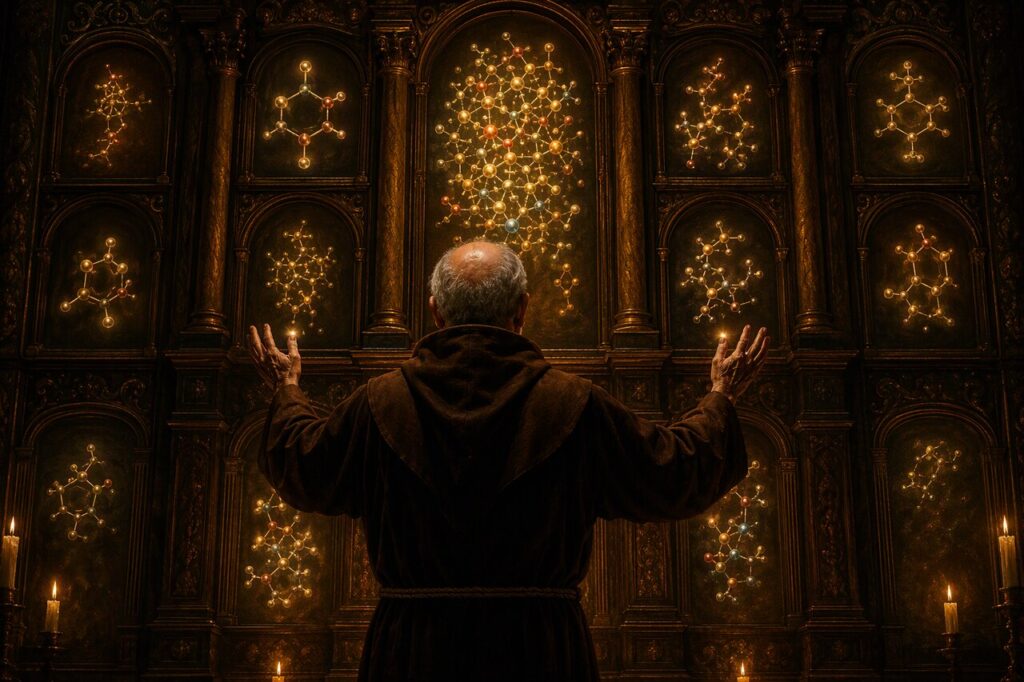
Epigenetics, DNA methylation, transgenerational inheritance, chromatin, acetyltransferases — science gave names to all of this only after the death of Padre Pio. Padre Pio did not know these words. He knew the reality that these words describe.
But he said: when parents pray — God hears, angels act, and great things happen.
The genome confirms every part of the sentence. When parents pray, the genome responds to the biochemical signals and hears the words — because the genome itself is language (God hears). The messengers — oxytocin, serotonin, cytokines, BDNF — carry the message to the code and activate the enzymes that open the chromatin (angels act). And the changes of expression pass to the next generations through the reproductive cells, touch the child who is beside you — through co-regulation, presence, calm — and reach the child who is far away (great things happen).
Do not worry — because worrying closes the chromatin. The chromatin of the parents and the chromatin of the children.
Pray with faith — because faith is repetition, and repetition consolidates epigenetic changes. Permanently. For generations.
Padre Pio bore the stigmata (the wounds of Christ) for fifty years. He heard confessions for up to fifteen hours a day. He saw angels — and he spoke about them as about colleagues from work.
In every human cell, signaling molecules do exactly what he preached: the molecules are messengers, angels, the molecules carry the message from the prayer to the genome and open the chromatin for generations.
He did not have a microscope. He had something better.
As within, so without.
He knew.
───────── ✦ ─────────
The prayer of a parent for a child
The Aaronic Blessing — the oldest recorded prayer that parents speak over their children, spoken for more than three thousand years (Numbers 6:24–26):
„May the Lord bless you and keep you.
May the Lord make his face shine upon you and be gracious to you.
May the Lord turn his face toward you and give you peace.”
Three sentences. Three instructions for the genome:
„May the Lord bless you and keep you” — may the messengers activate the protective genes: p53, the guardian of the genome; the DNA-repair proteins; the antioxidant proteins. The genome keeps guard.
„May the Lord make his face shine upon you” — may the chromatin open. The shining face = euchromatin (the open, active form of chromatin): the information available, the genes of development, of joy, and of calm — read.
„May the Lord be gracious to you” — grace is a gift that was not earned. On the level of the genome: the expression of genes that the child did not activate alone. The protective genes and the repair genes open not because the child did something — but because the parent prayed. Epigenetic inheritance is molecular grace: the child receives open chromatin that the child did not work for. A gift recorded in the reproductive cells of the parent.
„May the Lord turn his face toward you” — the genome is turned toward you. Not turned away, not inaccessible. In every one of the 37 trillion cells of your body, the genome is listening. The turned face = a responsive genome, ready — not closed in heterochromatin (the tightly packed, silent form of chromatin), not silenced by methylation. The messengers can arrive, because the genome has its face turned toward them.
„May the Lord give you peace” — may cortisol fall, may oxytocin rise, may the acetyltransferases open the chromatin permanently. Peace is not the absence of problems. Peace is open chromatin: a genome able to answer every challenge, because no gene has been silenced by fear.
Speak these words over your child. You do not need to understand the mechanism. The messengers know what to do. The genome knows how to answer. The angels know how to act.
───────── ✦ ─────────
Other prayers for children
Psalm 127:3
„Behold, children are a gift from the Lord, the fruit of the womb is a reward.”
A gift and a reward. Not an accident, not a product — a gift: something that comes from the Giver. On the level of the genome, a child is a genetic combination that has never occurred in the history of humanity. No human before this child and no human after this child will have the same genome. Meiotic recombination — the mixing of genes during the formation of the reproductive cells — builds a unique set. This is not a copy. This is a gift: one-time, created anew.
You — pray with faith.
───────── ✦ ─────────
Voices of the Genome — Part 5
Analysis and concept: Tomasz Mikulski — CellGod.live
October 2026
„Your body is a temple of God” — 1 Corinthians 3:16
───────── ✦ ─────────
Sources
The quote:
Saint Padre Pio (1887–1968)
Scripture:
Numbers 6:24–26 — the Aaronic Blessing
Psalm 127:3 — „Behold, children are a gift from the Lord, the fruit of the womb is a reward”
1 Corinthians 3:16 — „Do you not know that you are God’s temple and that God’s Spirit dwells in you?”
Series context:
Voices of the Genome, Part 1 — „Closer Than Air” (Saint Silouan the Athonite) — CellGod.live
Voices of the Genome, Part 2 — „Forgive and Come Closer to God” (Saint Gabriel Urgebadze) — CellGod.live
Voices of the Genome, Part 3 — „The Voice That Falls Silent” (Schema-Archimandrite Elijah) — CellGod.live
Voices of the Genome, Part 4a — „Knowledge Beyond Your Understanding” (Psalm 139:1–12) — CellGod.live
Voices of the Genome, Part 4b — „Woven in the Depths of the Earth” (Psalm 139:13–24) — CellGod.live
Scientific literature:
Yehuda R. et al., „Holocaust Exposure Induced Intergenerational Effects on FKBP5 Methylation”, Biological Psychiatry, 2016; 80(5):372–380
Bhasin M.K. et al., „Relaxation Response Induces Temporal Transcriptome Changes in Energy Metabolism, Insulin Secretion and Inflammatory Pathways”, PLOS ONE, 2013; 8(5):e62817
Dusek J.A. et al., „Genomic Counter-Stress Changes Induced by the Relaxation Response”, PLOS ONE, 2008; 3(7):e2576
Pembrey M.E. et al., „Sex-specific, male-line transgenerational responses in humans”, European Journal of Human Genetics, 2006; 14:159–166
Lutz A., Greischar L.L., Rawlings N.B., Ricard M., Davidson R.J., „Long-term meditators self-induce high-amplitude gamma synchrony during mental practice”, PNAS, 2004; 101(46):16369–16373
Ballard O., Morrow A.L., „Human Milk Composition: Nutrients and Bioactive Factors”, Pediatric Clinics of North America, 2013; 60(1):49–74
Weaver I.C.G. et al., „Epigenetic programming by maternal behavior”, Nature Neuroscience, 2004; 7(8):847–854
McGowan P.O. et al., „Epigenetic regulation of the glucocorticoid receptor in human brain associates with childhood abuse”, Nature Neuroscience, 2009; 12(3):342–348
Tahiliani M. et al., „Conversion of 5-Methylcytosine to 5-Hydroxymethylcytosine in Mammalian DNA by MLL Partner TET1”, Science, 2009; 324(5929):930–935
Gariaev P.P. et al., „The DNA-wave Biocomputer”, International Journal of Computing Anticipatory Systems, 2001; 10:290–310