Cover image: Dove in the air with wings wide open in-front of the sun. lotus_studio – Shutterstock.
The Painting That Was Three Hundred Years Ahead of Biology
Table of Contents
1. Introduction: The Holy Spirit — the Only Person of the Holy Trinity Without a Name and Without a Face
2. The Church of Saint Thomas in Prague and the Holy Trinity Painting by Karel Škréta
3. What Epigenetic Signals Are: DNA Methylation, Histone Acetylation and the Opening of Chromatin
4. Škréta’s Painting as a Map of the Cell Nucleus: the Holy Trinity, the Cherubs and the Nucleosomes
5. How the Holy Spirit Works in Everyday Life: Epigenetic Regulation in Real-Life Examples
6. Conclusion: the Holy Trinity in the Nucleus of Every Living Cell
1. Introduction: The Holy Spirit — the Only Person of the Holy Trinity Without a Name and Without a Face
I am returning to the „Genomic Intelligence” series after a break of several months. Before I show the new discovery, I need to remind you where we arrived. The third part makes sense only on the foundation of the first two parts.
In Part 1, I overturned an error that biology has repeated for 70 years — and my own error (Part 1: https://cellgod.live/god-is-the-intelligence-of-the-genome/). For two years, I thought that God was DNA. I was wrong. The error was beautiful and instructive. DNA is a carrier of information: a library, a hard drive, an antenna. The genome is a non-material, intelligent system that directs the reading of the DNA record, interprets the DNA record and carries out the DNA record. The genome works on three levels: the physical components, the integrated system, and the intelligence that emerges from the system. Modern science confirms this view from three directions at once. Denis Noble shows that DNA is a database, not a building plan. Michael Levin shows that bioelectric networks direct gene expression — the switching on and switching off of genes. Robert Rosen shows that life is its own cause. You also remember the origin of the word itself: GENOME = gen + -ōma (from the Greek word sōma, „body”) = „the Body of the Creator”. The word knew from the beginning.
In Part 2, I opened the first of the spiritual traditions: Christianity (Part 2: https://cellgod.live/the-genome-encoded-in-christianity/). Christianity records the genome with the precision of molecular biology:
God the Father emerges from clouds in paintings in thousands of churches. God the Father is the intelligence of the genome, which emerges from chromatin (DNA wound around proteins). God the Father does not emerge from clouds in the sky — God the Father emerges from euchromatin, from open, active genes, where the genome speaks.
The interior of a church is a map of the cell nucleus and of the endoplasmic reticulum (the network of membranes around the cell nucleus). The arch of the presbytery (the area around the main altar) is the nuclear envelope. The altar is RNA polymerase. The priest is a transcription factor. The pews with the faithful are the folds of the endoplasmic reticulum with ribosomes.
Jesus Christ is mRNA (messenger RNA) — the Messenger who leaves the cell nucleus so that the Word becomes flesh, meaning protein. This happens in the temple and in every living cell of your body, every second.
Words reach the genome. The Russian biophysicist Peter Gariaev (Pyotr Garyaev, who lived from 1942 to 2020) studied, within so-called wave genetics, how DNA responds to light and to sound, including the sound of human speech. Peter Gariaev also described the „phantom DNA effect” — a trace that DNA molecules leave behind in a field of light, even when the DNA molecules themselves are no longer present. The work of Peter Gariaev remains outside mainstream science and awaits independent confirmation. Yet the research of Peter Gariaev points in a direction: human words and human thoughts may be a signal for the genome.
The Lord’s Prayer („Our Father”) is a communication protocol with the genome — from addressing the Source („Our Father, who art in heaven”, meaning in the cell nucleus) to the command to execute: „Amen” is the ENTER key on a keyboard.
The Father decoded. The Son decoded. The foundation laid.
Now comes the question that the third part answers: where in this system is the Third Person of the Holy Trinity?
* * *
Notice something that people rarely talk about. The Holy Spirit is the only Person of the Holy Trinity who has no personal name.
Check this fact. The word „Father” describes a relationship. The word „Son” describes a relationship. And „Holy Spirit”? „Holy Spirit” is not a personal name. „Holy Spirit” is a description of a way of acting. The Hebrew word ruach means „breath” and „wind”. The Greek word pneuma means „breath” and „a movement of air”. The authors of Holy Scripture did not give the Third Person a personal name, because a personal name would tie the Third Person to one form.
In all of Holy Scripture, the Holy Spirit almost never appears twice in the same form. Once, the Holy Spirit is breath hovering over the waters (Genesis 1:2). Once, the Holy Spirit is a dove over the river Jordan (Matthew 3:16). Once, the Holy Spirit is a wind that shakes a house and fire above the heads of the apostles (Acts 2). Once, the Holy Spirit is the oil of anointing, and once, the Holy Spirit is living water. None of these forms is the Holy Spirit itself. Each of these forms is only a trace that the Holy Spirit leaves behind while passing by.
The Holy Spirit also has the only life story in the whole Holy Trinity that is written only with verbs. The Creed (the Christian profession of faith) says that the Father is the Creator. About the Son, the Creed says that the Son was born, suffered under Pontius Pilate and rose from the dead — concrete events, concrete names. And about the Holy Spirit? That the Holy Spirit is „the Lord, the giver of life”, „who proceeds from the Father and the Son”, „who has spoken through the prophets”. No event. No scene. Only processes: proceeding, speaking, giving life.
Sacred art followed the same rule. Painters gave the Father and the Son thrones, robes, gestures and human faces — painters can paint portraits of the Father and the Son. Painters gave the Holy Spirit one single portrait: a white dove. Painters did not invent the dove. Painters took the dove from one scene — from the baptism of Jesus in the river Jordan, when, according to the Gospel of Saint Luke:
„the Holy Spirit descended in a bodily shape, as a dove” (Luke 3:22)
Pay attention to the evangelist’s word: as a dove. Not „a dove”, but a likeness of a dove — a temporary form, taken on for one event.
Look also at what the dove does in paintings. In paintings, the Father and the Son are seated. The dove is never seated. The dove hovers above the scene, comes down from above and stops above a chosen person. In paintings, the Father and the Son are present. The Holy Spirit acts.
Apart from the dove, painters received nothing. For this reason, for twenty centuries, painters did not paint the Holy Spirit itself, but the effect of the action of the Holy Spirit: moving robes, lifted hair, tongues of fire, a beam of light. Try to paint the wind. You will paint trees bending in the wind. You recognise the wind by the trees.
* * *
When I connected these facts, the connection moved me deeply.
Read the descriptions of the Holy Spirit in Holy Scripture not as a theologian, but as a biologist looking for functions:
The Holy Spirit descends — the Holy Spirit comes from outside.
The Holy Spirit fills — the Holy Spirit does not add new content, but changes the state of what is already there.
The Holy Spirit „will remind you of everything” (John 14:26) — the Holy Spirit works like memory.
The Holy Spirit „will take from what is mine and will announce it to you” (John 16:14) — the Holy Spirit does not speak independently, but regulates what the Son said.
The Holy Spirit distributes gifts „to each person separately, as the Holy Spirit wills” (1 Corinthians 12:11) — the same Holy Spirit, different effects.
Nobody can see the Holy Spirit: „The Spirit breathes where he wills, and you hear his voice, but you do not know where he comes from or where he goes” (John 3:8).
Not once is the Holy Spirit the content. The Holy Spirit is always an action on the content. The Holy Spirit comes, switches on, silences, reminds, distributes and transforms.
In modern biology, there is exactly one layer of the living cell that fully fits this description. This layer does not change a single letter of the DNA code — and yet this layer decides everything that the DNA code will do. This layer is not visible in the DNA sequence. Only the effect of this layer is visible, in the appearance and in the functioning of the organism. This layer comes from outside — from the environment, from your words, from your stress, from your prayer — and is recorded in the genome.
This layer is called epigenetic regulation.
The thesis of this post: the Holy Spirit = the epigenetic regulation of the genome. This is not a metaphor. This is a precise mapping of functions, element by element — in the same way that the Father corresponds to the genome and the Son corresponds to mRNA.
The Holy Spirit has no personal name, because epigenetic regulation has no personal name. Epigenetic regulation has only effects.
And one painting in the Church of Saint Thomas in Prague shows these effects more precisely than I expected. This painting was made about three hundred years before science discovered what this painting shows…
(Bible quotations: translated into plain English from the Polish Jakub Wujek Bible, which follows the Latin Vulgate.)
2. The Church of Saint Thomas in Prague and the Holy Trinity Painting by Karel Škréta
The Church of Saint Thomas stands in Prague, in the district called the Lesser Town (Malá Strana), on Josefská Street, near Prague Castle.
Benedictine monks built the first church on this site, in the Romanesque style, before the year 1227. Since the year 1285, the Church of Saint Thomas has belonged to the Augustinian order. King Wenceslaus II of Bohemia and Queen Guta built a Gothic church here, which was consecrated in 1379. After a fire caused by lightning, the architect Kilian Ignaz Dientzenhofer rebuilt the church in the Baroque style, starting in 1725. A dome rises above the nave of the church.
The church holds four paintings by the Czech painter Karel Škréta (who lived from 1610 to 1674). One of these paintings is „The Holy Trinity”. The painting „The Holy Trinity” hangs in an altar portal under the dome of the church, next to the presbytery (the area around the main altar).
[Image: PRAGUE, CZECH REPUBLIC, SEPTEMBER 11 : architectural details of Saint Thomas church, september 11, 2019 in Prague, czech republic. Isogood_patrick – Shutterstock]
[Image: PRAGUE, CZECH REPUBLIC – OCTOBER 12, 2018: The baroque painting of Holy Trinity in church kostel Svatého Tomáše by Karel Škréta (1610 – 1674), Renata Sedmakova – Shutterstock]

Look at the interior of the church. Where the nave meets the presbytery, under the dome, two tall altar portals stand opposite each other. On the left side of the photograph stands the altar portal with the painting „The Holy Trinity”. The altar portal has a dark red marble frame with gold ornaments. Small carved cherubs sit on the top cornice (the projecting ledge at the top) of the altar portal. Next to the altar portal, on the wall, there are gold openwork window grilles. In front of the altar portal stand gold statues of bishops in mitres (tall bishops’ hats) — the bishops hold open books and tablets with text.
On the right side of the photograph, next to the second altar portal, sits a gold statue of an angel. The angel holds a shield with a Latin inscription: PER PROPRIUM SANGUINEM INTROIVIT — „Through his own blood he entered”. These are words from the Letter to the Hebrews (9:12) about Christ, who entered the Most Holy Place. Above the angel hangs a painting of the Mother of God with the Child Jesus.
Further back, behind the altar portals, the presbytery opens up. Gold openwork grilles run along the walls of the presbytery. At the far end of the presbytery stands the main altar in a gold frame, and under the main altar stands the tabernacle. In the dome above the presbytery, there is a round window, through which light enters the interior. In the dome, a golden glory (a radiant sun-like ornament) also shines: a bright yellow centre from which rays spread out in all directions.
This post is based on the painting „The Holy Trinity” by the painter Karel Škréta.
The Painting „The Holy Trinity” — What We See on the Canvas
Karel Škréta’s painting shows the whole Holy Trinity in one scene, high in heaven, on clouds.
On the left side of the painting sits Jesus Christ, the Son of God. Jesus has long dark hair and a beard. Jesus wears a blue tunic and a red cloak that flows down to the clouds. A bare foot of Jesus comes out from under the red cloak.
On the right side of the painting sits God the Father. God the Father has the face of an old man: a bald head and a long grey beard. God the Father wears a blue tunic and a wide golden cloak.
At the top of the painting, exactly between the heads of the Son and the Father, a white dove hovers with widely spread wings. Behind the white dove shines a large, bright circle of light. From the white dove, a thin vertical ray of light runs downward.
In the very centre of the painting, the hands of the Son and the hands of the Father meet. The Son and the Father together hold a vertical rod. In the hands of the Son and the Father, the rod is thicker, and towards the bottom, the rod becomes thinner and thinner. At the lower, thin end of the rod, the painter painted a human eye, which looks downward.
Under the feet of the Father and the Son, in the clouds, lie cherubs — small child-angels, of whom the painter showed only the heads and the wings. Look at the cherubs carefully. The painter did not paint all the cherubs in the same way. Some cherubs lie in shadow, other cherubs lie in the light. Among the cherubs in the light, two cherubs are kissing, and one of the two kissing cherubs has a green, brightly lit wing. At the very bottom of the painting, under the cherubs, a dark blue sphere is visible.
Why? The answer comes in section 4. First, we must look inside the living cell…
3. What Epigenetic Signals Are: DNA Methylation, Histone Acetylation and the Opening of Chromatin
From the Living Cell to the Nucleosome — What Biological Diagrams Show
Before we see what the Holy Spirit does, we must see where the Holy Spirit acts. Let us look at biological diagrams step by step — from the whole living cell to the smallest unit of chromatin.
[Image: „Animal Cell (Nucleus)” — Animal Cell Anatomy Structure Diagram illustration. BlueRingMedia – Shutterstock. with nucleosomes]
[Illustration:Chromatin, nucleosomes with DNA helix isolated in black background 3d illustration. sciencepics – Shutterstock]

First level: the living cell (the upper left part of the image). A cell membrane surrounds every living cell of the human body. Cytoplasm fills the inside of the living cell — in the CellGod model, the cytoplasm is the world. In the middle of the living cell lies the cell nucleus — in the CellGod model, the cell nucleus is heaven, the place where the genome lives.
Second level: the cell nucleus (the upper right part of the image). The nuclear envelope (the double membrane around the cell nucleus) surrounds the cell nucleus. The nuclear envelope has nuclear pores — gates between heaven and the world. In the middle of the cell nucleus lies the nucleolus (Latin nucleolus, „small nucleus”): a dense sphere where the living cell produces parts of the ribosomes. In the image, the nucleolus is yellow. Around the nucleolus, threads of chromatin fill the whole cell nucleus; in the image, the threads of chromatin are red. The red threads of chromatin look like rays spreading out from the nucleolus in all directions, all the way to the nuclear envelope.
Third level: chromatin. Chromatin is the DNA thread together with the proteins around which the DNA thread is wound. Each living cell of the human body contains about 2 metres of DNA thread. These 2 metres of DNA thread fit inside a cell nucleus with a diameter of about 6 micrometres (6 millionths of a metre). The DNA thread fits inside the cell nucleus only because the DNA thread is wound and folded very tightly.
Fourth level: the nucleosome (the lower, black part of the image). When we zoom in on chromatin, we see something that looks like beads on a string. Each bead is a nucleosome. A nucleosome is a group of eight proteins called histones, arranged into one compact cylinder. The DNA thread wraps almost twice around the cylinder of histones — one nucleosome holds about 147 base pairs of DNA (147 „letters” of the DNA code). One nucleosome has a diameter of about 11 nanometres (11 billionths of a metre).
Short, flexible ends of the histone proteins stick out from every nucleosome — the so-called histone tails (the flexible ends of the histone proteins). Remember the histone tails. Most epigenetic signals are written on the histone tails.
Look at the lower part of the image from left to right. On the left lies a thick yellow coil — chromatin wound so tightly that single nucleosomes are not visible. Nucleosomes spill out of the yellow coil: white spheres wrapped by a golden DNA thread. At first, the nucleosomes lie in a dense cluster. The further to the right, the more loosely the nucleosomes lie. At the very end, the DNA thread frees itself from the nucleosomes and unwinds into a double helix with coloured letters of the DNA code. On the golden DNA thread, between the loose nucleosomes, small green beads are visible — in biological diagrams, such small green beads usually represent epigenetic marks (small chemical tags on the DNA or on the histones).
One image shows the whole path: from closed chromatin, through chromatin that is opening, to a DNA thread that can be read.
The Two States of Chromatin: Closed Chromatin and Open Chromatin
Heterochromatin — closed chromatin. The nucleosomes lie tightly packed, one next to another. In electron microscope images, heterochromatin is dark and dense. The proteins that read genes have no access to the DNA thread. The genes in heterochromatin are silent.
Euchromatin — open chromatin. The nucleosomes lie loosely, with space between the nucleosomes. In electron microscope images, euchromatin is light and loose. The proteins that read genes have access to the DNA thread. The genes in euchromatin can be read and copied into mRNA.
The same DNA thread. The same genes. Two completely different states. Epigenetic signals decide whether a section of chromatin is closed or open.
The Three Main Epigenetic Signals
First signal: DNA methylation. Special enzymes (DNA methyltransferases) attach a small chemical group to the DNA thread — a methyl group, made of one carbon atom and three hydrogen atoms. The methyl group sits on one of the letters of the DNA code, on cytosine. The letter of the DNA code does not change — only a mark above the letter changes. When there are many methyl groups near the beginning of a gene (near the gene promoter), the gene is usually silenced. DNA methylation is the signal „be silent”.
Second signal: histone acetylation. Enzymes called histone acetyltransferases (HAT for short) attach an acetyl group to the histone tails. The acetyl group weakens the attraction between the histones and the DNA thread. The DNA thread loosens on the nucleosome, and the chromatin opens. Enzymes called histone deacetylases (HDAC for short) remove the acetyl group from the histone tails — then the chromatin closes again. Histone acetylation is the signal „open up”.
Third signal: chromatin remodelling. Large protein complexes that use energy from the molecule ATP slide nucleosomes along the DNA thread, push nucleosomes aside or remove nucleosomes from the DNA thread. Through chromatin remodelling, a chosen section of the DNA thread becomes available for reading.
Who Writes, Who Reads and Who Erases Epigenetic Signals
Biology divides the proteins that handle epigenetic signals into three groups:
proteins that write the signals — for example, DNA methyltransferases and histone acetyltransferases,
proteins that read the signals — these proteins recognise a mark on the DNA thread or on a histone tail and call other proteins to the site,
proteins that erase the signals — for example, histone deacetylases and TET enzymes, which remove methyl groups from the DNA thread.
Epigenetic signals are not written once and for all. Epigenetic signals come from outside and change throughout a human life. An epigenetic signal does not change the content of the Book of DNA. An epigenetic signal closes some pages of the Book of DNA and opens other pages.
This is exactly how Holy Scripture describes the Holy Spirit.
And this is exactly what Karel Škréta painted…
4. Škréta’s Painting as a Map of the Cell Nucleus: the Holy Trinity, the Cherubs and the Nucleosomes
[Image: comparison — the painting „The Holy Trinity” by Karel Škréta placed on a background with a chromatin model: clusters of tightly packed nucleosomes next to the misty cherubs, and loose nucleosomes with a DNA thread under the feet of the Holy Trinity]

In this comparison, I placed Karel Škréta’s painting on a background on which I arranged clusters of nucleosomes from a chromatin model. I placed each cluster of nucleosomes next to the group of cherubs whose state matches the state of the chromatin.
Let us start with the altar portal in which the painting hangs. Then let us move to the three Persons of the Holy Trinity, and finally let us go down the painting — to the clouds and the cherubs.
The Round Windows in the Dome = Nuclear Pores, and the Altar Portal = a Close-Up of the Nuclear Pore Complex (Hypothesis)
In Part 2, I described the arch of the presbytery as the nuclear envelope — the border between the cell nucleus and the cytoplasm. The nuclear envelope of a living cell has gates — nuclear pore complexes. Everything that enters the cell nucleus and everything that leaves the cell nucleus passes through the nuclear pores, including mRNA, the Word. In electron microscope images, nuclear pores look like round openings in the nuclear envelope.
In their shape, the round windows in the dome of the church correspond to the nuclear pores. The round windows are openings in the vault through which light from outside enters the interior — just as signals from the cytoplasm enter the cell nucleus through the nuclear pores.
The altar portals under the dome show something different: a close-up of the nuclear pore complex and of the details of the nuclear pore structure. The altar portals stand exactly on the border between the nave (the cytoplasm) and the presbytery (the cell nucleus). The painting in the altar portal is like a window through which we see what happens inside the cell nucleus. The elements around the altar portals match parts of the nuclear pore complex:
The gold openwork grilles = the filter in the centre of the nuclear pore. A nuclear pore is not an empty hole. In the centre of a nuclear pore, there is a dense mesh of proteins (nucleoporins) that works like a sieve: the mesh lets small molecules pass freely, and lets large molecules pass only with a „permit”. A grille lets light and sight through, but does not let a person through.
The cherubs on the cornices of the altar portals = transport proteins. Transport proteins (importins and exportins) wait at the entrance of the nuclear pore, take hold of a cargo molecule and carry the cargo molecule through the nuclear pore.
The bishops with open books = proteins that read. In Part 2, I described the priest as a transcription factor. The bishops with open books stand in front of the gate and read — just as transcription factors and the proteins that read epigenetic marks recognise the right place in the Book of DNA and show where the reading should begin.
The golden glory in the dome = the nucleolus. In the biological diagram in section 3, the nucleolus is a yellow sphere from which rays of chromatin spread out in all directions. In the dome, above the altar portals, a yellow centre shines, from which golden rays spread out in all directions.
Each of these elements shows one process inside the cell nucleus, frozen in motion: the entry of a signal through the nuclear pores, transport through the gate, the reading of the Book of DNA, the work of the nucleolus.
The White Dove and the Ray of Light = the Holy Spirit = the Epigenetic Signal
The white dove hovers at the very top of the painting. The white dove is the Holy Spirit — epigenetic regulation. The ray of light that runs downward from the white dove is the epigenetic signal — a signal that comes from above, from outside, and descends to the chromatin.
The white dove does not sit next to the Father and the Son; the white dove hovers above the Father and the Son. In the same way, epigenetic regulation is not part of the DNA record. Epigenetic regulation acts above the DNA record — exactly as the Greek word „epi” says: „above”.
God the Father = the Genome, and the Clouds = Chromatin
On the right side of the painting sits God the Father, an old man in a wide golden cloak. God the Father is the Genome — the Genomic Intelligence that emerges from chromatin. God the Father sits on the clouds, which are chromatin, and the golden cloak of the Father flows down and covers the chromatin. The genome lives in chromatin and embraces all of the chromatin.
All the cherubs in the painting lie in the clouds — just as all the nucleosomes lie in chromatin.
God the Father does not look at the viewer. God the Father looks down — at the hands, at the rod and at the cherubs below. The genome constantly oversees the chromatin and directs the reading of the Book of DNA. But only the section of the Book of DNA that an epigenetic signal has opened beforehand can be read.
Jesus Christ = mRNA, and More Broadly: RNA
On the left side of the painting sits Jesus Christ, the Son of God, in a blue tunic and a red cloak. The bare foot of Jesus touches the clouds closest to the brightly lit cherubs.
Jesus Christ is mRNA — the Word that is copied from the genome, leaves the cell nucleus and becomes flesh, meaning protein. mRNA can be produced only from open chromatin. The bare foot of the Son stands exactly where the chromatin is open.
In Škréta’s painting, however, the Son does more than go out into the world. Together with the Father, the Son holds the rod that directs the light of the dove downward, onto the cherubs. For this reason, in this scene, Jesus Christ is not only mRNA, but more broadly: RNA. The genome copies into RNA not only recipes for proteins. The genome also copies many RNA molecules that never become protein. Some of these RNA molecules return to the chromatin and help to show which section of chromatin should close and which section should open. The best-known example is an RNA molecule called Xist, which in women silences one of the two X chromosomes. The Son does not only carry the Word into the world. The Son rules together with the Father.
The Rod with the Eye = a Nuclear Receptor (Hypothesis)
We do not have one hundred percent certainty about what the rod in the hands of the Father and the Son is. However, we assume that the rod is a nuclear receptor — a protein that is a sensor and a receiver of a signal at the same time. One example of a nuclear receptor is the glucocorticoid receptor, the receptor for the stress hormone cortisol.
A nuclear receptor works in four steps — and each step is visible in the painting:
The nuclear receptor catches a signal from outside. One part of the nuclear receptor binds a signal molecule, for example a hormone. In the painting, the upper, thick part of the rod rests in the joined hands of the Father and the Son, where the light from the white dove arrives. The signal of the Holy Spirit passes through the genome and through RNA.
The nuclear receptor carries the signal to the chromatin. The rod guides the light from top to bottom, from the hands of the Father and the Son to the clouds.
The nuclear receptor binds to one specific section of DNA. The second, narrow part of the nuclear receptor recognises a short sequence of letters of the DNA code and binds only to this sequence. In the painting, the lower end of the rod is as thin as a needle and points at one place. At the end of the rod, the eye „looks” — the eye recognises the right place.
The nuclear receptor calls the enzymes that write epigenetic signals. The chromatin at this place opens or closes. In the painting, the eye looks at the six brightly lit cherubs.
The Cherubs in Shadow = Clusters of Tightly Packed Nucleosomes (Heterochromatin)
At the top of the painting, on the left and on the right, and at the bottom on the right, the cherubs are crowded together, one next to another. The faces of these cherubs are misty and almost disappear into the grey clouds.
In the comparison image, I placed clusters of tightly packed nucleosomes next to these cherubs. At the top right, I also placed a thick yellow coil of chromatin — chromatin wound even more tightly.
[Image: close-up — at the top, a cluster of nucleosomes („Nucleosomes”); at the bottom, misty cherubs from Škréta’s painting („Cherubs”)]

The close-up shows this clearly. At the top: the white histone spheres lie one on another, and the golden DNA thread wraps every sphere and leaves no free space. At the bottom: the faces of the cherubs overlap, small white wings stick out between the faces, and the cherubs almost merge with the clouds.
This is heterochromatin — closed chromatin. The genes in heterochromatin are silent. The cherubs in shadow are silent too: the cherubs in shadow have no clear faces, do not look at anyone and do not move. The further from the light of the dove, the more closed the chromatin is.
The Six Cherubs in the Light = Loose Nucleosomes with an Uncovered DNA Thread (Euchromatin)
Under the feet of the Father and the Son lie six cherubs that the painter brightly lit. These six cherubs lie exactly where the eye at the end of the rod is looking. The faces of these six cherubs are clear. Each of the six cherubs has free space around each cherub.
In the comparison image, under these cherubs, I placed loose nucleosomes with an uncovered golden DNA thread, and a double helix that frees itself from the nucleosomes.
This is euchromatin — open chromatin. The genes in euchromatin can be read and copied into mRNA, the Word. The cherubs in the light are alive: the cherubs in the light have clear faces, look around and embrace one another.
The Head and Wings of a Cherub = the Nucleosome and the Histone Tails
The painter did not paint the cherubs whole. The painter painted only a round head and wings that stick out from the head to the sides.
A nucleosome looks the same: a round cylinder of eight histone proteins, from which the histone tails stick out. The head of a cherub corresponds to the cylinder of histone proteins. The wings of a cherub correspond to the histone tails — the place where the signal of the Holy Spirit is written.
The Pair of Kissing Cherubs = Contact Between an Enhancer and a Gene Promoter (Hypothesis)
Among the six brightly lit cherubs, two cherubs are kissing. One of the two kissing cherubs has a green, brightly lit wing. The other cherubs have dark or reddish wings.
Something very similar happens in open chromatin. The DNA thread forms a loop, and two sections of DNA that lie far apart on the DNA thread touch each other. The first section is an enhancer — a stretch of DNA that strengthens the reading of a gene. The second section is a promoter — the place where the reading of a gene begins. When the enhancer touches the promoter, the gene switches on.
An active enhancer carries its own clear epigenetic mark on its nucleosomes: an acetyl group on the tail of histone H3 (biologists write this mark as H3K27ac). By this mark, biologists recognise which enhancer is switched on at a given moment. The green, brightly lit wing marks one of the two kissing cherubs — just as the acetylation mark marks the active enhancer that is touching the promoter at this moment.
The kissing cherubs are the moment when a gene wakes up to life. The green wing shows which of the two cherubs carries the signal.
The Cherub Looking Upward = a Gene Ready to Be Read (Hypothesis)
One of the brightly lit cherubs looks straight up — at the Father and the Son, towards the light. The other cherubs look to the side or down. The cherub looking upward is a gene ready to be read — a gene in open chromatin, turned towards the genome and towards the Word.
The Dark Blue Sphere Under the Feet of the Holy Trinity = the Histone Locus Body (Hypothesis)
At the very bottom of the painting, under the brightly lit cherubs, lies a dark blue sphere. The cell nucleus of a living cell contains many round structures without a membrane, called nuclear bodies. Each nuclear body has a different task. In microscope images, all nuclear bodies look similar — like small spheres. Therefore, the position of the sphere in the painting and the story that the painting tells decide which nuclear body the sphere represents.
In my view, the sphere under the feet of the Holy Trinity is the Histone Locus Body. The Histone Locus Body forms on clusters of genes from which the living cell produces histones. The Histone Locus Body processes the recipes for histones — the proteins from which nucleosomes are built. The Histone Locus Body works most intensely when the living cell copies its DNA thread and needs new nucleosomes to package the new DNA thread.
Škréta’s whole painting tells a story about nucleosomes: the head of a cherub is the cylinder of histones, and the wings of a cherub are the histone tails. The sphere lies under the cherubs — at the source of the nucleosomes. The Histone Locus Body is the factory from which the „heads of the cherubs” come.
I will show the sphere in close-up in a separate post, in a different painting.
The Whole Painting in One Paragraph
The Father and the Son sit on clouds of chromatin. The Holy Spirit hovers above the Father and the Son and sends one ray of light downward. The ray of light passes through the hands of the Father and the Son, through the rod and through the eye, and falls on the chromatin. Where the ray of light falls, the nucleosomes loosen, the DNA thread is uncovered, and genes wake up to life. Where the ray of light does not reach, the cherubs remain crowded and misty.
5. How the Holy Spirit Works in Everyday Life: Epigenetic Regulation in Real-Life Examples
Škréta’s painting shows one moment in one cell nucleus. But epigenetic signals reach a human being throughout life. Every day, some cherubs in the cell nucleus come out into the light, and some cherubs hide in shadow. A human being does not choose his or her Book of DNA. But a human being has an influence on which signals reach the Book of DNA.
Here are real-life examples that show how this works.
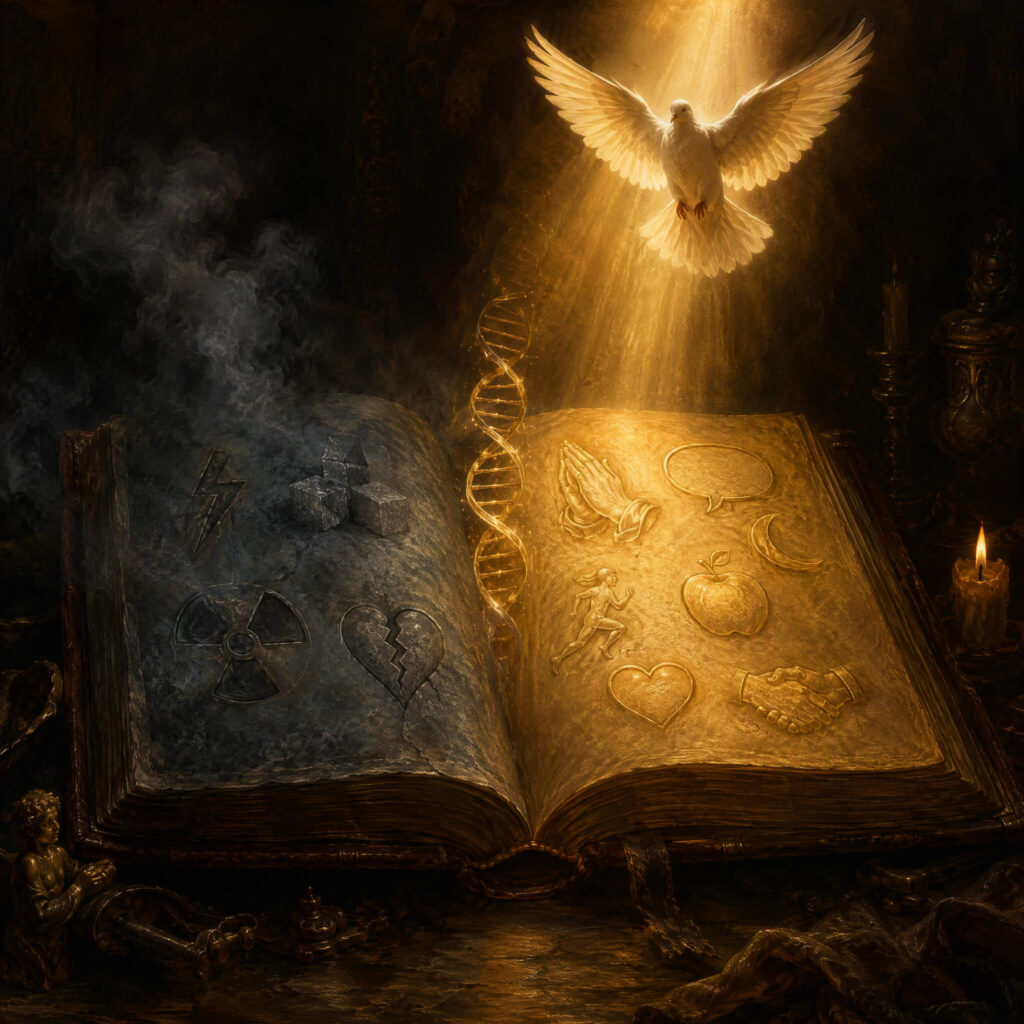
[Image: „The Book of DNA: one page in the mist, the other in the light — man does not choose the Book, but he chooses the signals that reach it. Composition and symbols: Tomasz Mikulski — Cell God; image created with AI, 10/2026.”]
Example 1: Identical Twins — the Same Book of DNA, Different Lives
Identical twins have the same DNA record. When identical twins are small children, the epigenetic marks of the twins are almost the same. Researchers from Spain (Mario Fraga and colleagues, 2005) compared identical twins of different ages. The older the twins were, and the more the lives of the twins differed — food, work, tobacco smoking, place of residence — the more the epigenetic marks of the twins differed.
The same Book of DNA. Different lives. Different pages of the Book of DNA opened and closed.
Example 2: The Queen Bee and the Worker Bee — One Food Changes a Whole Life
A queen bee and a worker bee can hatch from eggs with the same DNA record. The difference lies in the food. A larva that receives royal jelly (a special food produced by worker bees) becomes a queen: the queen bee is larger, lays eggs and lives for several years. A larva that does not receive royal jelly becomes a worker bee and lives for several weeks. In 2008, researchers showed that DNA methylation takes part in this transformation — when researchers silenced, in the larvae, the enzyme that writes methyl groups on DNA, most of the larvae developed into queens, even without royal jelly.
The same DNA record. A different signal from outside. A completely different life.
Example 3: Maternal Care Is Recorded in the Genes of the Offspring
Canadian researchers (Ian Weaver, Michael Meaney and colleagues, 2004) observed rats. Some rat mothers often lick and groom their young; other rat mothers do this rarely. Young rats that received a lot of maternal care had different epigenetic marks in the brain on the gene of the glucocorticoid receptor — the same nuclear receptor that I compared, in section 4, to the rod in the hands of the Father and the Son. In adult life, these rats reacted to stress more calmly.
Care and touch did not change a single letter of the DNA record. Care and touch changed how the DNA record is read.
Example 4: A Famine from Decades Ago Recorded in Body Cells
In the winter of 1944–1945, the western Netherlands suffered a great famine, later called the Dutch Hunger Winter. In 2008, researchers showed that more than 60 years later, people who were in their mothers’ wombs during the Dutch Hunger Winter had different methylation marks on the gene IGF2 than their brothers and sisters born at another time.
A signal that reached a human being before birth remained recorded in the body cells of this human being for more than 60 years.
Example 5: Physical Exercise, Sleep and Sugar
Epigenetic signals change not only over decades, but also within days and hours. In 2012, Swedish researchers showed that a single intense training session already changes methylation marks on genes in the muscles. A single night without sleep changes methylation marks on the genes of the human biological clock.
The strongest example is sugar. In 2008, Australian researchers exposed cells of blood vessels to a high level of sugar for only a short time. Then the sugar level returned to normal. Even so, epigenetic marks remained on the histone tails, and a gene that triggers inflammation stayed switched on for the following days. Doctors call this phenomenon „metabolic memory”. A constant excess of sugar leads to type 2 diabetes, one of the most common chronic diseases in the world, which shares common roots with some cancers.
The good news: many epigenetic signals can be reversed. A cherub that lies in shadow today can come out into the light tomorrow.
Example 6: Silence, Prayer and Meditation
In 2014, researchers from Spain and the United States studied people who practised intensive mindfulness meditation for one day. After one day of meditation, the activity of the genes for HDAC enzymes fell in the blood cells of these people — the same enzymes that I described in section 3 as the enzymes that close chromatin. This was a small study and requires further confirmation. But the direction is clear: the state of the human mind reaches all the way to the cell nucleus.
In Part 2, I showed that the Lord’s Prayer is a communication protocol with the genome. Here we see how this communication may work: through calm, through attention, through words.
Full Decoding: Two Layers at the Same Time
I return to the rule that I use in the whole series. Every sentence about the Holy Spirit works on two layers at the same time.
The first layer is human life: prayer, thought, word, deed, relationships with other people. The second layer is molecular biology: epigenetic signals, gene expression, proteins. Neither layer replaces the other layer. Prayer is not „only biochemistry”. And biochemistry is not „only a metaphor” for prayer. Both layers happen at the same time, in the same human being.
What to Do So That Good Signals Reach Us
Saint Paul describes how to recognise that the Holy Spirit is at work in a human being:
„The fruit of the Spirit is love, joy, peace, patience, kindness, goodness, long-suffering, gentleness, faith, modesty, self-control, chastity.” (Galatians 5:22–23)
Let us look at the first four fruits of the Holy Spirit on two layers at the same time — in human life and in the living cell.
Love. In human life, love is closeness, care and devotion to another human being. In the body, closeness and touch release oxytocin — a signal molecule that I describe in the CellGod model as one of the angels, the messengers. Example 3 with maternal care shows that care leaves a lasting trace in the chromatin of the offspring and calms the reaction to stress for a whole lifetime.
Joy. In human life, joy is the state in which a human being willingly acts, creates and draws closer to other people. In the body, joy and reward are connected with signal molecules such as dopamine and serotonin. Joy is not a reward at the end of the road. Joy is a signal that the road is right.
Peace. In human life, peace is calm of the heart and the absence of fear. In the body, peace means a low level of cortisol, the stress hormone. When cortisol is low, the glucocorticoid receptor — the „rod” from Škréta’s painting — does not send an alarm signal to the chromatin. Example 6 with meditation shows that calm of the mind reaches all the way to the enzymes that close chromatin.
Patience. In human life, patience is persistence in doing good, even when the effects are not yet visible. In the living cell, one good day does not reset the whole chromatin at once. Epigenetic marks change from day to day, from week to week, from year to year — just as the twins from Example 1 differ more with every year of life. Patience means giving the Holy Spirit time.
A fruit is an effect. In the same way, the brightly lit cherubs in Škréta’s painting are the effect of the light from the white dove. Nobody can force a fruit — a fruit ripens by itself when the tree has light, water and good soil. So what can every human being do so that good signals reach the Book of DNA?
Silence and prayer. Every day, a few minutes of silence, prayer or calm, deep breathing. Remember: the Hebrew word ruach and the Greek word pneuma mean „breath”.
Words. Pay attention to the words you speak to other people and to yourself. Words cause stress or calm in a human being, and stress and calm reach the cell nucleus.
Sleep. Regular sleep at night, at fixed hours. Sleep is the time when the body puts things in order and repairs damage.
Physical movement. Daily physical movement — walking, physical work, exercise. Physical movement sends the muscles the signal „be ready”.
Food. Real, unprocessed food — the kind that, for generations, has gone into the Polish Easter food basket blessed in church (święconka): eggs, meat, cheese, bread, salt. Protein from eggs, meat, fish and cheese is complete protein — complete protein contains all the amino acids that the body cannot produce by itself, in proportions close to human needs. Most plant proteins lack some amino acids: cereals lack lysine, and legumes (beans, peas, lentils) lack methionine. To build epigenetic marks, the living cell needs specific nutrients, and many of these nutrients are easiest to obtain from food of animal origin:
eggs — the richest everyday source of choline, from which the body produces methyl groups,
meat, organ meats, fish, cheese and eggs — a source of methionine, the amino acid from which the living cell builds the molecule SAM, the main donor of methyl groups for DNA and histones; also a source of vitamin B12, which in nature occurs practically only in food of animal origin,
oily fish — omega-3 fatty acids,
natural fats — the body breaks down fats into, among other molecules, acetyl-CoA, a molecule that supplies acetyl groups, and acetyl groups open chromatin on the histone tails,
green leafy vegetables, liver and legumes — a source of folic acid, which, together with vitamin B12, takes part in producing methyl groups.
Limit sugar: sweetened drinks, sweets and ready-made food with glucose-fructose syrup. Most green vegetables contain very little sugar.
Relationships. Closeness, touch, caring for other people and accepting care from other people. The example of maternal care shows how deeply care reaches.
Forgiveness and letting go of anger. Long-lasting anger and long-lasting stress keep a high level of cortisol, the stress hormone, in the body. Cortisol reaches the glucocorticoid receptor, and the glucocorticoid receptor affects the chromatin.
Avoiding poisons — in the body, in the surroundings and in relationships. Excess alcohol, tobacco smoke and other poisons leave clear, harmful marks in the chromatin. A toxic environment is also a poison: polluted air, chemicals at the workplace, constant noise. Relationships and partnerships can also be poison — relationships in which a human being lives for years in quarrels, humiliation, fear or under constant pressure. Such constant stress keeps a high level of cortisol in the body, and cortisol reaches the chromatin through the glucocorticoid receptor — through the „rod” from Škréta’s painting. The example of maternal care works in both directions: a good relationship opens chromatin, and a toxic relationship closes chromatin. Sometimes the best signal that a human being can send to his or her Book of DNA is to walk away from what is poisoning him or her.
Saint Paul also writes briefly:
„Do not extinguish the Spirit.” (1 Thessalonians 5:19)
The Holy Spirit acts in every human being. But a human being can open the way for the signal of the Holy Spirit or close the way for the signal of the Holy Spirit.
Note: this post does not replace medical advice. If you are ill or take medicines, discuss every change in food, physical activity or treatment with your doctor.
6. Conclusion: the Holy Trinity in the Nucleus of Every Living Cell
I began this post with a question: where in the system of the genome is the Third Person of the Holy Trinity?
The answer is in an altar portal under the dome of the Church of Saint Thomas in Prague, next to the presbytery.
God the Father, the Genome, is the Author and directs the reading of the Book of DNA. The Son of God, RNA, is the Word that goes out into the world and becomes flesh. The Holy Spirit, epigenetic regulation, is the white dove that hovers above the Father and the Son and shows which Word will be spoken today.
Three Persons — one God. Three processes — one system. The genome without epigenetic regulation does not know which page of the Book of DNA to open. Epigenetic regulation without the genome has nothing to open. And without RNA, no Word leaves the cell nucleus for the world. Karel Škréta painted this unity: the Father and the Son hold one rod, and above the Father and the Son, in one circle of light, hovers the white dove.
At the beginning, I wrote: you recognise the wind by the trees. In Škréta’s painting, the trees are the cherubs. Nobody sees the Holy Spirit — we see only the cherubs that, in the light of the dove, loosen and wake up to life.
Karel Škréta lived from 1610 to 1674. The nucleosome was discovered in 1974 — about three hundred years after the death of the painter.
In Part 2, I announced that the next parts would cover Islam, Judaism, Hinduism, Taoism and Freemasonry. I changed the order — deliberately. Other traditions cannot be decoded while the reference pattern is incomplete. Now the Holy Trinity is decoded in full. But Christianity encodes much more than the Holy Trinity. For this reason, in the next parts of the series, I will stay with Christianity:
What Is the Human Soul?
Heaven, Hell and Purgatory
Sin and Original Sin
The Sacraments: Baptism
The Sacraments: Confirmation
The Sacraments: the Eucharist (Holy Communion)
The Sacraments: Confession (the Sacrament of Penance)
The Sacraments: the Anointing of the Sick
The Sacraments: Holy Orders (the Priesthood)
The Sacraments: Marriage (Holy Matrimony)
The Sunday Liturgy — Why Every Week?
The Way of the Cross (Stations of the Cross) and the Resurrection
Only with the complete pattern of Christianity will we enter the temples of other traditions: Islam, Judaism, Hinduism, Taoism and Freemasonry.
[Image: the Holy Trinity saying goodbye — God the Father and Jesus Christ on golden clouds smile and wave to the viewer; above the Father and the Son, the white dove in a circle of light; below, smiling cherubs waving from the clouds. Tomasz Mikulski — Cell God; image created with AI, 10/2026.”]

As a farewell, I show one more painting. This painting is not a work by Karel Škréta — this painting was generated with artificial intelligence, in the style of Baroque oil painting.
In Škréta’s painting, the Father and the Son look down at the chromatin. In this painting, the Father and the Son look straight at you, smile and wave to you with one hand. Above the Father and the Son, in a circle of golden light, hovers the white dove. And under the feet of the Father and the Son, there is not a single cherub left in shadow. All the cherubs are brightly lit, laughing and waving to you from the clouds.
This is what chromatin looks like when the signal of the Holy Spirit reaches the chromatin: open, bright and alive.
And what Karel Škréta painted is happening now, at this moment, in the nucleus of every living cell of your body. In each of the roughly 37 trillion cells of your body, some cherubs are coming out into the light right now, and some cherubs are hiding in shadow.
Which cherubs will come out into the light today — the answer depends also on you…
All is One, and One is All.
Image analysis, matching and compilation: Tomasz Mikulski — Cell God: 10/2026
Bibliography
- Wikipedia, „St Thomas’ Church, Prague”: https://en.wikipedia.org/wiki/St_Thomas%27_Church,_Prague
- Saint Thomas church in Prague. Kostel svatého Tomáše | Praha 1
- Městská část Praha 1, „Kostel svatého Tomáše”: https://www.praha1.cz/kostel-svateho-tomase/
- Fraga M. F. et al. (2005). Epigenetic differences arise during the lifetime of monozygotic twins. Proceedings of the National Academy of Sciences 102(30): 10604–10609.
- Kucharski R. et al. (2008). Nutritional control of reproductive status in honeybees via DNA methylation. Science 319(5871): 1827–1830.
- Weaver I. C. G. et al. (2004). Epigenetic programming by maternal behavior. Nature Neuroscience 7(8): 847–854.
- Heijmans B. T. et al. (2008). Persistent epigenetic differences associated with prenatal exposure to famine in humans. Proceedings of the National Academy of Sciences 105(44): 17046–17049.
- Barrès R. et al. (2012). Acute exercise remodels promoter methylation in human skeletal muscle. Cell Metabolism 15(3): 405–411.
- Cedernaes J. et al. (2015). Acute sleep loss induces tissue-specific epigenetic and transcriptional alterations to circadian clock genes in men. Journal of Clinical Endocrinology and Metabolism 100(9): E1255–E1261.
- Kaliman P. et al. (2014). Rapid changes in histone deacetylases and inflammatory gene expression in expert meditators. Psychoneuroendocrinology 40: 96–107.
- El-Osta A. et al. (2008). Transient high glucose causes persistent epigenetic changes and altered gene expression during subsequent normoglycemia. Journal of Experimental Medicine 205(10): 2409–2417.
- Giovannucci E. et al. (2010). Diabetes and cancer: a consensus report. Diabetes Care 33(7): 1674–1685.
- Shukla A. P. et al. (2015). Food order has a significant impact on postprandial glucose and insulin levels. Diabetes Care 38(7): e98–e99.