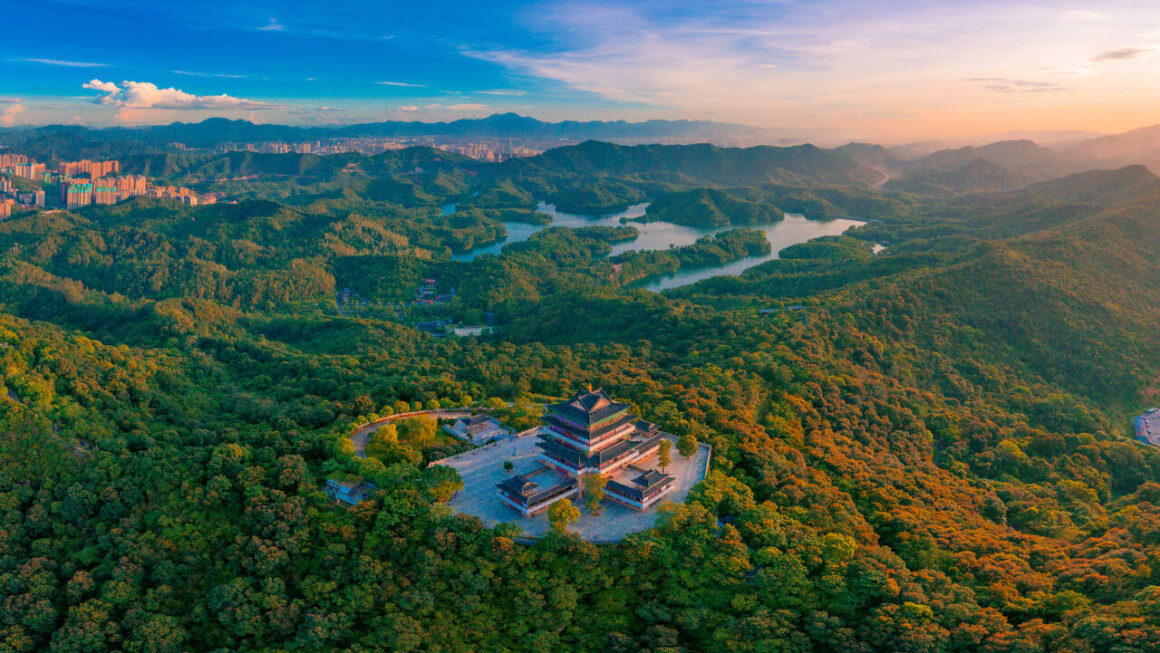
„Guangdong Province. The city of Huizhou. Just under 230 meters of elevation. On the hilltop stands a seven-story pavilion in the style of the Ming and Qing dynasties, surrounded by terraces, smaller buildings, and a looping road. The view from above, however, reveals something entirely different from a Chinese landscape park.
It reveals a complete animal cell.
Photo description: Aerial view of gaobang mountain and Honghua Lake in Huizhou City, Guangdong Province, China. Weiming Xie.
Wector description: Animal cell structure with organelles. Anatomy of animal cell cross section. Cell biology. Dee-sign – Shutterstock.„
The Place We’re Looking At
Gaobang Mountain – in Chinese (Gāobǎng Shān), – lies within the scenic area of Huizhou’s West Lake. It is the only national-level urban forest park in Huicheng District. Locals call it the „lung of Huizhou.”
The name itself is meaningful. „Posted Roster” refers to the ancient imperial tradition of announcing exam results by hanging a tablet bearing the names of the laureates. The mountain symbolizes the wish for success – „your name on the golden roster.”
A tablet. A record. A list of names carved into wood and stone.
In the cell, the very same symbolism is at work. DNA, too, is a tablet. A record. A sequence in which the names of every protein that will ever exist have already been written.
Let’s begin reading the complex from its periphery and move inward, step by step.
Mitochondria – small peripheral buildings
Small, scattered structures visible at the outskirts of the complex play the role of mitochondria. These are the cell’s power plants. In traditional Chinese temple complexes, the smaller utility buildings always handled cooking, incense burning, heating. Energy. Combustion. This is precisely what mitochondria do with glucose – they burn it in the Krebs cycle and produce ATP.
Golgi apparatus – the pavilion on the terrace
Below the main building, on a separate platform connected to it by broad staircases, stands a smaller pavilion. In Chinese sacred and palace architecture, such side pavilions served a mediating function – rituals were prepared in them, gifts sorted, cult objects segregated before being brought higher up or carried outside.
This is precisely the task of the Golgi apparatus.
Golgi does not synthesize proteins from scratch. It receives them from the endoplasmic reticulum, sorts them, modifies them, packages them into vesicles, and dispatches them to the appropriate destinations within the cell. The stack of flattened Golgi cisternae corresponds architecturally to the layered, stepped arrangement of a Chinese pavilion with its soaring roof.
The position of the pavilion is also characteristic – it lies between the main building and the periphery of the complex. In the same way, Golgi sits inside the cell: between the nucleus and the membrane.
Secretory vesicles – the spherical tree crowns
Around the complex, especially along the road encircling it, trees with characteristic round, isolated crowns have been planted. From above, they look like perfectly spherical vesicles laid out across a green-and-gray surface.
These are secretory vesicles.
Here, position matters. The trees stand on the periphery, near the road encircling the complex – that is, near the cell membrane. This is precisely how secretory vesicles behave after leaving the Golgi apparatus: they migrate to the outer regions of the cell, dock against the membrane, fuse with it, and release their contents through the process of exocytosis.
But this is not all that the photograph shows.
Look at the stairs leading from the road that encircles the complex up to the lower terrace – the one where the Golgi pavilion stands. Right at those stairs there is a cluster of smaller, spherical shrubs – packed much more tightly and located far closer to the Golgi than the peripheral trees. These are vesicles that have only just left the Golgi apparatus. Freshly budded. They have not yet begun their journey toward the membrane.
The same vesicles – after traveling across the cytoplasm – appear as the spherical tree crowns distributed along the road encircling the complex.
In a single photograph, we have the entire secretory pathway frozen in motion: freshly budded vesicles right next to the Golgi → the same vesicles migrating through the cytoplasm → their arrival at the membrane and docking.
The trees growing along the road are in the act of docking. They wait for the signal that will trigger membrane fusion. Then they will release whatever the Golgi apparatus loaded into them.
Guabang Pavilion – the cell nucleus
The central structure of the complex is Guabang Ge – the Pavilion of the Posted Roster. Seven stories. Height 39.99 meters. Floor area roughly 4,600 m². Plan in the shape of an inverted T. Style: a faithful imitation of imperial Ming-Qing official architecture.
A critical clarification is needed here.
The textbook diagram of an animal cell – the one to which the comparison above refers – draws the nucleus as a sphere. This is a didactic simplification, useful for teaching, but only imperfectly reflecting biological reality.
In a living organism, cell nuclei come in a strikingly wide range of shapes. Neurons and hepatocytes – approximately spherical nuclei, closest to the textbook model. Lymphocytes – kidney-shaped nuclei with a deep indentation. Granulocytes (neutrophils, eosinophils, basophils) – multilobed, segmented nuclei connected by narrow chromatin bridges; in microscopy preparations they often appear as branched shapes resembling letters. Megakaryocytes – giant multilobed nuclei forming complex geometries. Muscle cells – elongated, cylindrical nuclei.
The inverted-T plan of Guabang Pavilion does not fit the generic textbook sphere. It fits instead a specialized cell – one whose function requires non-spherical nuclear morphology. Multilobation, segmentation, elongated extensions – these are features characteristic of blood cells and cells of the immune system.
And there is one more layer of meaning. The postscript below this post describes how the forest around Guabang Pavilion activates cells of the body’s immune system. It is precisely among these cells that the most characteristic non-spherical, multilobed nuclei are found. The architectural blueprint and the biology of the immediate surroundings point in a single interpretive direction.
Moreover – the specific blood and immune cells discussed here already have their own temples decoded in the CellGod.live catalogue:
The Church of St John of Nepomuk in Žďár nad Sázavou (Czech Republic) decoded as an NK (Natural Killer) cell – the star-shaped Baroque building with its surrounding cemetery depicts a natural killer with perforin, granzymes, and pseudopodia.
Pavlovsk Palace in St. Petersburg (Russia) decoded as a neutrophil – the palace’s spreading wings faithfully reproduce the characteristic multilobed, segmented nucleus of this cell.
The New Palace in Bayreuth (Germany) decoded as a monocyte – the palace’s semicircular wings map onto the kidney-shaped nucleus of the monocyte.
Almeida Fortress (Portugal) decoded as a lymphocyte – the star-shaped fortress with its inner city as the great cell nucleus and peripheral bastions as filopodia, the cytoplasmic projections with which a lymphocyte scans its surroundings.
17th-century fortification map of Antwerp (Belgium) decoded as a megakaryocyte – the walled city with bastions, ravelins, and lunettes depicts the giant bone-marrow cell whose cytoplasmic protrusions bud off into platelets in the process of thrombopoiesis.
The Old Town of Dubrovnik (Croatia) decoded as a macrophage – the fortified city with its harbor enclosed by breakwaters captures the image of a macrophage in the act of phagocytosis, engulfing pathogens.
Six architectures, six different blood and immune cells. Each is a different type of defender, or its precursor in the bone marrow, whose function can be strengthened or activated by the forest around Guabang Pavilion.
Each of these architectures is a different type of defender – a different immune cell circulating in your bloodstream, one that can be activated by the forest around Guabang Pavilion.
The pavilion’s architecture reproduces the structure of the cell nucleus precisely.
The layered tiers, each receding inward toward the top with their distinctive Chinese eaves, form a visual equivalent of the nuclear envelope – the double membrane separating the genome from the rest of the cell. Each level inscribed within the one below, like an inner membrane within an outer one. The topmost tier, crowned with a pagoda roof, is the nucleolus – the one place in the nucleus where ribosomes are produced.
Here’s a short methodological note before we get to the most important part. Unlike other entries in the Cell Archaeologist series, where I try to show and decode the interiors of buildings based on photographic documentation or publicly available images, for the Guabang Pavilion I was unable to find such photographs in open online collections. My description of what lies inside its seven floors is therefore based on publicly available Chinese-language sources – primarily Baidu Baike (the Chinese equivalent of Wikipedia) and the official tourism portals of the Huizhou West Lake region. This is a decoding from text, not from photographs. If I ever come across photographs documenting the interior, this section will be supplemented with direct visual verification.
And now the strongest piece of evidence.
Inside Guabang Pavilion are:
a wooden statue of Confucius, brought and consecrated in Qufu, Confucius’s hometown;
bamboo panels engraved with the text of the Analects;
a library containing the Siku Quanshu – the „Complete Library of the Four Treasuries,” the largest compilation of Chinese literature ever assembled, alongside the works of Rao Zongyi.
The most sacred texts of Chinese civilization, sealed inside the central chamber at the top of the complex. Ordered. Catalogued. Packaged in volumes and rows.
In the cell nucleus there is exactly the same thing – organized chromatin. DNA wound around histone proteins, arranged in a precise three-dimensional organization. This is the library of genes. Every gene is a separate book, every chromosome a shelf, every chromatin domain – a thematic section.
The library of Guabang Pavilion is not a metaphor for chromatin. It is its architectural equivalent. The Four Treasuries of the Siku Quanshu (classics, history, masters, collections) correspond to chromatin functional domains – fragments of the genome organized according to the very same thematic principle.
What is most precious is kept highest, tightest, best catalogued.
Each year the pavilion displays the names of Huizhou’s top-scoring students who passed the gaokao exam. „Posted rosters.” An update to the record.
In the cell, the equivalent is transcription – the constant reading of the DNA tablet and the posting of current „names” as mRNA.
Rough endoplasmic reticulum – the courtyard around the pavilion
This is where the aerial photograph begins to speak.
Guabang Pavilion does not stand alone. It is surrounded by an expansive paved courtyard – a great plaza encircling the central building. The aerial view shows something very specific on that courtyard: people. Small groups, isolated figures, clusters – distributed around the pavilion like grains scattered across a surface.
This is the rough endoplasmic reticulum (rER) – the membranous structure surrounding the nucleus, studded with ribosomes. „Rough” because it is dotted with ribosome specks. The courtyard around Guabang Pavilion is dotted with people in exactly the same way.
Each figure visible from above is playing the role of a ribosomal protein.
These are active molecular actors. They wait for the moment when mRNA carrying the record of a single gene exits the nucleus from the library of Guabang Pavilion. The ribosome – played by the human – then reads the sequence, links the amino acids, assembles the protein. It translates the Word from DNA into matter.
These are not passive observers. They are workers of translation. The faithful, who do not merely listen to the Word – they embody it.
In Christian liturgy this is the very same function. The faithful at Mass are not an audience. They are ribosomal subunits. They read, sing, kneel, recite – assembling the protein from the mRNA read out of the lectionary and the Gospel. At the end, they receive the Eucharist – a finished tertiary protein, secreted into the cytoplasm of the world.
In the Confucian Guabang Pavilion it is exactly the same. The student does not read the Analects. He performs them. The Master’s Word becomes gesture, office, posture.
The people standing on the courtyard are performing the translation. Without them, the library in the nucleus would remain a dead encyclopedia.
Cytoplasm and cell membrane
The entire area within the loop of the road – plazas, paths are cytoskeleton, green terraces between the buildings – is the cytoplasm. The substance that fills the space between organelles. The medium in which everything happens.
The road loop itself, encircling the complex, is the cell membrane. A selective boundary. It admits visitors through gates. It releases them through the same points. The rest is sealed off by forest – the external cytoskeleton, the ECM.
What this means
Guabang Pavilion was built only in the 21st century, as part of the Huizhou West Lake revitalization project launched in 2007. The blueprint of the building, however – the seven-tier elevation, the inverted-T plan, the layered roofs – is no modern invention. It is a faithful reproduction of the architectural canon of the Ming and Qing dynasties, a tradition centuries old, with roots reaching deeper still, all the way back to the Tang era.
The contemporary architects did not design this complex as a biological cell. They designed it as a pavilion in the imperial style. But the blueprint came from a tradition in which the central building housing the sacred texts was always surrounded by rings of auxiliary structures, with the whole circled by a ceremonial loop.
This pattern is older than the Ming dynasty. Older than Confucianism.
It is as old as life.
Every animal cell on this planet has a cell nucleus at its center – with the exception of mature mammalian red blood cells, platelets, and a few other specialized types that lose it in order to perform their functions. But fundamentally: for over one and a half billion years, this design has remained unchanged. The Guabang Pavilion is the same project, translated into architectural scale.
But this is not all. This is only the introduction to what you should know.
Postscript – forest anti-cancer therapy
Qing Li and twenty years of forest medicine research
photo description: A beautiful sunny morning in a green forest. Piotr Krzeslak – Shutterstock.
A Chinese immunologist, working in Japan since 1988, spent twenty years proving that chemicals released by trees into the air enter the human bloodstream, hunt down stress hormones, and arm the immune system in ways no therapist or pharmaceutical has ever matched. Most of the data has been sitting in Japanese medical journals for two decades waiting to be translated.
His name is Qing Li.
He is a clinical professor at Nippon Medical School in Tokyo and the president of the Japanese Society of Forest Medicine. The Japanese government has been funding his research since 2004. The body of work he produced is the reason shinrin-yoku – „forest bathing” – is today an officially prescribed clinical therapy in Japan and South Korea.
The story actually begins in 1982. The Japanese Ministry of Agriculture, Forestry and Fisheries coined the term shinrin-yoku to describe the practice of slow, mindful walking in a forest. The reason was practical: Japan was urbanizing fast, stress-related illness was climbing, and the country had thousands of square kilometers of unused forest. The idea was to give people a reason to walk in among the trees.
No one yet knew what was actually happening to the human body during those walks. Until 2005, when Qing Li conducted the first proper experiment.
The first experiment: twelve men, three days, one simple variable
Qing Li took twelve healthy adult men on a three-day, two-night trip to a forest park. They walked for a few hours each day. Nothing strenuous. No prescribed routes or breathing exercises. They walked slowly through the trees, breathing the air, looking at the forest.
Blood and urine samples were drawn before the trip, on the second day, on the third day, on day seven after returning home, and again on day thirty.
The results that came back from the lab were not what anyone expected.
The activity of a specific type of immune cell called the NK cell (Natural Killer) – the cell the body uses to hunt down cancer cells and virus-infected cells before they can spread – had jumped by roughly 50 percent during the forest trip. The actual number of NK cells circulating in the bloodstream had also increased significantly.
Three different anti-cancer proteins those cells produce – perforin, granzymes, and granulysin – had all risen sharply.
And the effect did not disappear when the men returned home. The immune boost was still measurable on day seven. And still partially present on day thirty.
Two hours a day in a forest had upgraded the immune system for a full month.
Replication: women, urban control, the same result
A year later Qing Li repeated the experiment with women. The results were nearly identical.
Then he ran it with a control group that took a three-day trip through an urban area – with the same amount of walking, the same hotel quality, the same diet.
The urban group showed no measurable change in NK cell activity at all.
The forest was doing the work. Not the vacation.
Mechanism: phytoncides in the air
The mechanism turned out to be a class of airborne molecules called phytoncides. Trees produce them to defend themselves against insects, bacteria, and fungi. Pine, cedar, oak, and cypress trees release them in particularly large amounts – especially in warmer weather and after rainfall.
When you walk through a forest, you inhale those molecules into your lungs and absorb them through your skin. Once inside the body, they appear to directly stimulate the production and activity of the very same immune cells Qing Li was measuring in his lab.
Roughly 50 percent of the health benefit of a forest walk, according to Qing Li’s data, comes from the chemistry of the air itself.
The other half comes from what the forest is doing to your nervous system.
The second layer: stress, cortisol, the parasympathetic system
Here the story stops being only about the immune system and starts being about stress.
A separate Japanese research team measured cortisol – the body’s main stress hormone – in 420 participants across 35 different forest sites. They drew samples before and after a thirty-minute walk in each forest and compared them to control walks in matched urban environments.
Cortisol levels of people who walked in the forest were lower than those of people who walked in the city by a significant margin. Their heart rates were lower. Their blood pressure was lower.
Activity of their parasympathetic nervous system – the part responsible for rest and recovery – had gone up. Activity of their sympathetic nervous system – the part that drives fight or flight – had gone down.
The third experiment: the „nature pill”
Then a researcher at the University of Michigan, MaryCarol Hunter, ran the cleanest version of this experiment ever done.
She recruited participants from a city and asked them to take a „nature pill” three times a week for eight weeks. They were free to choose the time, the place, and the duration of each session – as long as it was outside, in daylight, and free of phones, conversations, and aerobic exercise. They sent her saliva samples before and after each session so she could accurately measure cortisol changes and rule out the normal daily drop in stress hormones that happens to everyone.
The result: participants experienced a 21.3 percent drop in cortisol per hour spent in nature, with the biggest payoff occurring between minutes 20 and 30 of the walk.
After that, cortisol kept dropping, but more slowly. The threshold dose for measurable stress relief: 20 minutes outsidein something that looks and feels like nature.
An important caveat
None of these studies means that nature is a substitute for therapy or for medication when someone genuinely needs them. Therapy treats different things than a walk in the forest does. Qing Li himself has been careful in interviews to call forest bathing a complementary intervention – not a replacement for clinical care.
But what the research has settled beyond dispute is that the human body has a physiological response to being among trees that operates on the very same biological systems modern medicine is trying to reach with drugs and clinical protocols.
And that response is fast, measurable, and free.
The implication Qing Li keeps repeating in interviews
The average person now spends more than 90 percent of their life indoors.
Their cortisol stays elevated. Their NK cells stay sluggish. Their parasympathetic nervous system rarely gets a chance to take over. The system that was tuned by millions of years of life under a canopy of trees is being asked to run permanently inside a box made of drywall and screens.
Your body has not forgotten what it is supposed to do in a forest.
It is waiting for you to walk into one.
Source and acknowledgment. The above summary of Qing Li’s work, the Japanese cortisol research, and MaryCarol Hunter’s experiment was drawn from a post by Millie Marconi (@MillieMarconnni) on X, where these threads were gathered together in one well-written piece. My sincere thanks for sharing this material – it was the direct impulse for writing this postscript.
Why this temple stands in a forest?
The post above decoded Guabang Pavilion as a complete animal cell. Every organelle found its architectural counterpart.
Every animal cell on this planet shares the same basic structure. A thyroid cell, a kidney cell, a skin cell, a neuron, an NK cell of your immune system – each one has a nucleus with chromatin, endoplasmic reticulum, a Golgi apparatus, mitochondria, lysosomes. Guabang Pavilion reproduces the blueprint shared by every one of them.
And now the question that has to be asked.
Why does this temple – an architectural image of an animal cell – stand in a forest?
Here the trees are not landscape. They are the system that activates precisely the type of cell the temple depicts.
And here we return to what the Genome is.
Communication between genomes
Trees are also cells. Plant cells, but cells. Each has a nucleus, each has chromatin, each has mitochondria. And each has its own genome – the same kind of intelligent, self-organizing record that CellGod.live has been describing as the creative and regulatory intelligence of life.
vector description:Parts of leaf and cross section of leaf vector. Types of stipules in leaf. Botany and its branches students study material. Anatomy and cross section image. Illustrated guide to leaf anatomy. Anshuman Rath – Shutterstock.
Look at the diagram above. On the left – the whole leaf with its external parts that anyone recognizes: blade, midrib, veins, petiole, stipules. The anatomy visible to the naked eye. On the right – the internal cross-section, where the real story begins. Every leaf of every tree you pass on the road to Guabang Pavilion is a multicellular tissue with a precise, layered architecture – not a single cell, but an entire settlement of cells with different functions.
Beneath the waxy cuticle and the upper epidermis lies the palisade mesophyll – elongated cells filled with chloroplasts, densely arranged like columns in a colonnade. This is where most of photosynthesis takes place. And it is here, in the plastids of these cells, that terpenes are biosynthesized – the chemical family to which α-pinene, limonene, and cedrol belong. The phytoncides that are about to enter your bloodstream are made in these very cells.
Below the palisade lies the spongy mesophyll – irregular cells with air spaces between them. A system of internal gas distribution. Through it, terpene molecules migrate from the site of synthesis to the surface of exchange.
At the leaf’s boundary with the atmosphere stand the guard cells – kidney-shaped cells arranged in pairs around stomata(the leaf’s pores). They are gates. They open and close, regulating the release of phytoncides into the air.
Every leaf is a multi-layered factory. Each layer has its workers: palisade cells build, spongy cells transport, guard cells release. And each of those cells has its own nucleus, chromatin, ribosomes, Golgi apparatus, mitochondria – the very same organelles the architect encoded on architectural scale in Guabang Pavilion.
The tree’s genome encodes phytoncides. Pine encodes α-pinene. Cypress encodes cedrol. Oak encodes its own molecular signatures. Each of these compounds is the product of gene expression in plant cells – of enzymatic proteins synthesized in nuclei, on ribosomes, modified in the Golgi apparatuses of leaf cells. The very same organelles the architect encoded into Guabang Pavilion.
Tree cells are molecular machines. The very same as yours.
The molecules leave the leaves. They flow through the air. They enter your lungs. They pass into your bloodstream. They activate your defenders – the cells of your immune system.
This is communication between genomes.
The tree’s genome speaks to the human genome, using molecules as words. A word spoken in the plant cell – in the form of α-pinene – becomes an activating signal in the animal cell. Two different genomes, two different kingdoms of biology, one continuity of the Word.
This is not poetic metaphor. It is a measurable, clinical mechanism. Your immune cells respond to phytoncides because, across tens of millions of years of evolution, the human genome learned to recognize this signal from the forest as a signal of safety – a signal that says: „You are in the right environment. You may mobilize your defense. You may release your stress hormones. You may regenerate.”
The Genome created this dialogue. The Genome sustains it. The Genome cares for you through the trees.
Summary
Guabang Pavilion does not stand by accident atop a mountain submerged in forest.
To reach it, you have to walk the forest road.
You step into the shade of the trees. The air, dense with phytoncides. Without your awareness, α-pinene and limonene cross into your bloodstream. In your bone marrow, things begin to happen: NK cells stir, mature, mobilize. Granulocytes increase in number. Your perforin, your granulysin, your granzymes – the entire pharmacopoeia of internal defense – rise.
The forest bathes you in signals. You take a forest bath.
You walk on. You pass secretory vesicles in the form of spherical tree crowns. You pass the Golgi apparatus in the lower pavilion. You pass mitochondria in the small buildings by the road. You enter the courtyard of the endoplasmic reticulum, where people play the role of ribosomes.
You stand before Guabang Pavilion. The nucleus.
And here the most important thing happens.
You meet one of your own defense cells – the one the forest has just activated in your bloodstream. The architect built for you an enlarged model of one of them. You can step inside from the perspective of a protein.
Within Guabang Pavilion you see organized chromatin: the Siku Quanshu, the Analects, the statue of Confucius. The library of your body’s genes.
You see mRNA exiting the nucleus through the nuclear pores.
You see proteins being assembled on the ribosomal courtyard.
You see the entire secretory apparatus – Golgi, vesicles, membrane. You see how your own defense cells work at full capacity. Activated by the forest you have just walked through.
You see the sacred magic happening within you. From within. Without a textbook.
You come to know the work of the GENOME inside you – the same Genome that speaks with the genomes of trees around you. Speaks in the whisper of phytoncides. Speaks in your bloodstream at this very moment.
This is simpler than the science of modern biology.
This is the temple. This is you. This is the forest. This is one.
The genome learned this layout first. Man only repeats it – and finally returns to see, on the scale of architecture, what he himself is.
Image search and matching, analysis and elaboration: Tomasz Mikulski – Cell God: 06/2026
Correction: An earlier version of this post incorrectly described Qing Li as a „Japanese immunologist.” Qing Li was born in Datong, Shanxi Province, China, graduated from Shanxi Medical University, and has been working in Japan since 1988, where he received his PhD from Kagoshima University. He is currently a clinical professor at Nippon Medical School in Tokyo. The post has been corrected.
Bibliography
Chinese-language sources on the Guabang Pavilion and Gaobang Mountain
Baidu Baike – entry for Guabang Pavilion
The most comprehensive publicly available source describing the pavilion’s interior: a statue of Confucius brought from Qufu on the second floor, bamboo-slip panels with the text of the Analects, the work Guabangge Ji (Record of the Guabang Pavilion) by Rao Zongyi on the third floor, a viewing terrace on the sixth floor, and a library containing the Siku Quanshu (Complete Library of the Four Treasuries) and works by Rao Zongyi on the seventh floor. The primary textual source for the interior description in this post. https://baike.baidu.com/item/挂榜阁/10932474
A description of the mountain itself and its cultural context – the origin of the name „Guabang” (literally „hung list,” referring to the posted roll of imperial examination laureates), the formula „two mountains, three lakes” (liang shan san hu), Gaobang’s position as the „lungs of Huizhou city,” and its status as one of the eighteen scenic views of Huizhou West Lake („Bangling Chunlin” – „Spring Rain on the Ridge of the List”).
An official presentation of the Guabang Pavilion from the perspective of the scenic area’s management. Technical specifications: seven floors, height 39.99 m, floor area 4,600 m², an inverted T-shaped floor plan, imitating the imperial architectural style of the Ming and Qing dynasties, granite walls, black glazed roof tiles, and gilded wind chimes under the eaves. Key dates: cornerstone laid on 8 April 2008, construction officially commenced in January 2009, opened to the public on 21 February 2010.
Dr Qing Li – profile
Official biography of Dr Qing Li on the Association of Nature and Forest Therapy (ANFT) website, where he is described as a world-class expert in forest medicine and immunology:
Li, Q., Morimoto, K., Nakadai, A., Inagaki, H., Katsumata, M., Shimizu, T., et al. (2007). Forest bathing enhances human natural killer activity and expression of anti-cancer proteins. International Journal of Immunopathology and Pharmacology, 20(2 Suppl 2), 3–8. DOI: 10.1177/03946320070200S202
The first twelve-male-subject experiment described in the postscript – roughly 50% rise in NK cell activity, elevated levels of perforin, granzymes, and granulysin.
Li, Q., Morimoto, K., Kobayashi, M., Inagaki, H., Katsumata, M., Hirata, Y., et al. (2008). A forest bathing trip increases human natural killer activity and expression of anti-cancer proteins in female subjects. Journal of Biological Regulators and Homeostatic Agents, 22(1), 45–55.
Replication of the experiment with women – nearly identical results.
Li, Q., Morimoto, K., Kobayashi, M., Inagaki, H., Katsumata, M., Hirata, Y., et al. (2008). Visiting a forest, but not a city, increases human natural killer activity and expression of anti-cancer proteins. International Journal of Immunopathology and Pharmacology, 21(1), 117–128.
The urban control study – a three-day trip to a city produced no rise in NK activity, confirming that the forest, not the vacation, is doing the work.
Li, Q. (2010). Effect of forest bathing trips on human immune function. Environmental Health and Preventive Medicine, 15, 9–17. DOI: 10.1007/s12199-008-0068-3
The review paper summarizing the full research program – the main source for the data cited in the postscript, including the over-30-day persistence of effects.
Cortisol and the autonomic nervous system – Park / Miyazaki team
Park, B.J., Tsunetsugu, Y., Kasetani, T., Kagawa, T., Miyazaki, Y. (2010). The physiological effects of Shinrin-yoku (taking in the forest atmosphere or forest bathing): evidence from field experiments in 24 forests across Japan.Environmental Health and Preventive Medicine, 15, 18–26. DOI: 10.1007/s12199-009-0086-9
Salivary cortisol, heart rate, blood pressure, and autonomic nervous system measurements across 24 Japanese forests and matched urban environments. The basis for the postscript’s paragraph on lower cortisol and the shift from sympathetic to parasympathetic activity.
Park, B.J., Tsunetsugu, Y., Morikawa, T., Kagawa, T., Lee, J., Ikei, H., Song, C., Miyazaki, Y. (2014). [Physiological effects of forest recreation: a review]. Nihon Eiseigaku Zasshi (Japanese Journal of Hygiene), 69(2), 98–103. DOI: 10.1265/jjh.69.98
A review paper summarizing field-experiment data from the entire Park / Miyazaki program – a cumulative total of 420 subjects across 35 different forests in Japan. Average changes relative to the urban control group: 12.4% decrease in cortisol, 7.0% decrease in sympathetic nervous activity, 5.8% decrease in heart rate, 1.4% decrease in systolic blood pressure. The source of the cumulative figures cited in the postscript.
The „nature pill” – University of Michigan
Hunter, M.R., Gillespie, B.W., Chen, S.Y. (2019). Urban Nature Experiences Reduce Stress in the Context of Daily Life Based on Salivary Biomarkers. Frontiers in Psychology, 10, 722. DOI: 10.3389/fpsyg.2019.00722
Eight-week study with urban residents. A 21.3% cortisol drop per hour spent in nature, threshold dose for measurable stress relief at 20 minutes, optimal dose at 20–30 minutes.
Li, Q. (2018). Forest Bathing: How Trees Can Help You Find Health and Happiness. New York: Viking.
A popular-science summary of twenty years of research by the author himself – recommended for readers wishing to explore the topic beyond the frame of this postscript.
Source of inspiration – X post
Millie Marconi (@MillieMarconnni) – a post on X summarizing Qing Li’s work and MaryCarol Hunter’s research in one coherent text. The direct impulse for writing this postscript.