„Angkor Wat – Temple or Giant Plant Cell”
What if ancient builders had access to microscopes? What if their knowledge of the microscopic world was so advanced that they deliberately recreated it in monumental architecture? In today’s post, we’ll examine Angkor Wat—the largest temple in the world—which, when viewed from above, astonishingly resembles a plant cell. Every element of this structure has its biological counterpart, forming a harmonious whole. Is this a coincidence, or a forgotten truth about ancient science?
,Photo description: The temple complex of Angkor Wat, the ancient city of Cambodia. Panoramic photos of an aerial drone.
,Photo description: Model of plant cell in laboratory for education of biology.
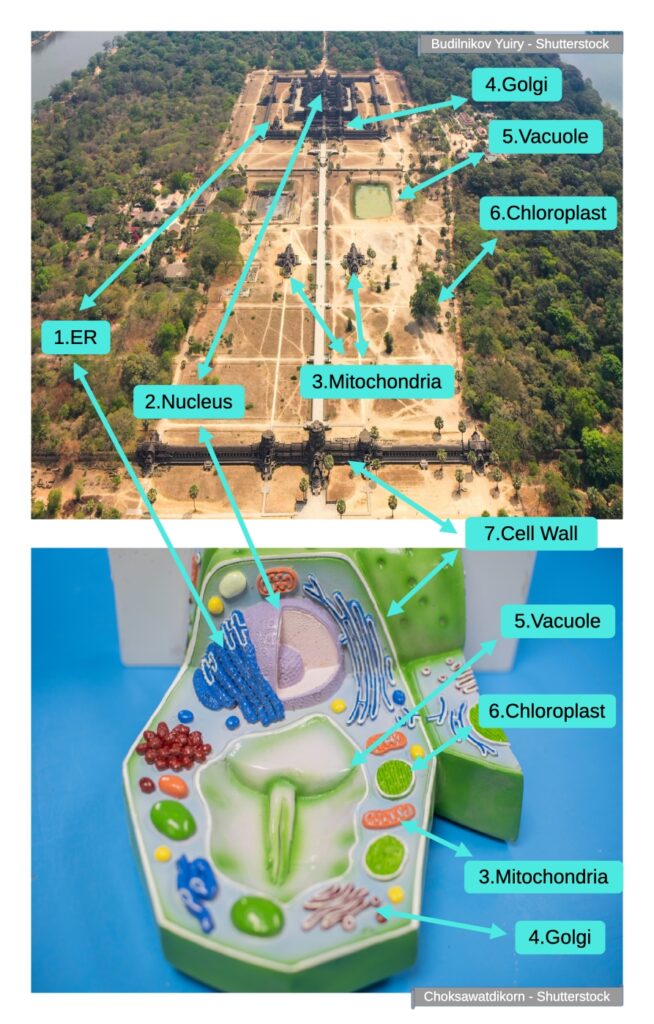
1. The main courtyard is the endoplasmic reticulum – the labyrinth of corridors and courtyards perfectly mirrors the tangled channels of the reticulum, responsible for transporting substances within the cell.
2. The central tower is the cell nucleus – the dominant temple tower serves as the command center, just as the nucleus governs cellular processes.
3. The libraries are mitochondria – the repositories of knowledge function like mitochondria, storing the energy necessary for life.
4. The hall in the main courtyard is the Golgi apparatus – the main corridor, through which pilgrims and priests flow, acts like the Golgi apparatus, sorting and distributing the „molecules” of the temple’s life.
5. The water reservoirs are vacuoles – the sacred ponds collect water, much like vacuoles regulate the cell’s water balance.
6. The trees inside the complex correspond to chloroplasts – the greenery absorbs sunlight, converting it into energy, exactly like chloroplasts in plants.
7. The walls are the cell membrane – the massive stone enclosure protects the temple, just as the cell wall provides rigidity and protection to the plant.
Angkor Wat is not just an architectural masterpiece—it’s a map of the microscopic world, encoded in stone. Too many elements align with unsettling precision to dismiss it as mere chance. Did the ancient Khmer people see what we only discovered with microscopes? Or are temples not just places of worship, but also stone textbooks left by our ancestors as clues?
„AMAZING FACTS ABOUT PLANT CELLS THAT WILL ASTONISH YOU”
- Miniature Power Plants – A single plant cell can contain up to 50 chloroplasts, each producing energy through photosynthesis. It’s like a microscopic solar power station!
Giant Vacuoles – In mature plant cells, the vacuole can occupy up to 90% of the cell’s volume, acting as a storage for water and toxins.
Cellular „Social Media” – Plant cells communicate with each other through plasmodesmata – microscopic tunnels that transport nutrients and chemical signals.
Living Skeletons – Unlike animals, plants don’t have bones. Their rigidity comes from the cellulose cell wall, which is so durable it serves as the main component of… paper!
Green Solar Batteries – Chloroplasts weren’t always part of plant cells. Scientists believe they were once free-living bacteria that were absorbed by cells and became their „energy partners.”
Cellular Zombies – Some plant cells (like those in wood) are dead but still perform structural functions – like ghosts that keep working!
Microscopic Army – Plant cells can recognize pathogen attacks and send alarm signals, activating defense mechanisms – their very own immune system!
Did you know about these incredible properties of plant cells? If you have a favorite fact, share it in the comments!
,Combining images and analysis by Tomasz Mikulski – Cell God, date: 01/2025
- Links and references:
- Built. 12th century, source. https://en.wikipedia.org/wiki/Angkor_Wat
- Cambodia’s Wonder: The Mysteries of Angkor Wat, https://www.wildnectarcollection.com/post/cambodia-s-wonder-the-mysteries-of-angkor-wat
- Plant cells, https://pmc.ncbi.nlm.nih.gov/articles/PMC7449582/
- Plant Cell Facts for Kids, https://www.factsjustforkids.com/plant-facts/plant-cell-facts-for-kids/