„Fort Gaines: A Military Plant Cell”
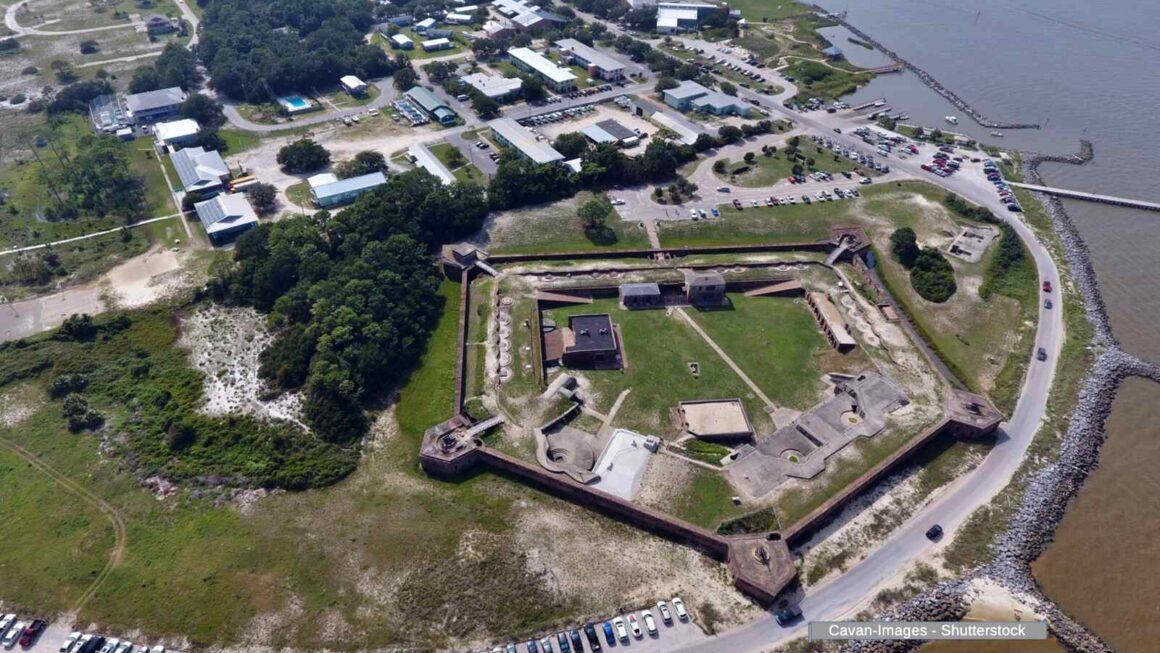
Did 19th-Century Engineers Replicate the Microscopic World in Architecture? On my blog I reveal a forgotten truth: temples, fortresses, and cities mirror biological structures known to our ancestors. Today, we examine Fort Gaines in Alabama—its star-shaped design, thick walls, and internal organization bear a striking resemblance to… a plant cell
,Photo description: Fort Gaines Alabama from the sky.
,Illustration description: Plant cell isolated on white.
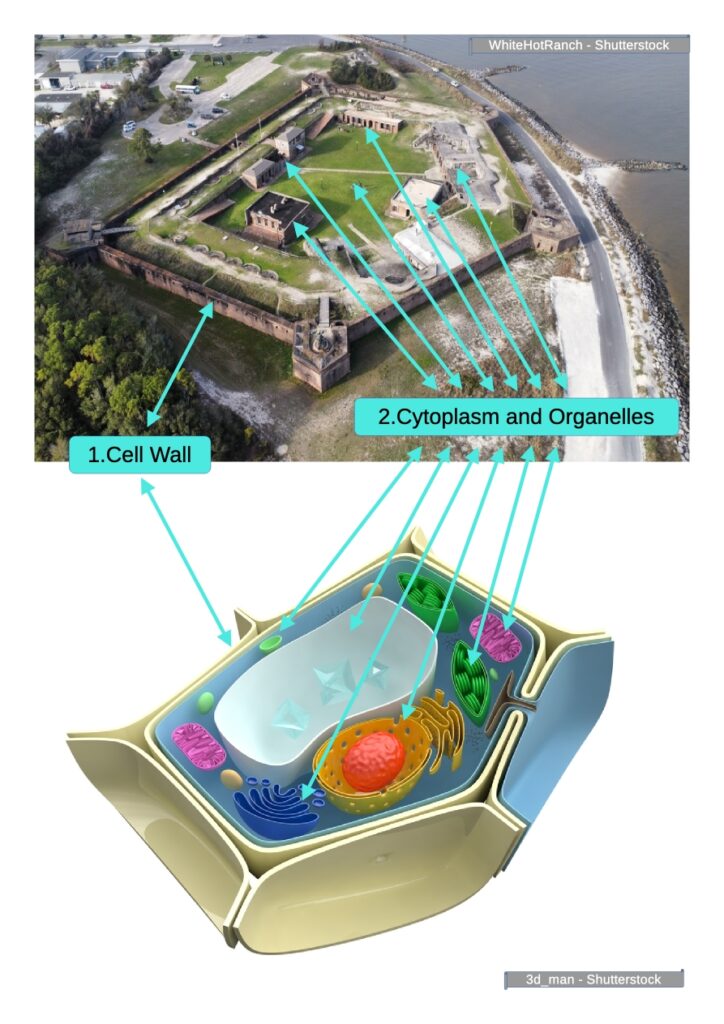
- 1. „Thick Walls: A Brick-and-Earth Cell Wall” The fort’s walls are the architectural equivalent of a cell wall. Their layered construction (brick + earthen mounds) mirrors the cellulose-lignin matrix of plants. Both structures share the same purpose: to shield the interior from threats—for the cell, pathogens; for the fort, cannonballs. Even the dry moat acts like a cuticle, an extra barrier protecting the fort’s „cytoplasm.”
- 2. „Interior Structures: Organelles in Military Form”
- Every building in the fort mirrors a cellular organelle:
- – The chapel is the nucleus—command center and repository of „genes” (orders, traditions).
- – Barracks are the Golgi apparatus—preparing (protein-like) soldiers for defense.
- – The courtyard is the vacuole—a space regulating „pressure” (troop morale).
- – Gunpowder stores are mitochondria—the power source (explosive energy!).
- – Cannon casemates are peroxisomes—neutralizing enemies like enzymes detoxify cells.
Fort Gaines is no exception—it’s further proof of an archetypal blueprint humanity has replicated for millennia. Star-shaped forts, cathedrals with nave-like membranes, cities designed as tissues… All suggest our ancestors understood the microscopic world better than we think. Or perhaps God (or nature) designed everything by the same principles?What do you think? Leave a comment and share your theory!
„Divine Engineering: 7 Amazing Facts About Plant Cells”
1. „Living Fortresses” Plant cell walls are Earth’s oldest „concrete” structures – their cellulose microfibers are stronger than steel relative to their thickness. Each cell is a miniature living fortress!
2. „Green Atomic Factories” Chloroplasts are the only structures on Earth that have mastered nuclear fusion at room temperature – they split water using solar energy, just as stars split atoms.
3. „Memory Encoded in Sugar” Plants have a cellular internet – signals transmitted through phloem in the form of sugars carry not only energy but also information about pest attacks, encoded in molecular patterns.
4. „Immortal Cell Lines” Some plant cells (e.g., in sequoias) live over 2000 years without signs of aging – their DNA self-repairs, a dream of every medical biologist.
5. „Cellular Force Field” The vacuole occupying 90% of the cell’s volume generates pressure of 10 atmospheres – like a balloon that could lift a car if it weren’t microscopic.
6. „Botanical Teleportation” Plasmodesmata connecting cells are true molecular space-time tunnels – even entire viruses and proteins travel through these nano-channels.
7. „God’s Color Code” Anthocyanins in vacuoles change color based on pH – that’s why hibiscus is red and forget-me-nots are blue. Like chemical stained glass in a cellular chapel.
The plant cell is the most advanced nanotechnology laboratory we know – and it runs on water and light!
Did you know every leaf contains more complex structures than the latest smartphone? Comment which fact surprised you most!
,Combining images and analysis by Tomasz Mikulski – Cell God, date: 01/2025
- Links and references:
- Built. 1821, source. https://en.wikipedia.org/wiki/Fort_Gaines_(Alabama)
- Plant cells, https://en.wikipedia.org/wiki/Plant_cell