” 1. The Centennial Hall in Wroclaw as a Living Cell”
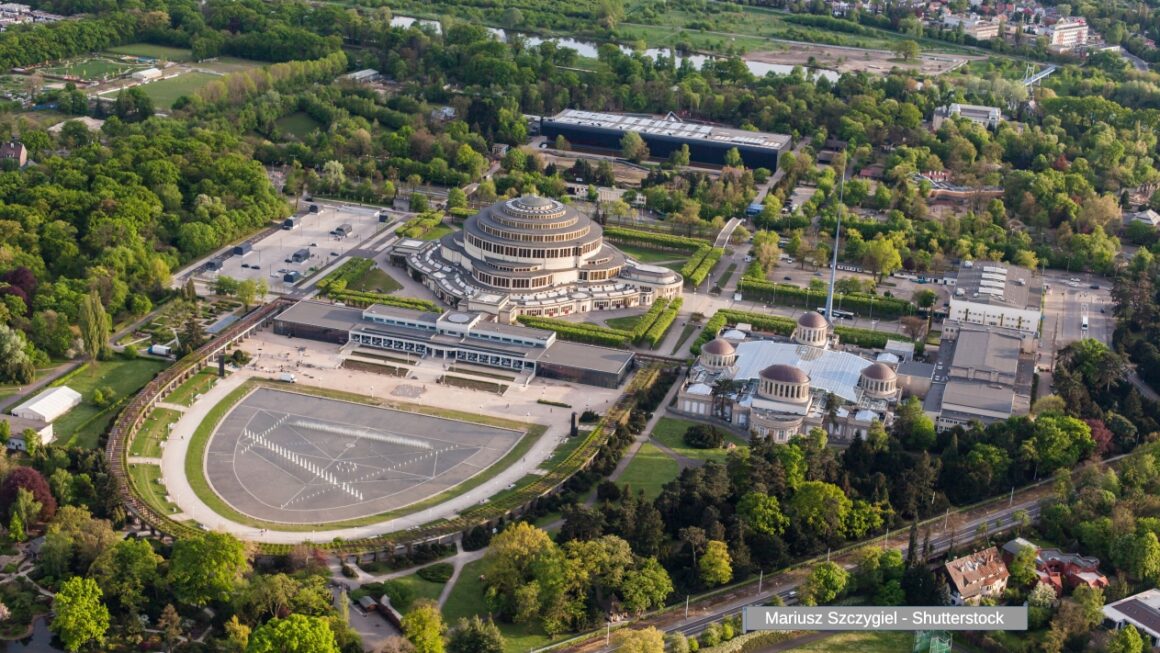
Architecture has always been a reflection of human ingenuity, blending art, science, and history into structures that stand the test of time. One such masterpiece is the „Centennial Hall” in Wroclaw, Poland. Built between 1911 and 1913 by architect Max Berg, this monumental structure was designed to commemorate the 100th anniversary of the victory over Napoleon at the Battle of Leipzig. Its massive reinforced concrete dome, spanning 65 meters in diameter, was a groundbreaking achievement in engineering and a symbol of modernity at the time. But what if we looked at the Centennial Hall not just as a feat of architecture, but as a „living cell”? From a bird’s-eye view, the entire complex resembles a cellular structure, where each element plays a specific role, and the whole functions as a harmonious, dynamic entity. Let’s explore how the Centennial Hall and its surroundings can be compared to the organelles of a cell.
,Photo description: aerial view of wroclaw city suburbs in Poland.
,Illustration description: Abstract illustration of the biological cell.
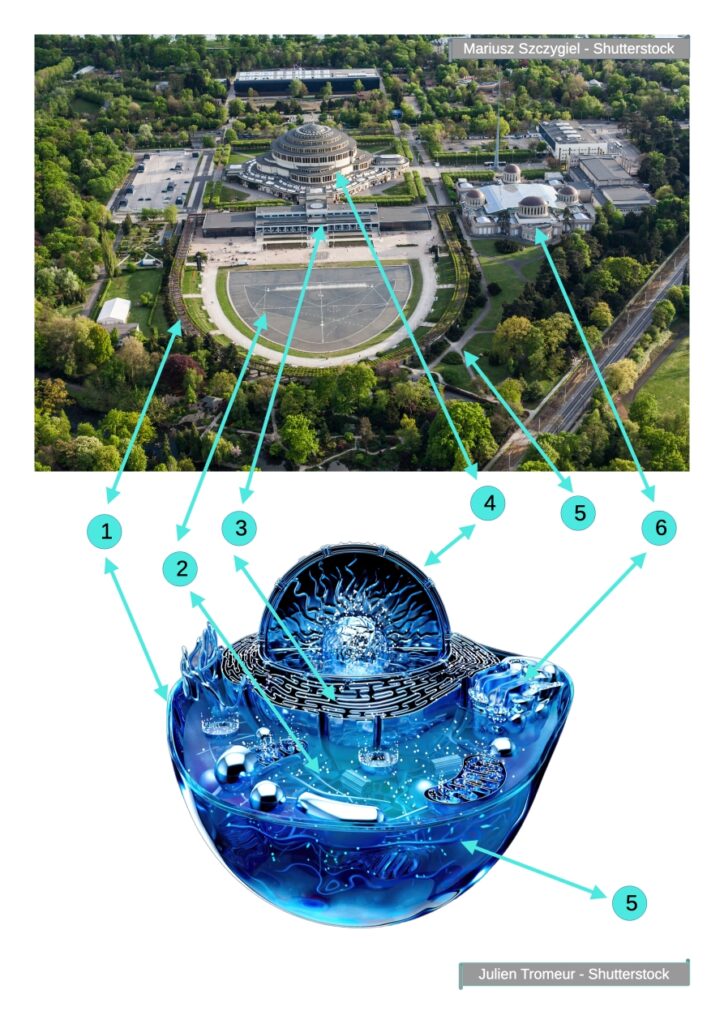
- 1. „Pergola – The Cell Membrane” – The pergola, surrounding the fountain, evokes the image of the cell membrane, which encloses and protects the cell. – The cell membrane regulates the flow of substances, while the pergola defines the boundaries of the complex, serving as its iconic gateway.
- 2. „Multimedia Fountain – The Cytoplasm” – The fountain, with its dynamic water jets, mirrors the fluid cytoplasm that fills the cell. The cytoplasm is the medium where cellular processes occur, and the fountain brings life to the complex, attracting visitors and creating a vibrant atmosphere.
- 3. „Congress Center – The Endoplasmic Reticulum (ER)” – Located near the hall, the Congress Center resembles the network-like structure of the ER, which wraps around the nucleus. The ER synthesizes and transports proteins, while the Congress Center serves as a hub for ideas and information, where knowledge is processed and shared.
- 4. „The Centennial Hall – The Nucleus” – The dome of the hall dominates the complex, much like the nucleus dominates a cell. Its circular shape and imposing scale evoke the image of a spherical nucleus, the control center of the cell. Just as the nucleus stores DNA and directs cellular activities, the main hall is the „heart” of the complex, hosting major events and setting the tone for the entire area.
- 5. „Pathways – The Cytoskeleton” – The park’s pathways, weaving through the complex, resemble the microtubules and filaments of the cytoskeleton. The cytoskeleton provides structure and enables transport within the cell, just as the pathways connect different parts of the complex, allowing people to move freely.
- 6. „Four Domes Pavilion – The Golgi Apparatus” – The pavilion, with its distinctive domes, resembles the Golgi apparatus. The Golgi apparatus modifies and sorts proteins, while the Four Domes Pavilion processes and presents art, transforming creative ideas into cultural experiences.
„The Centennial Hall as a Living Cell”
The Centennial Hall complex is more than just a collection of buildings – it’s an „organism”, where each element plays a vital role. The hall itself is the „nucleus,” setting the tone for the entire site, while the surrounding structures – like organelles – work together to create a harmonious whole. From above, this architectural marvel resembles a living cell, where every detail has its place and purpose. Just as the cell is the basic unit of life, the Centennial Hall is a cornerstone of Wrocław’s identity – a place where history, culture, and technology converge to create something extraordinary. It’s a true „Cellular God” in the world of architecture.
” 2. The Pergola at the Centennial Hall as a Cell Membrane”
Architecture often draws inspiration from nature, but sometimes, nature can be the key to understanding architecture. One place where this analogy becomes strikingly clear is the „Pergola” at the Centennial Hall complex in Wroclaw, Poland. This semi-circular, reinforced concrete structure, surrounding the multimedia fountain, not only captivates with its form but also – upon closer inspection – resembles the „cell membrane”, one of the most important structures in biology.
,Photo description: Pergola in Wroclaw on an autumn sunny day.
,Vector description: Amphipathic Molecules and Membrane Structure – Vector Medical Illustration.
,Photo description: An arcade covered with plants circulating fountain at Stulecia hall in Wroclaw, Poland.
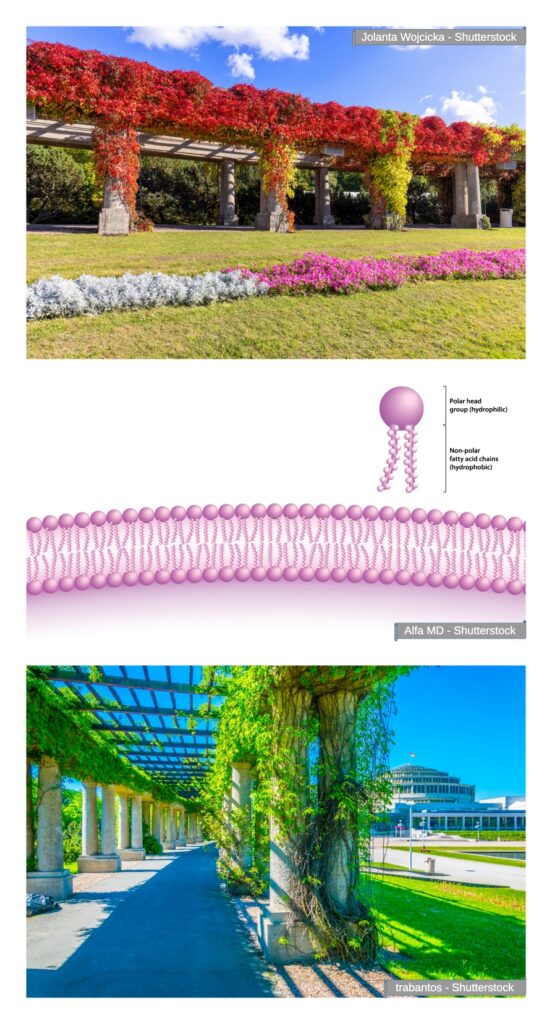
- „The pergola, with its regular, twin columns on both sides”, resembles the double layer of phospholipids that make up the cell membrane. Its semi-circular shape and symmetrical pillars evoke the image of a flexible yet stable membrane structure. – The cell membrane surrounds the cell, protects it, and controls the flow of substances. Similarly, the pergola surrounds the fountain, defining the boundaries of the complex while serving as its iconic gateway. It is the „guardian” that separates the interior of the complex from its surroundings while allowing the free flow of people.
- „Twin Pillars and Their Bases – Phospholipids” – The pillars of the pergola, especially their twin pairs, resemble the molecules of phospholipids that form the double layer of the cell membrane. Their bases, firmly anchored in the ground, bring to mind the hydrophilic „heads” of phospholipids, while the slender columns correspond to the hydrophobic „tails.” – Phospholipids create a flexible yet stable membrane structure, and the pillars of the pergola play a similar role – providing support and stability while allowing the free movement of people. Just as phospholipids are the basic „building blocks” of the membrane, the pillars are the fundamental elements of the pergola.
The pergola at the Centennial Hall complex is not just an architectural element but also a „biological metaphor”. Its twin pillars and semi-circular shape resemble the double layer of phospholipids that form the cell membrane. Just as the membrane protects the cell and controls the flow of substances, the pergola defines the boundaries of the complex while inviting people inside. This connection between architecture and biology shows how nature inspires humanity, and how humans – often unconsciously – mimic nature. Can you spot other similarities between the Centennial Hall and a cell? Share your thoughts in the comments!
,Combining images and adding a description details made by Tomasz Mikulski – Cell God, date: 03/2025