1. „The Stellar Beauty, Zwolle and the Human Skin Cell”
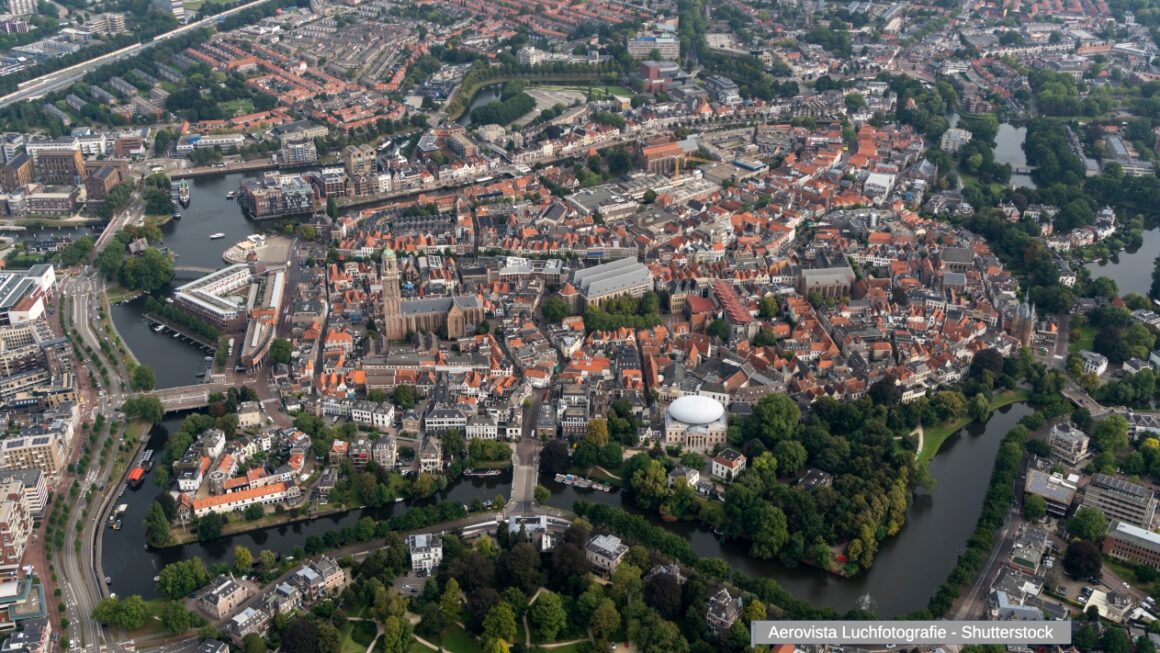
Sometimes, to truly appreciate the beauty and harmony of the world, we need to look at it from a completely different perspective. Today, I invite you on a journey that connects the macro and micro worlds – from the star-shaped layout of the historic city of Zwolle in the Netherlands to the star-like structure of a human squamous epithelial skin cell. Zwolle, a charming city in the Netherlands, captivates not only with its history but also with its unique urban design. When viewed from above, its center resembles a star. This is not just a result of urban planning but also a symbolic representation of how nature and human intervention can coexist in perfect balance.
,Photo description: Aerial view of the dutch historic fortified city Zwolle, in the province of Overijssel, Holland. The town has an old star fortification.
,Photo description: View in microscopic of human skin cells.Squamous epithelium cells.Cytology and pathology laboratory department.Magnification 400 X.
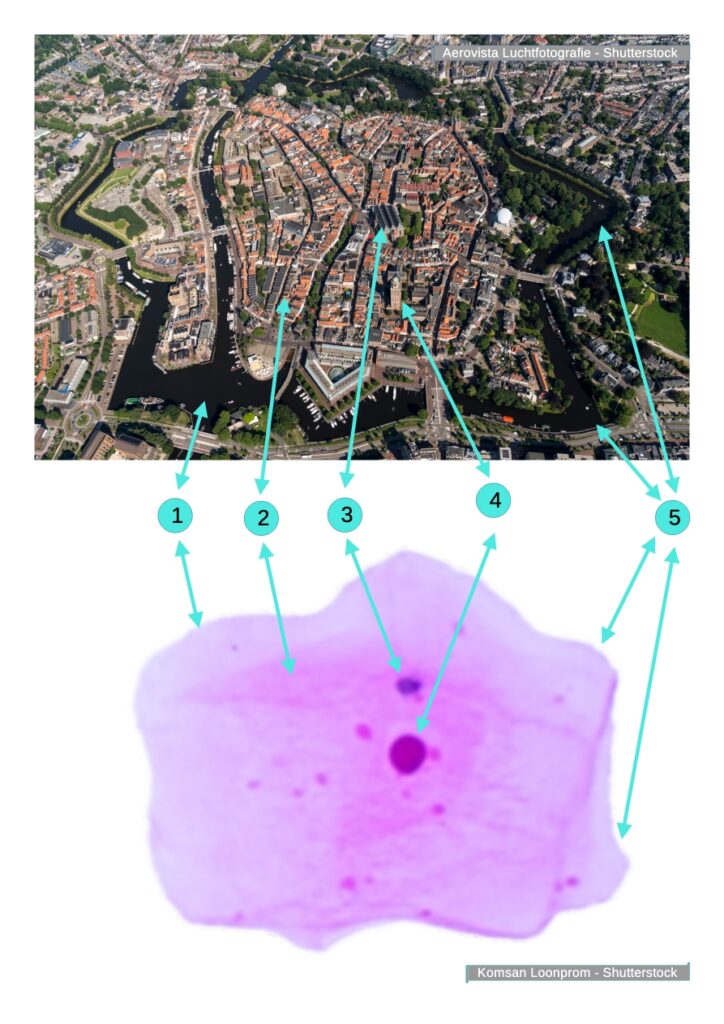
- „The Squamous Epithelial Skin Cell: A Star in the Microcosm” Now, let’s zoom into the microcosm, into the depths of our bodies. Squamous epithelial skin cells, though invisible to the naked eye, have an extraordinary structure. Some of them, particularly those with a star-like shape, resemble tiny stars. Their extensions, like rays, spread outward, forming a network of connections that provide cohesion and flexibility to the tissue. These cells play a crucial role in protecting our body from external factors.
- 1. „Streets and Canals” – „The Cytoskeleton and Cell Membrane” The „canals” surrounding the city resemble the „cell membrane”, which controls what enters and exits the cell, protecting its interior from the chaos of the external world. Meanwhile, the winding streets of Zwolle, weaving between buildings, can be compared to the „cytoskeleton” – a network of protein fibers that gives the cell its shape and enables intracellular transport.
- 2. „Cytoplasm as the City’s Interior” The cytoplasm is the life-filled interior of a cell, where key metabolic processes take place. Similarly, the interior of Zwolle pulses with life – it’s a space where residents move, work, and meet. Streets, squares, and canals form a network that, like the cytoplasm, connects all elements of the city into a cohesive whole. This is where energy and dynamism are concentrated, driving the functioning of the entire organism – whether it’s a city or a cell.
- 3. „Basilica of the assumption of the Blessed Virgin Mary in Zwolle as the Nucleus and Endoplasmic Reticulum” , is the heart of Zwolle. Is described in third section.
- 4. „The St. Michael’s Church as the Golgi Apparatus” Opposite Basilica of the assumption of the Blessed Virgin Mary stands the St. Michael’s Churchy, is described in next section.
- 5. „The Star-Shaped Periphery as Epithelial Cell Extensions” When viewed from above, Zwolle has a distinctive star-shaped layout, particularly visible in its outskirts. Streets radiate outward, creating a network of connections that resemble the „extensions of star-shaped epithelial cells”. These extensions play a key role in the cell – they increase the surface area for contact with neighboring cells, ensuring tissue cohesion and flexibility. Similarly, the streets on the outskirts of Zwolle connect the city to its surrounding areas, forming a communication network that keeps the city alive.
Is it a coincidence that both the macro and micro worlds exhibit similar patterns? Perhaps it’s evidence of a „Cellular God” – a universal designer who, at every scale, ensures harmony and functionality. Whether in the star-shaped layout of a city or the structure of a cell, we see the same attention to detail, the same logic, and the same beauty. I encourage you to look at the world around you with curiosity. You might discover similar analogies that remind you of how incredibly complex yet orderly our world is.
2. „Organelle Collaboration – A Harmonious City-Cell”
,Photo description: The Peperbus or Onze Lieve Vrouwetoren with Onze Lieve Vrouwebasiliek is a medieval cruciform church on the Ossenmarkt in Zwolle subordinate to St. Michael’s Church. Zwolle skyline urban city center.
,Illustration description: Internal structure of an animal cell, 3d rendering. Section view. Computer digital drawing.
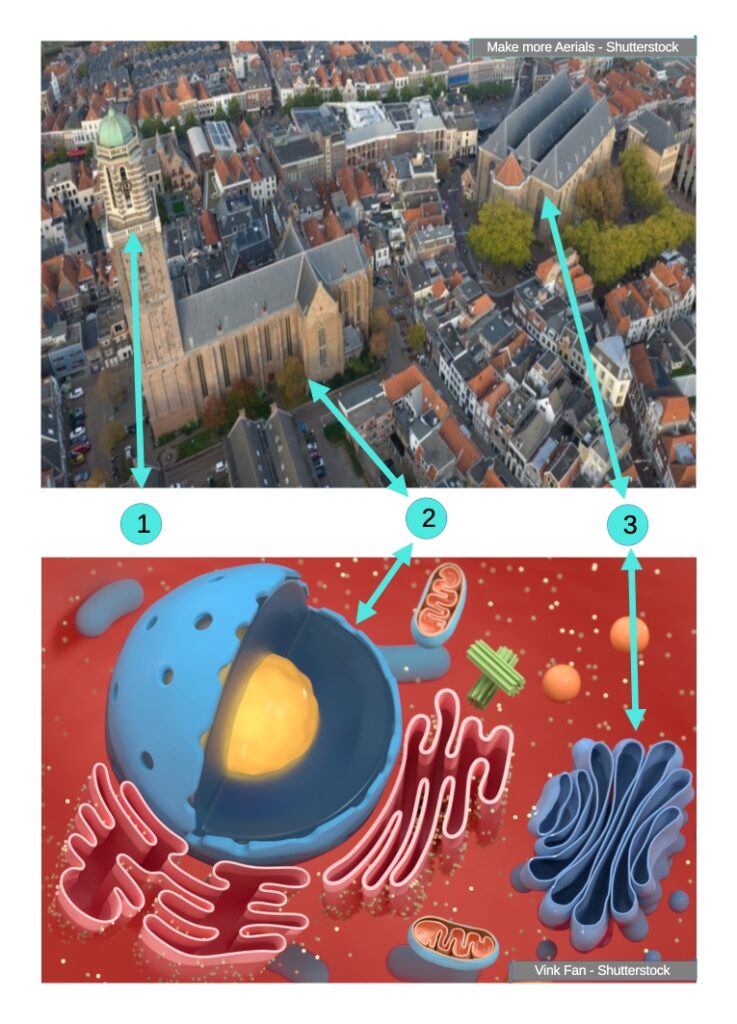
- 1. The „Basilica tower – Peperbus” represents the „dorsal ruffle” – structures involved in transport and communication.
- 2. „Basilica of the assumption of the Blessed Virgin Mary in Zwolle” – Is described in third section.
- 3. „St. Michael’s Church – The Golgi Apparatus” Opposite Basilica of the assumption of the Blessed Virgin Mary stands the „St. Michael’s Church”. This majestic building perfectly fits the role of the „Golgi apparatus” in our cellular analogy. The Golgi apparatus is the sorting, modifying, and distribution center for proteins and lipids. Similarly, St. Michael’s Church, as a spiritual and cultural institution, is where ideas and values are „processed” and disseminated, shaping the future of the city. Visually, the tower and parallel roofs of the Academy resemble the stacks of cisternae in the Golgi apparatus – layered structures that act as the cell’s logistics hub. The collaboration between Basilica of the assumption of the Blessed Virgin Mary (the nucleus and ER) and the St. Michael’s Church (the Golgi apparatus) mirrors the close cooperation of organelles in the cell: proteins produced in the endoplasmic reticulum are sent to the Golgi apparatus, where they are modified and prepared for transport to other parts of the cell or outside.
„Organelle Collaboration – A Harmonious City-Cell” In a cell, as in a city, each structure has its role, but it is their collaboration that creates a functioning organism. The „nucleus” (Basilica of the assumption of the Blessed Virgin Mary) manages processes, the „endoplasmic reticulum” (the main nave, pews, and organ) produces and processes, the „Golgi apparatus” (St. Michael’s Church) sorts and distributes, and the „cytoskeleton”(streets) provide structure and transport. In a squamous epithelial cell, this harmonious collaboration is crucial for maintaining the integrity of the skin and its protective functions. Similarly, in Zwolle – the interaction of historic buildings, streets, and canals creates a city that is not only beautiful but also functional.
3. „Basilica of the assumption of the Blessed Virgin Mary – The Nucleus, Nucleolus and Endoplasmic Reticulum”
Basilica of the assumption of the Blessed Virgin Mary in Zwolle, the Netherlands, where sacred architecture becomes a living metaphor for a cell, and every element of the interior corresponds to the functions of cellular organelles. We’ll explore how the presbytery, the altar, the nave, the pews, the faithful, the organ can reflect the nucleus, the nucleolus, the rough and smooth endoplasmic. But this is not just about one Basilica – Ready? Let’s dive in!
,Photo description: Zwolle, Overijsel/The Netherlands – Oct.23 2014: Interior of the Basilica of Our Lady of the Assumption called the Peperbus in the city of Zwolle.
,Vector description: Nucleus and Endoplasmic reticulum structure. Infographics. Vector illustration on isolated background.
,Photo description: Zwolle, Overijsel/the Netherlands – Oct. 4, 2018: The 18th century Schnitger Organ in the interior of the 13th century romanesque St. Michael’s Church in the historic hanseatic city of Zwolle.
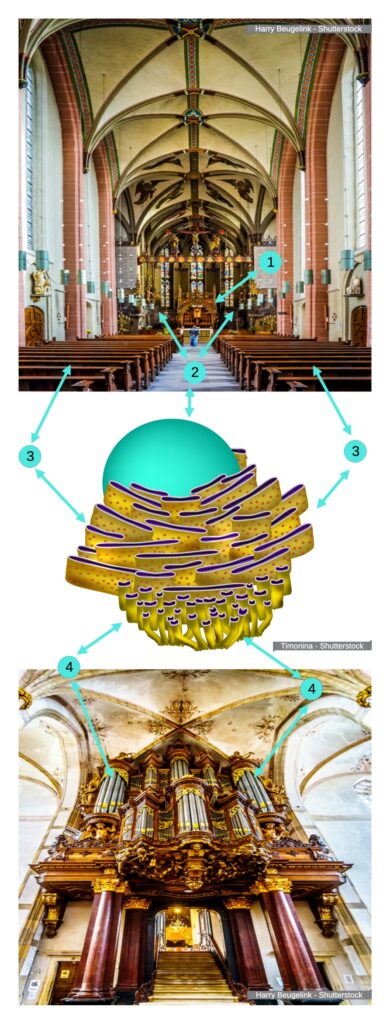
- 1. „The Nucleolus – The Altar” Within the nucleus lies the „nucleolus”, responsible for producing ribosomes – the protein factories. In the church, the altar is the central point of the presbytery, the place where the Eucharistic sacrifice is offered. – „Function in the liturgy”: The altar, like the nucleolus, is the source of spiritual life. Here, the bread and wine(protein and blood) are transformed into the Body and Blood of Christ, which nourish the soul, just as proteins and blood are essential for cellular life.
- 2. „The Nucleus – The Presbytery” In a cell, the nucleus is the control center, the place where DNA is stored and where the most important decisions about the cell’s functioning are made. In Basilica of the assumption of the Blessed Virgin Mary in Zwolle, the role of the nucleus is played by the „presbytery” – the space around the altar where the priest celebrates the liturgy. This is where all eyes of the faithful are directed, and where the most important liturgical act – the Eucharist – takes place. – „Function in the liturgy”: The presbytery, like the nucleus, is the heart of the church. Here, the priest, like the “genetic code,” proclaims the Word of God and administers the sacraments, guiding the entire community.
- 3. „Rough Endoplasmic Reticulum and Ribosomes – The Nave, Pews, and the Faithful” The rough endoplasmic reticulum is a structure covered with ribosomes, which synthesize proteins – the building blocks of life. In Basilica of the assumption of the Blessed Virgin Mary, the „nave, pews, and the faithful” fulfill a similar role. – „Function in the liturgy”: The faithful, like ribosomes, are active participants in the liturgy. Their prayers, hymns, and responses create “spiritual proteins” that build up the community. The nave and pews are the space where this “synthesis” takes place – where faith becomes alive and visible.
- 4. „Smooth Endoplasmic Reticulum – The Organs” The smooth endoplasmic reticulum is responsible for lipid synthesis and detoxification in the cell. In the church, this role is played by the „organ”, which enriches the liturgy with music. – „Function in the liturgy”: The organ, like the smooth endoplasmic reticulum, “purifies” and enhances the atmosphere of the liturgy. Its sounds lift the prayers of the faithful toward heaven, creating harmony and beauty that aid in contemplation and focus. The organ in the photo is in the church of St. Michael. I have no way of publishing the original organ from the Basilica, so I replaced it with something as similar as possible. You can see the original in this link. https://fr.dreamstime.com/église-d-organe-basilique-notre-madame-ciel-zwolle-les-pays-bas-image137682498
Basilica of the assumption of the Blessed Virgin Mary in Zwolle is not just a building – it is a living organism where every element has its place and function. The presbytery, the altar, the nave, the pews, the faithful, the organ, all work together, creating a harmonious whole, much like the organelles in a cell. The liturgy is the process that unites these elements into one, just as metabolism unites cellular functions.
,The Sacred Blueprint: Temples as Reflections of Cellular Order. What makes this analogy even more profound is the realization that Basilica of the assumption of the Blessed Virgin Mary in Zwolle is not an exception. All sacred temples around the world, built by our ancestors, follow a similar blueprint. They were designed to reflect the order and harmony of cellular structures, as if our forebears knew that the key to understanding the divine lies in the intricate design of life itself. These temples were meant to guide us, to remind us of our place in the earth, and to ensure that we never lose our way in the chaos of existence.
,Combining images and adding a description details made by Tomasz Mikulski – Cell God, date: 03/2025

One thought on “Netherlands, aerial view of the dutch historic fortified city Zwolle, in the province of Overijssel. ”