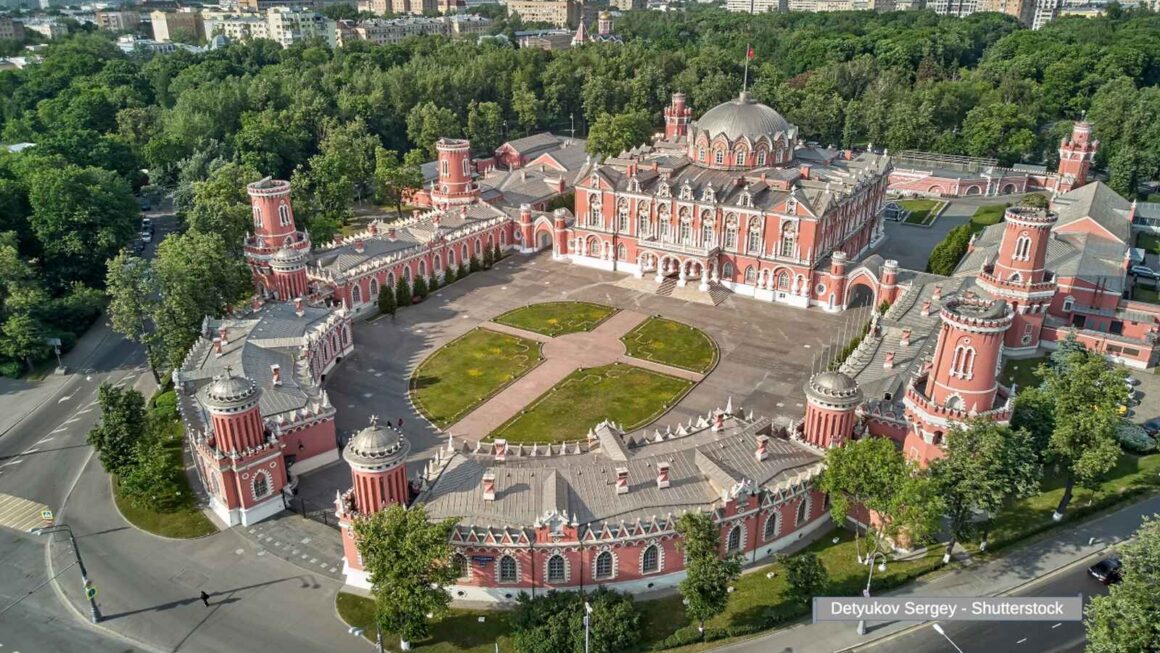
1. The Petrovsky Palace vs Parietal cell of stomach wall.
Sometimes the most beautiful analogies are hidden where we least look for them. Today I invite you to a journey where the history of architecture meets biology. Let’s compare the Petrovsky Palace in Moscow with the lining cell of the stomach wall. Sounds exotic? Let’s see how these two worlds-monumental and microscopic-merge in an amazing way.
,Photo description: Petrovsky Palace on Leningradskii avenue in sping. Aerial drone view. Moscow, Russia.
,Illustration description: Parietal cell of stomach wall, beautiful colorful drawing on a white background.
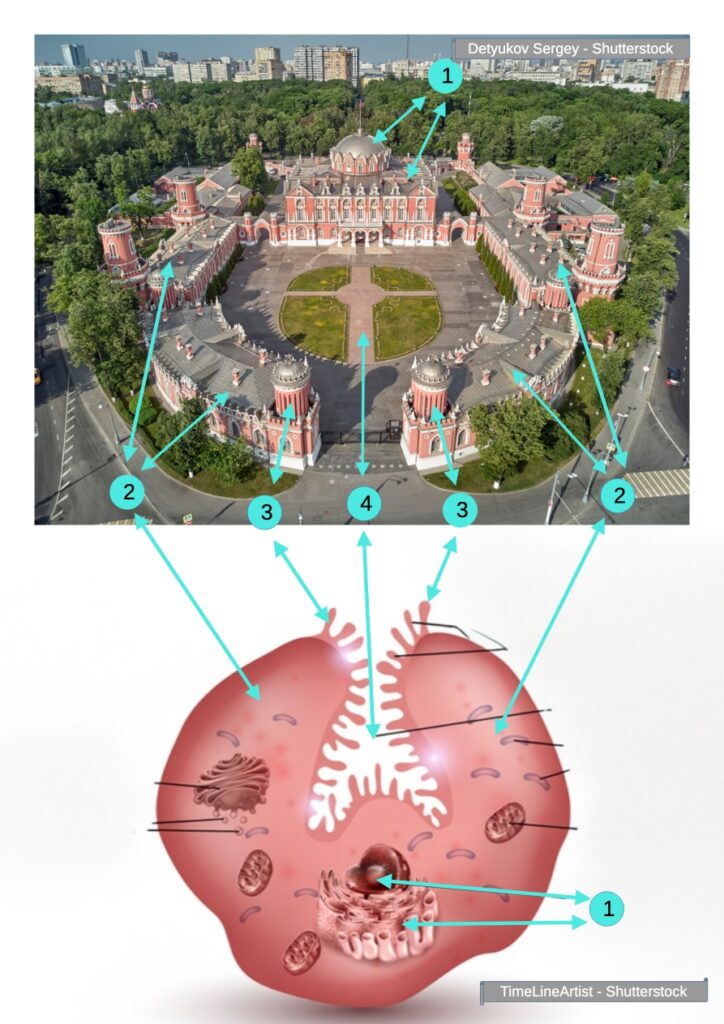
- 1.Central part: Dome of the Palace and its periphery structure as nucleus and endoplasmic reticulum: the central part of the palace is topped by an impressive dome that dominates the entire structure. It is the heart of the building, symbolizing strength and stability. Around it stretch wings, full of complex corridors and rooms that resemble a network of connections.
Parietal cell: in the center of the cell is the nucleus – the „dome” that manages all cellular processes. Around it stretches the endoplasmic reticulum – both rough (with ribosomes) and smooth. This network of channels is a „corridor” transporting proteins and lipids, necessary for the functioning of the cell. Analogy: The dome of the palace is like the nucleus of a cell-the command center. The endoplasmic reticulum is the construction of the periphery of the palace Dome, which provide communication and transportation. - 2. Front walls with entrance vs. canaliculi: the front of the palace is decorated with rounded walls with a representative entrance, decorated with columns and sculptures. It is a place where guests are welcomed and at the same time an Access Control Point.
- Parietal cell: on the front of the cell are „canaliculi” – structures resembling miniature tunnels. It is through them that the cell releases hydrochloric acid (HCl) into the stomach. Their rounded shape maximizes the excretory surface.
- Analogy: the rounded walls of a palace with an entrance are like the channels of a cell – both structures combine elegance with functionality. The entrance to the palace controls the flow of people, and the ducts – the flow of chemicals.
- 3. Turrets: architectural details and microcovilli: the turrets of the Palace are not only decorative elements, but also strategic observation points. They give the building character and serve as a place of control. Parietal cell: the microvilli on the surface of the cell resemble these turrets – they are protrusions that increase the surface area of the cell, but also perform sensory and transport functions. Analogy: the turrets of the Palace are like microvilli of a cell – both decorative and functional. They are guards who care about safety and efficiency.
- 4. Front Square: the space in front of the Palace and the cell canals: in front of the palace stretches a spacious square that serves as a place of meetings, ceremonies and protection. This is the space that connects the palace with its surroundings. Parietal cell: inside the cell are „ducts” that form a network of transport channels. This is the space where the exchange of substances takes place and where hydrochloric acid (HCl) is produced. Analogy: The Square in front of the palace is like the space of the tubules of a cell – a place where Exchange and interaction take place. The Square is functional and full of life, as are the tubules, which are key to the functioning of the cell.
Function Of The Parietal Cell: The Guardian Of The Stomach. The parietal cell is the true hero of our digestive system. Its main function is the production of hydrochloric acid (HCl), which helps in digestion, and the internal factor necessary for the absorption of vitamin B12. Thanks to them, our stomach can work like a working machine, breaking down food and protecting the body from harmful microorganisms.
Reflection: Why Is This Analogy So Beautiful? The Petrovsky Palace and the Parietal Cell are two worlds that are united by a common goal: protection and functionality. One protects the rulers, the other our body. Both are engineering masterpieces that combine beauty with practicality.
Conclusion: the next time you eat a meal, think of the Petrovsky Palace. Your parietal cells work just like a tsarist architect – with precision, elegance and dedication. After all, isn’t our body the greatest Palace?
2. Dome of life, Interior Architecture of the Petrovsky Palace and the cell nucleus.
Nucleus Function: Cell Command Center. The cell nucleus is the true command center. It stores DNA, which contains instructions for all cellular processes, controls gene expression and coordinates the action of the entire cell. Without the nucleus, the cell could not function – just as a palace without a dome would lose its identity.
,Photo description: Interior of the Petrovsky Palace.
,Vector description: Structure of the nucleus-Nucleus is an organelle in eukaryotic cells.
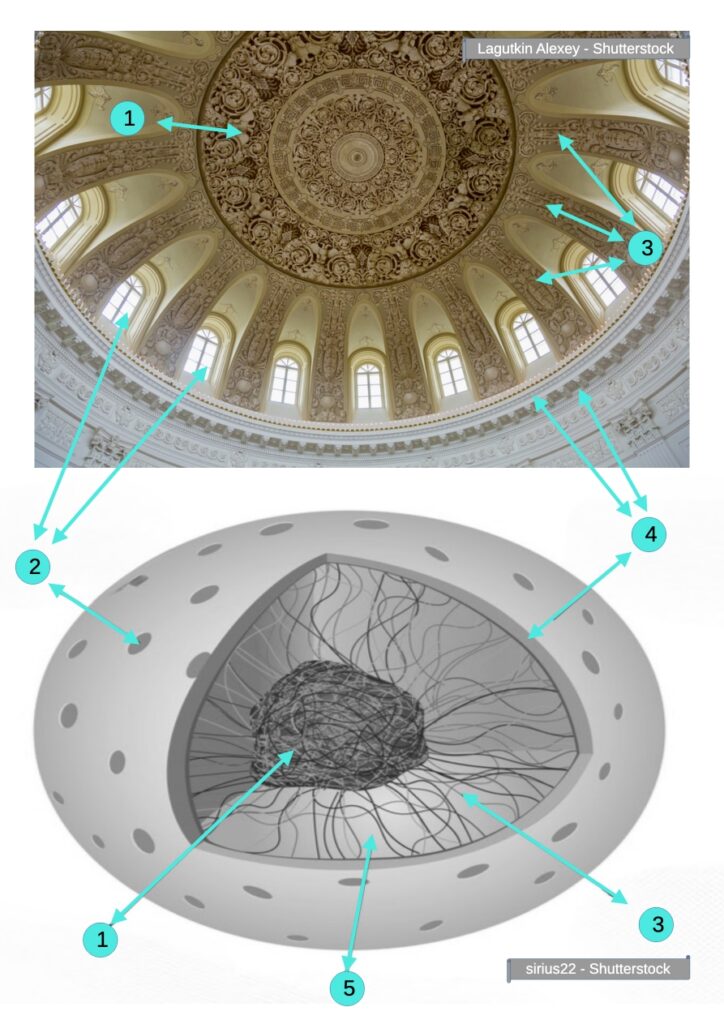
- 1. Nucleolus as the Central decoration of the Dome in the Petrovsky Palace: inside the dome of the palace there is an impressive central decoration-often gilded or painted, which attracts the eye and forms the heart of the entire structure. This is the point around which all attention is focused.
Cell nucleus: in the center of the cell nucleus is a nucleolus – a small but extremely important structure, responsible for the production of ribosomes. This is the” heart ” of the nucleus, without which the cell could not function.
Analogy: the Central decoration of the dome is like a nucleolus – both are the central point that gives meaning and function to the entire structure. - 2. Windows in the Dome as pore complexes: The Dome of the palace is decorated with numerous windows that let in light and air, connecting the interior with the surroundings. These are places where there is an exchange between the outside and the inside world.
Cell nucleus: in the nuclear membrane there are pore complexes – channels that allow the transport of molecules between the nucleus and the cytoplasm. These are „windows” that allow communication and Exchange. Analogy: windows in a dome are like pore complexes – both structures act as” connectors ” between the two worlds. - 3. The structure of the Dome between the windows as chromatin and lamina: the space between the windows of the dome is filled with intricate decorations – paintings, sculptures or mosaics. These are the elements that give the dome consistency and durability. Cell nucleus: the space between the pore complexes is filled with chromatin (condensed DNA) and nuclear lamina – a network of proteins that stabilize the structure of the nucleus. Analogy: the decorations between the windows of the dome are like chromatin and lamina – both ensure the consistency and stability of the entire structure.
- 4. Dome ring at the base as a nuclear membrane structure: at the base of the dome is a massive ring that supports the entire structure. This is the element that connects the dome with the rest of the structure and ensures its stability. Cell nucleus: the nuclear membrane, made up of two layers, surrounds the nucleus and separates it from the cytoplasm. It is the” ring ” that gives the nucleus its shape and protects its contents. Analogy: the ring at the base of the dome is like a nuclear membrane – both structures perform a protective function and give shape to the entire structure.
- 5. Interior decoration as a Nucleoplasm: the interior of the dome is filled with decorations-paintings, gilding and sculptures that form a harmonious whole. It is a space that is full of life and beauty. Cell nucleus: the interior of the nucleus is filled with nucleoplasm – a dense fluid in which chromatin, the nucleus and other structures are suspended. It is the” inside ” that is teeming with molecular life. Analogy: the interior decoration of the dome is like a nucleoplasm – both fill the space, giving it life and functionality.
Reflection: Why Is This Analogy So Profound?The Dome of the Petrovsky Palace and the cell nucleus are two worlds that are united by a common goal: „integration and protection.” One protects the cultural heritage, the other the genetic heritage. Both are engineering masterpieces that combine beauty with practicality.
The next time you look at the dome of the palace, think of your cell nucleus. It is these microscopic „domes” in our cells that allow us to exist, develop and enjoy life. Isn’t biology the most beautiful form of architecture? Inspiration: Moscow and the cell-two worlds, one story about the harmony of form and function. Do you like that analogy? Leave a comment and share your thoughts! 🌟
,Combining images and adding a description details made by Tomasz Mikulski – Cell God, date: 02/2025