The Army as an Immune System. The Empire’s Insignia as Biological Code.
,Russia bears many signs. We read two of them here. An Order. An Eagle. Each has a molecular twin in the body. Armies encoded biology. Not metaphorically. Geometrically.
,First Seal — The Double-Headed Eagle = Langerin
3 / 3
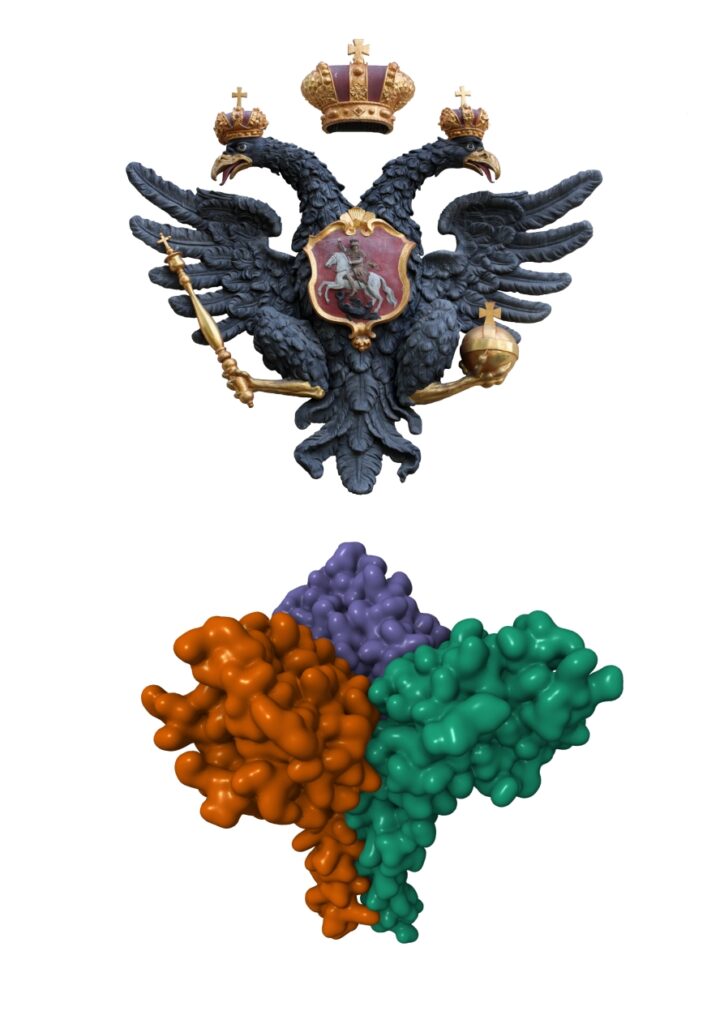
,The Empire’s crest has three crowns. Langerin has three subunits.
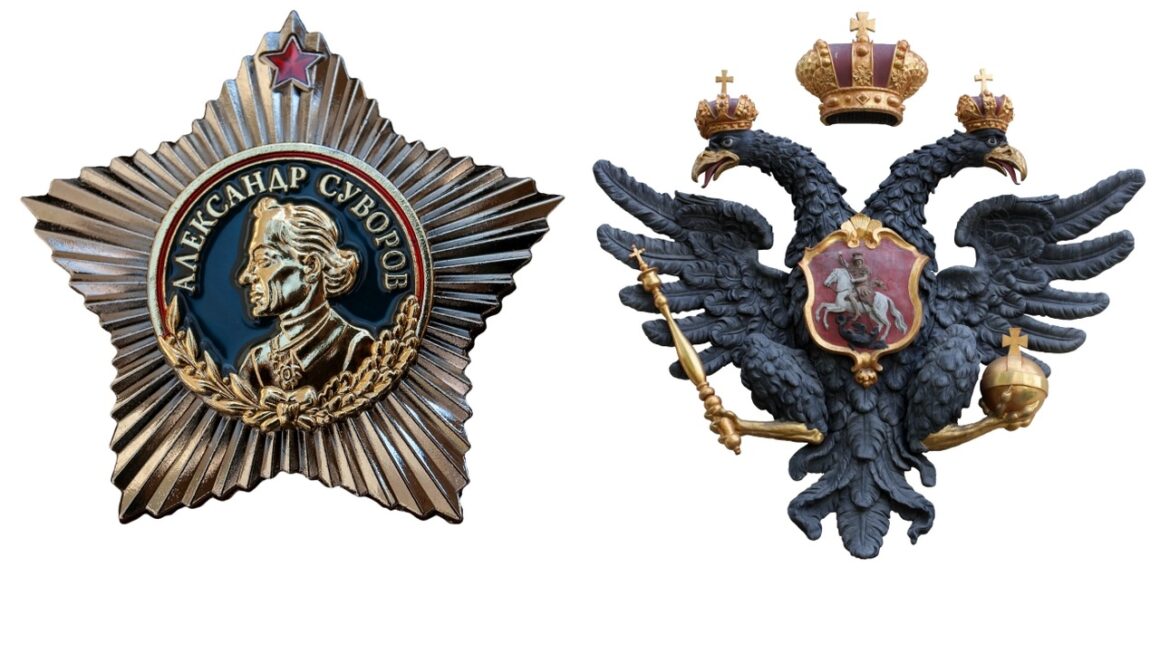
,Photo description: Romanov Imperial coat of arms, Eagle with two heads on a white background. revers – Shutterstock.
,Illustration description: Structure of human langerin. 3D cartoon and Gaussian surface models. PDB 3kqg, white background. VD Image Lab – Shutterstock.
Langerin (CD207) is a C-type lectin. A protein that recognizes sugars. Every pathogen carries sugars on its surface — virus, bacterium, fungus. Langerin reads them like a code.
It sits on Langerhans cells — the guardians of skin and mucous membranes. Langerhans cells are sentinels at the body’s border.
One view of the trimer shows two domains extending to the sides and a third positioned centrally — a geometry that mirrors the eagle’s two heads with the crown between them. The trimer’s main axis, however, is three-fold, like the three crowns of the coat of arms. The symbolic language and the structural language look at the same molecule from two sides.
In the central shield — St. George piercing the dragon. This is not an allegory of moral victory. This is an image of phagocytosis.
St. George is the Langerhans cell. The horse is its motility — the sentinel does not stand still, it runs. The spear is the membrane tendril piercing the pathogen. The dragon is the infection that, without this blow, would have entered deeper.
The Langerhans cell drives a membrane projection into the pathogen, surrounds it, swallows it. Langerin recognizes viruses (HIV, dengue, influenza), bacteria, fungi. The battlefield — the mucosal barrier.
Scepter and imperial orb in the eagle’s talons? It could be: two functional domains of a protein – a sugar-recognizing domain (mannose) and a domain presenting antigen to T lymphocytes. Power over recognition. Power over presentation.
Three crowns are mandatory. Because the protein is a trimer.
The coat of arms was not an emblem. It was a diagram of a receptor.
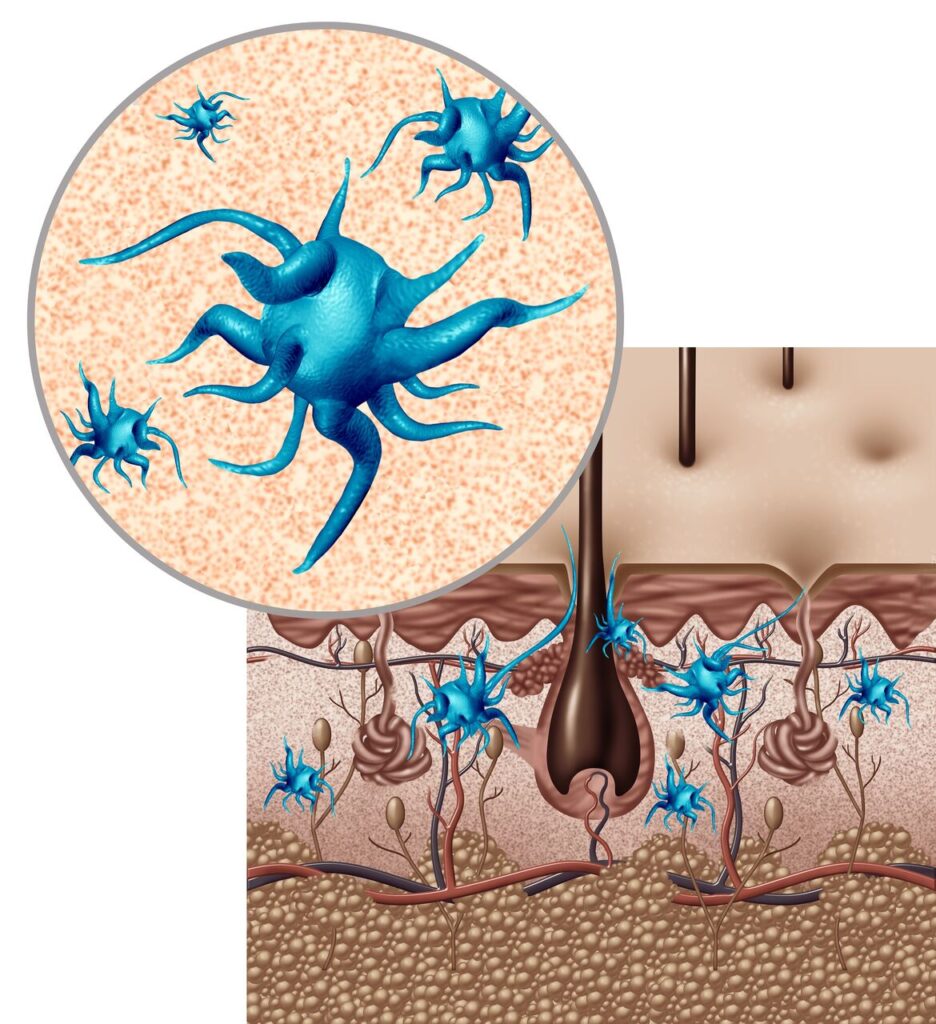
Illustration description — Skin immunity sentinel cells anatomy diagram concept showing a cross section of human skin with hair follicle with Langerhans cells dendritic cells as immune surveillance within skin tissue. Lightspring – Shutterstock.
In Your Divine Body
Look at the illustration. What you see is happening in you right now — under every square centimeter of your skin.
Every square centimeter of your skin contains about 700 Langerhans cells. Literally a border guardhouse. Every pathogen that tries to cross the epidermal barrier meets Langerin.
Their shape is not accidental. Those long, branching tendrils visible in the magnification are the reason they are called dendritic — from the Greek dendron, tree. Each cell is a sentinel tree whose branches reach between the other cells of the skin, searching for the foreign. The sentinel does not stand still. Tendril by tendril it reaches into the depths of the tissue.
This shape — a tree-like cell with many tendrils reaching into the depths of the tissue — appears in the brain too, as microglia. I read the same architecture earlier in the fort of Nossa Senhora da Graça in Elvas.
When you get a tattoo — pigment lands in the dermis, and Langerhans cells come running immediately. They try to engulf the ink particles like any other intruder. Some they engulf and carry to the lymph nodes. Other particles are too large — the Langerhans cells stay with them for a lifetime, holding them trapped deep in the skin. That is why a tattoo is permanent — it is not the pigment that holds the design, it is your border sentinels holding the pigment.
Langerin binds HIV. Langerhans cells in the mucous membrane, when healthy, block the virus before it reaches the T lymphocytes. It is the first line of defense against infection. St. George pierces the dragon in mucous membranes millions of times a day.
When you touch nickel jewelry and a rash appears — that was Langerin recognizing nickel as a foreign antigen. Contact dermatitis is the Empire’s coat of arms showing its teeth.
UV radiation destroys Langerhans cells. That is why after long sun exposure your skin loses its border guard — herpes viruses awaken, warts multiply, fungal infections take hold. A border without sentinels is not a border.
Second Seal — The Order of Suvorov = CRP
5 / 5
The Order of Suvorov is a five-pointed star. CRP — C-reactive protein — is a five-subunit pentamer.
Five arms. Five subunits. C5 symmetry.
Photo description: Order of Suvorov – Model of the Order of the USSR, isolated on a white surface. May 9 Victory Day. Translation of Russian inscriptions: Alexander Suvorov. Vladimir Ya – Shutterstock.
Illustration description: C-reactive protein (CRP, human) inflammation biomarker, chemical structure. Infections and inflammation cause increased blood levels of this protein. Cartoon + wireframe + semi-transparent surface. StudioMolekuul – Shutterstock.„
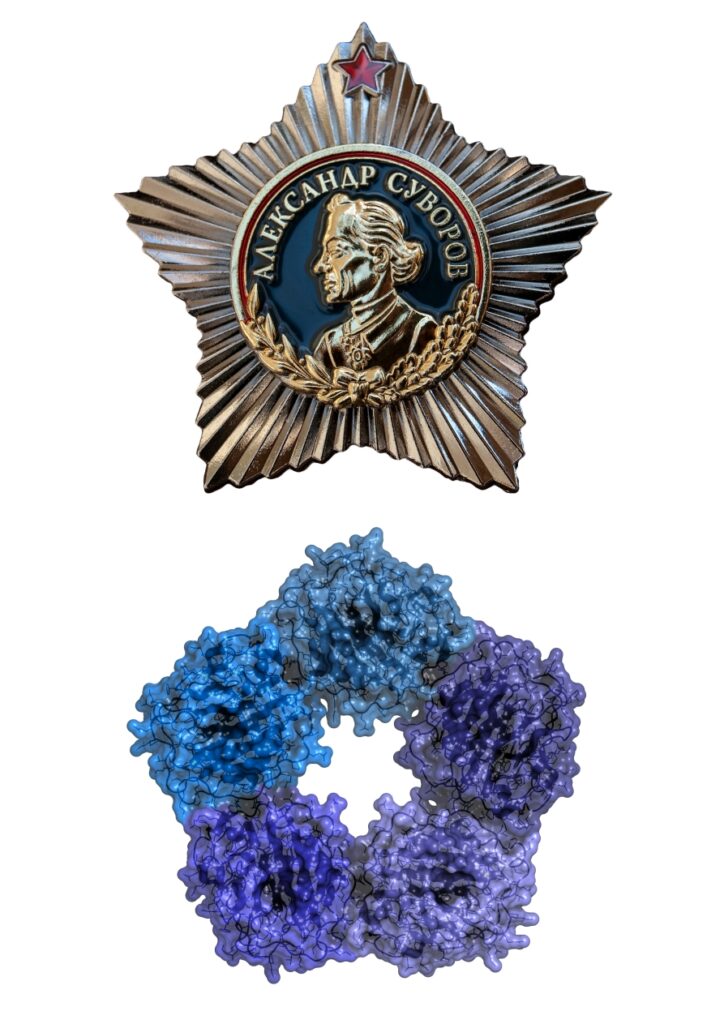
Alexander Suvorov never lost a battle. Sixty-three engagements. Sixty-three victories. A first-line commander — the one who stops the enemy before the enemy reaches the capital.
CRP does the same in the body. It is the first line of the acute phase response. It appears in serum within hours of injury or infection. It binds phosphocholine on the surface of the pathogen. It activates complement. It marks the target for macrophages.
CRP is the general of early defense. The Order of Suvorov is its insignia.
Red star above the portrait? It could be: C-reactive protein – the red signal of activation. Laurel wreath around the bust? It could be: a ring of calcium ions, without which CRP cannot bind to its target. Every element of the decoration has its molecular counterpart.
An order awarded to commanders for victories achieved with smaller forces against larger ones. An exact description of how CRP works — a few protein molecules trigger a cascade of reactions many times larger than themselves.
The Order was not a decoration. It was a diagram of a protein.
Illustration description: Liver anatomy set. Hepatic system organ lobule and hepatocyte structure. Arterial and venous supply and gallbladder. Flat vector illustration. inspiring.team – Shutterstock.
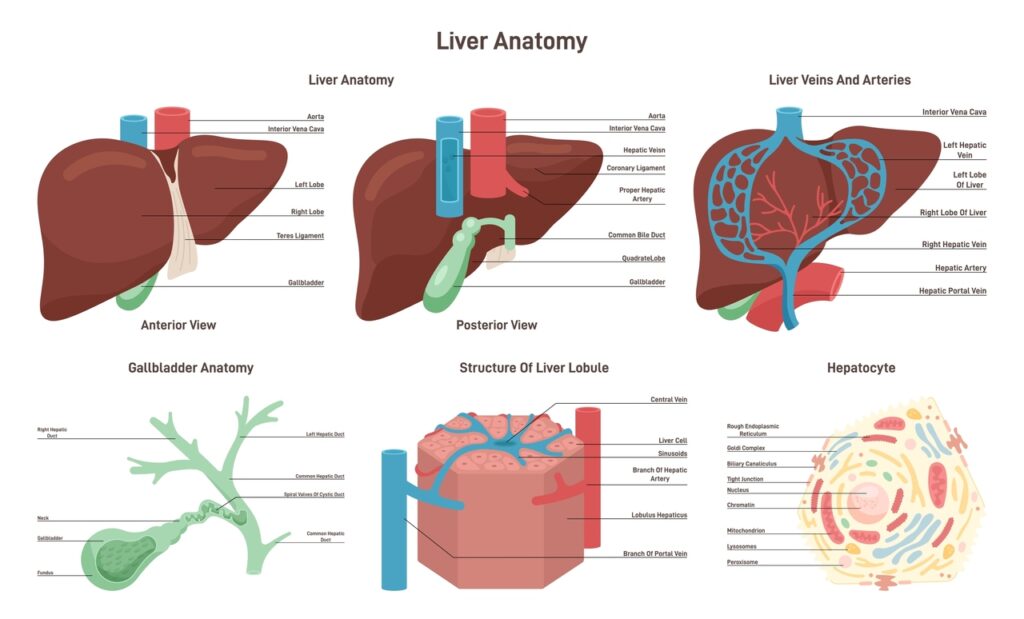
CRP is born in the liver. Hepatocytes — the cells of the liver — forge it on the signal that battle is raging somewhere. Each such cell is a small factory, and inside it is a place called the rough endoplasmic reticulum. There ribosomes sit in dense rows and assemble plasma proteins, one after another. That is the place where you sit in the pews of a church.
In Your Divine Body
When you catch the flu — CRP rises. From 1 mg/L to fifty, a hundred, sometimes two hundred. Within six hours of the first symptom. The doctor draws blood, sees the number, knows something is unfolding in the body. That is Suvorov receiving a report from the front.
When you break a leg — CRP rises. Surgery, implant, healing — CRP accompanies every phase. It drops when healing ends. Doctors watch CRP after a procedure the way a general watches a report from the battlefield. A drop = the front is stabilizing.
In a heart attack CRP rises. In rheumatoid arthritis CRP rises. In sepsis CRP explodes — from 1 to 300 mg/L within a day. Suvorov lost no battle. CRP misses no threat.
Every blood test in which you see „CRP” — that number tells you how many generals of early defense your Genome has just sent to the front.
Two Lines, One Body
Two signs. Two proteins. Both defensive.
Langerin – pathogen recognition at the boundary. The guard at the gate.
CRP – acute phase response in the depths. The reaction once the enemy is already inside.These are not random proteins. They are two lines of the same defense. Langerin stands at the boundary and recognizes the foreign before it can enter. CRP waits inside and strikes once the barrier has been breached. Detection at the gate and response behind it. No army defends itself with a single line. Neither does any organism.
These are also two phases of every defense: recognition, reaction. First the guard at the boundary. Then the force in the depths. Every army in the world operates on this scheme. Every immune system in the world operates on this scheme. Because it is the same scheme.
Russia – a nation with the longest borders in the world, historically organized around defense. Its military insignia are not decoration. They are a functional map of its own immunology.
Every empire must solve the same problem as every organism: how to recognize the foreign at the border, how to strike once the border has been crossed. The Genome solved it with proteins. Empires solved it with armies. The solutions are identical because the problem is identical.
Armies encoded biology. Or biology organized armies. From the perspective of the genome as intelligence – it is the same operation, performed on two scales.
The Genome builds an organism and defends it. The Empire builds a state and defends it. The same structures encode the same functions at both levels.
Geometry never lies.
These two proteins are acting in You right now.
As you read this sentence, Langerin stands on your skin. Hundreds of guards on every square centimeter, facing the world, ready to recognize what is foreign before it can creep in.
At that same moment, CRP circulates in your blood. Quiet, low, watchful. Waiting for the signal that the barrier has been breached. When it falls – it will rise within hours.
The guard at the border. The response in the depths. Two lines of defense – the same ones the Empire cast in bronze and gold.
Other Insignia
Each of these signs has a shape. Each exists to mark defense, sacrifice, a border.
I have shown you two. Geometrically, they correspond to the two defense proteins. The rest are waiting.
Only one country. Only one chest. And hundreds of signs.
How many of them did the Genome leave for us to read?
Photo illustration:Moscow, Russia. Meeting of veterans on Theater Square. Victory Day, May 9. Andrey Pozharskiy – Shutterstock.
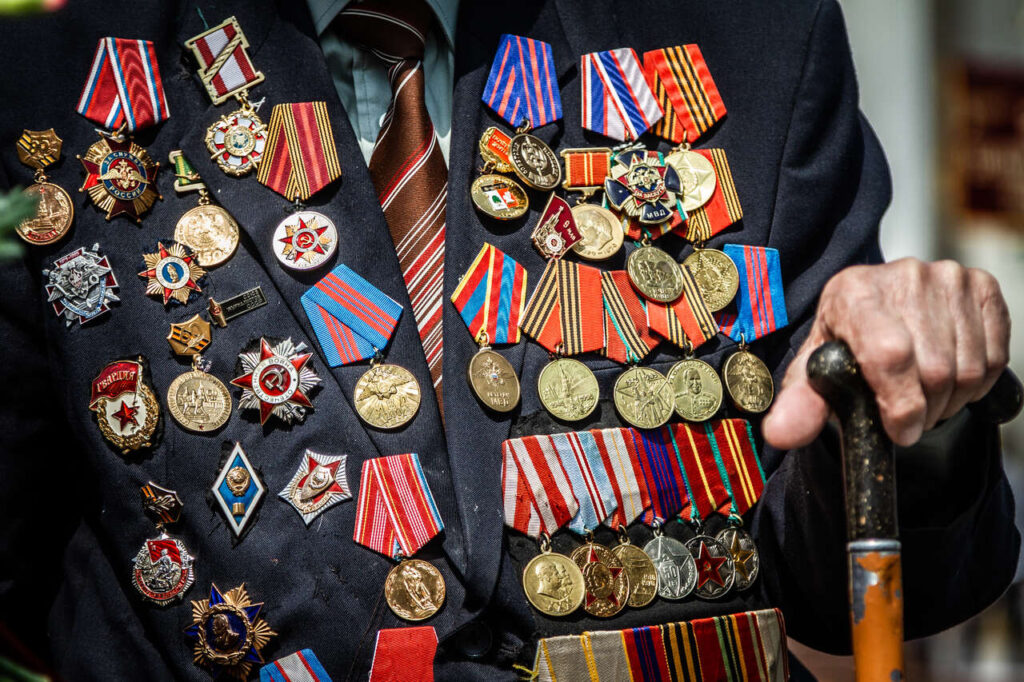
Image search and matching, analysis and elaboration: Tomasz Mikulski – Cell God: 05/2026
- Scientific references
First Seal — CRP (C-reactive protein)
Tillett, W.S., & Francis, T. (1930). „Serological reactions in pneumonia with a non-protein somatic fraction of pneumococcus.” Journal of Experimental Medicine, 52(4): 561–571. The original discovery of CRP. The zero point of acute-phase immunology. Journal of Experimental Medicine →
Wu, Y., Potempa, L.A., et al. (2024). „C-reactive protein: structure, function, regulation, and role in clinical diseases.” Frontiers in Immunology, 15: 1425168. The most recent comprehensive review of pentamer structure, phosphocholine binding with Ca²⁺, and clinical roles. Primary source for this section. Frontiers in Immunology →
Olson, M.E., Hornick, M.G., et al. (2023). „A biofunctional review of C-reactive protein (CRP): differentiating pentameric and modified CRP isoform effects.” Frontiers in Immunology, 14: 1264383. Explains the pCRP → mCRP shift at the site of inflammation. Source for the „red star = active state” claim. Frontiers in Immunology →
Sproston, N.R., & Ashworth, J.J. (2018). „Role of C-Reactive Protein at Sites of Inflammation and Infection.” Frontiers in Immunology, 9: 754. CRP kinetics in response to different types of damage — source for the „In Your Divine Body” section. Frontiers in Immunology →
Schmidt-Arras, D., & Rose-John, S. (2016). „IL-6 pathway in the liver: From physiopathology to therapy.” Journal of Hepatology, 64(6): 1403–1415. The liver as the organ producing CRP. Hepatocytes synthesize acute-phase proteins (CRP, SAA, haptoglobin, fibrinogen) on the signal of interleukin-6 from the site of inflammation. Source for the „CRP is born in the liver” claim. Journal of Hepatology → - PDB 1B09 — human CRP with bound calcium and phosphocholine. Three-dimensional structure of the pentamer with the visible ring of five calcium-binding sites. RCSB Protein Data Bank →
Second Seal — Langerin (CD207)
Feinberg, H., et al. (2010). „Trimeric Structure of Langerin.” Journal of Biological Chemistry, 285(17): 13285–13293. Foundational paper on the trimer. Shows that C3 symmetry is functionally necessary for recognizing pathogen sugars — not decorative. Journal of Biological Chemistry →
PDB 3KQG — human Langerin trimer. Exactly the structure shown in the section’s infographic. RCSB Protein Data Bank →
de Witte, L., et al. (2007). „Langerin is a natural barrier to HIV-1 transmission by Langerhans cells.” Nature Medicine,13: 367–371. Langerin blocks HIV transmission — the biological basis for the „St. George pierces the dragon” narrative. Nature Medicine →
Seité, S., et al. (2015). „UV Radiation Induces the Epidermal Recruitment of Dendritic Cells that Compensate for the Depletion of Langerhans Cells in Human Skin.” Journal of Investigative Dermatology, 135(7): 1846–1854. Langerhans cell depletion after UV lasts up to 4 weeks — source for the „UV destroys the border sentinels” claim. Journal of Investigative Dermatology →
Baranska, A., et al. (2018). „Unveiling skin macrophage dynamics explains both tattoo persistence and strenuous removal.” Journal of Experimental Medicine, 215(4): 1115–1133. Source for the tattoo-persistence claim. Journal of Experimental Medicine →
⚠ Note: Baranska et al. show that pigment is held mainly by dermal macrophages, not epidermal Langerhans cells. In the post, use „the skin’s immune cells” / „border sentinels” rather than pointing only to Langerhans cells.
Historical context
Order of Suvorov — Wikipedia → Coat of arms of the Russian Empire — Wikipedia →
Publication note
12 entries: 8 peer-reviewed publications (Nature Medicine, J Biol Chem, J Exp Med, Frontiers in Immunology) + 2 PDB structures (1B09, 3KQG). The 3D structures are publicly available and interactive — viewable in PyMOL or NGL Viewer.