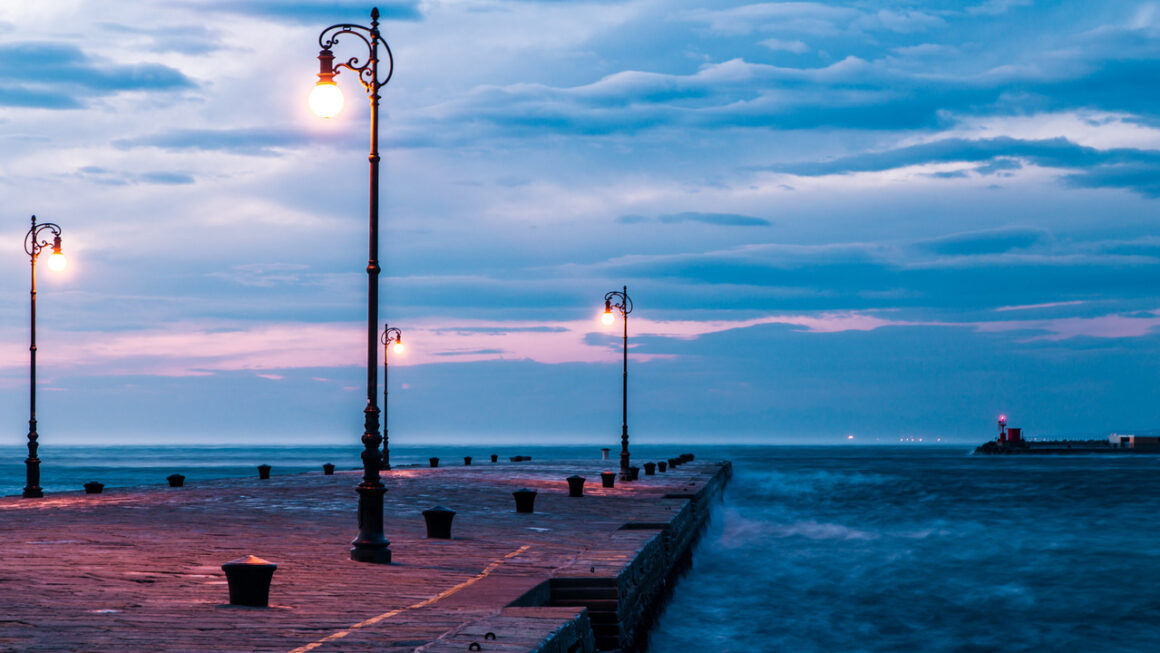
Old port lanterns as a molecular map of pattern recognition receptors (PRRs)
I have shown you many times how and where the ancients encoded the appearance of cell types.
In churches. In monasteries. In mosques and Buddhist pagodas. In castles and palaces.
But also in citadels. And in entire cities.
You remember the post about Zwolle — „Stellar beauty, Zwolle and the human skin cell”? A Dutch fortified city in the province of Overijssel, seen from above — the full structure of a human skin cell inscribed into the star-shaped fortifications. https://cellgod.live/holand-zwolle/
Or the post https://cellgod.live/croatia-old-town-dubrovnik/ Croatia, old town Dubrovnik. Stone Phagocytosis – The Medieval Urban Macrophage”
So — cities too.
And in every city — stand lanterns. In every artistic style. Renaissance. Baroque. Rococo. Art Nouveau. Every style, every era, every region — its own form.
Today I will show you how one model of these lanterns encodes the appearance of one of the cellular receptors.
More precisely: the old street lamps on Mutrah Corniche in Muscat (Oman) encode the full topology of pattern recognition receptors (PRRs) — the class of molecular guardians of innate immunity in the membranes of mammalian immune cells. The canonical example shown in the image is TLR4 — the most-studied member of the TLR family, whose image Wikipedia uses as the visual representative of the entire PRR class.
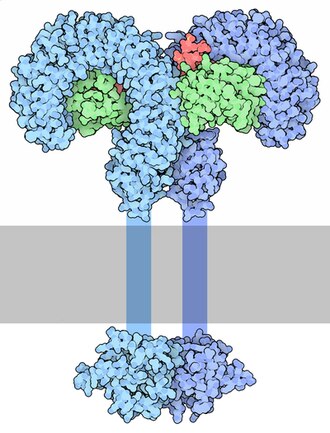
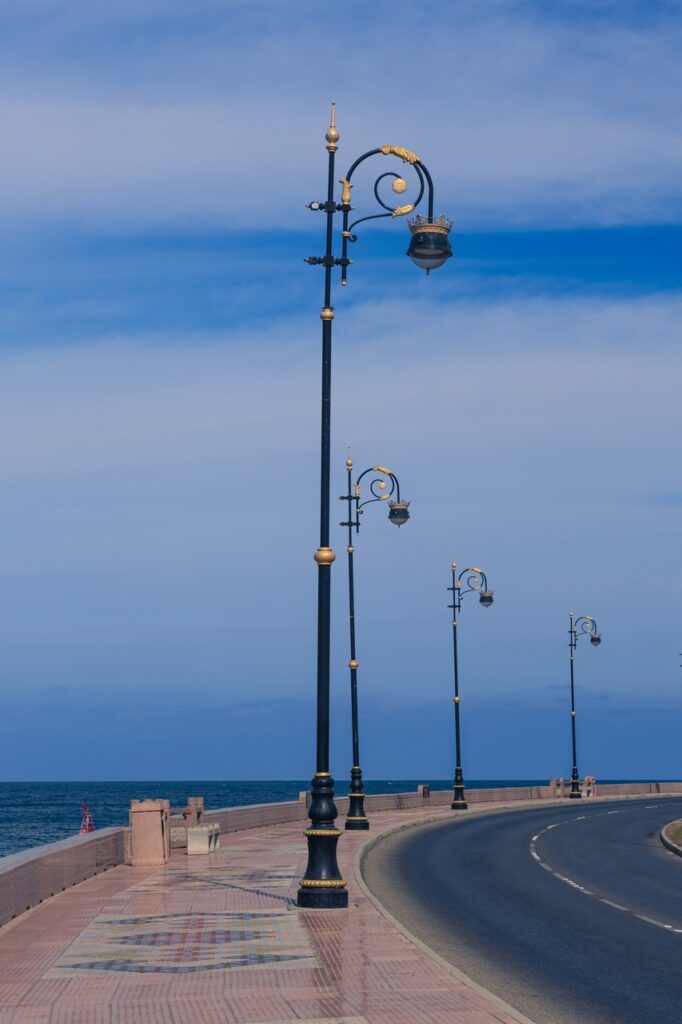
Photo description: Old street lamps at Mutrah Corniche. Muscat, Oman. Diego Coppola – Shutterstock.
PARALLELS — ELEMENT BY ELEMENT
The lanterns at Mutrah Corniche are tall slender wrought-iron constructions, decorated with gold rings on the post, with a characteristic scrolled S-curve bracket at whose end hangs a globe with a bulb inside. Each lantern stands on a massive base anchored in the pavement of the promenade. Mutrah Corniche — corniche — is the seaside promenade of the old port of Muscat, one of the oldest ports of the Arabian Peninsula.
That is: the lantern stands on the boundary of land and sea. It watches the line on which everything from outside arrives.
TLR4 does the same at the molecular level — it sits on the boundary of the cell, on the line of the plasma membrane, watching everything that arrives from extracellular space.
Four constructional elements, one to one:
1. S-curve bracket → LRR horseshoe
The scrolled bracket of the lantern, extending from the post in an arc — is exactly the same shape as the leucine-rich repeats (LRR) domain in TLR4. The LRR horseshoe is built from approximately 22 repeats of a leucine-rich motif, arranged in a spiral forming the characteristic curved arc. The function is also the same: a bracket reaching into external space, carrying the detecting element at its end.
2. Globe with bulb → MD-2 with LPS (polymer inside the horseshoe)
At the end of the S-curve bracket hangs a globe, inside which sits a bulb — the active element, detecting darkness and emitting light. This is exactly the polymer visible inside each LRR horseshoe in the crystal image: MD-2 as the globe (housing), with LPS bound in its hydrophobic pocket as the bulb (active element). Without the globe there is no light. Without MD-2 there is no detection. The same ratio of housing to ignition element, at both scales.
3. Lantern post → transmembrane α-helix
The long, slender, vertical post of the lantern passes through the air, connecting the upper element (globe on bracket) with the lower element (base on the pavement). In TLR4, exactly the same function is performed by the transmembrane α-helix — a segment of about twenty hydrophobic amino acids piercing the lipid bilayer of the cell membrane, connecting the extracellular LRR horseshoe with the intracellular signaling domain. The post must be of precise length — too short, the lantern does not shine above the heads of passersby; too long, it loses stability. The transmembrane α-helix also has a precisely defined length, fitted to the thickness of the membrane.
It is the vertical element of passage across the boundary. In both cases.
4. Base anchored in the pavement → cytoplasmic TIR domain
The lantern has a massive base, anchored in the stone surface of the promenade. This is the foundation that seats the entire construction in the city’s infrastructure — through this base flows the electrical current powering the bulb (or in the gas era, the gas to the burner). The signal from outside arrives at this base, so it can be transmitted further, into the energy network of the city.
In TLR4, this function is performed by the cytoplasmic TIR domain (Toll/Interleukin-1 Receptor) — a signaling module anchored inside the cell, to which the signal from the activated receptor arrives. Through TIR flows the signal to adapter proteins (MyD88, TRAM, TRIF), which in turn launch the cytokine cascade and mobilization of the immune system. This is the base through which the receptor is connected to the signaling network of the organism.
MAPPING
Element of the Mutrah Corniche lantern Element of the TLR4 receptor Function S-curve bracket LRR horseshoe Reach into external space Globe with bulb (polymer in globe) MD-2 with LPS in pocket Housing with active element Lantern post Transmembrane α-helix Passage across the boundary Base anchored in pavement Cytoplasmic TIR domain Signal base, network connection Four layers of correspondence. The full vertical topology, from the detecting head, through the transmembrane segment, to the signaling base.
This is not a „general” similarity. This is mapping element by element.
THE CALL
Tonight, walking home, look up.
At every lantern you pass.
You are seeing an atlas of membrane proteins written in iron, in glass, in bronze. Three centuries of cataloguing innate immunity, at scale one to one billion.
Every bracket is an LRR horseshoe.
Every globe is MD-2.
Every bulb is LPS.
Every base is a TIR domain.
Every lantern is a cell receptor.
You are not in a city.
You are inside a city cell.
And the cell is looking back…
…because every lantern is its eye.
Image search and matching, analysis and elaboration: Tomasz Mikulski – Cell God: 06/2026