„1. Almeida Fortress: The Stone Reflection of a Lymphocyte – The Hidden Code of Ancient Architects”
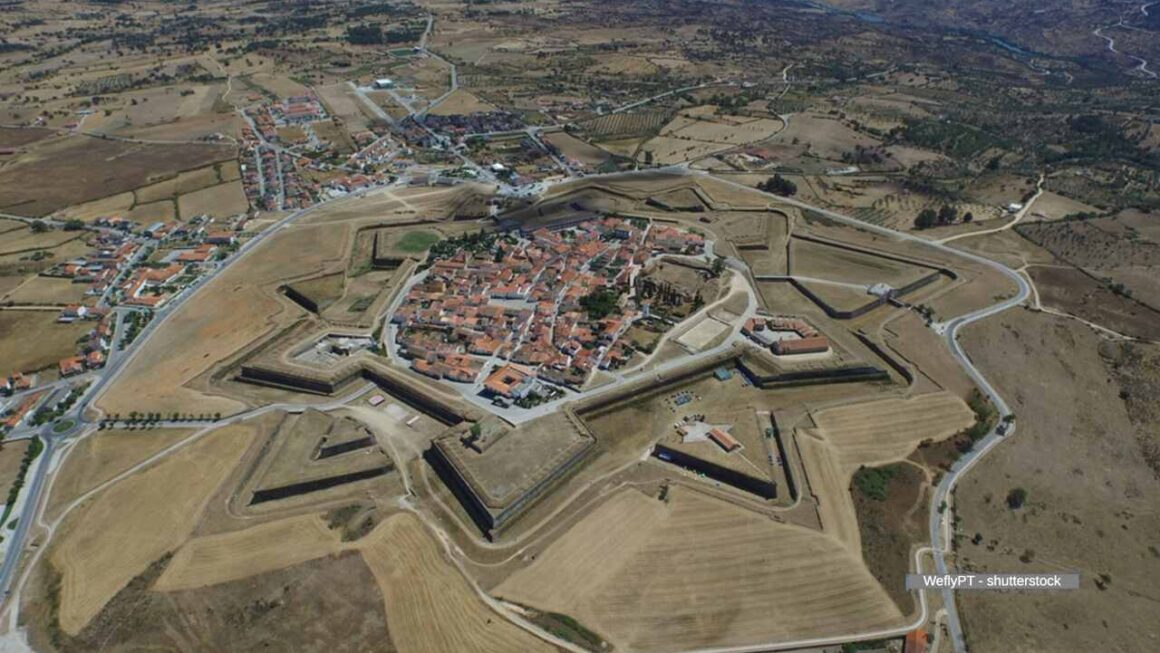
,Photo description: Almeida fortification.
,Illustration description: Lymphocyte, white blood cell of immune system.
, Could the monumental structures of antiquity and the Middle Ages contain encoded knowledge about the microscopic world of the human body? Portugal’s Almeida Fortress, with its imposing star-shaped defensive layout, appears to be a living reflection of a lymphocyte—the guardian cell of our immune system. In this article, we will explore the fascinating parallels between fortress architecture and cellular biology, suggesting that our ancestors may have understood structures that modern science has only recently begun to study. Could these stone walls hold the true „image of God”—hidden in the language of cellular anatomy?
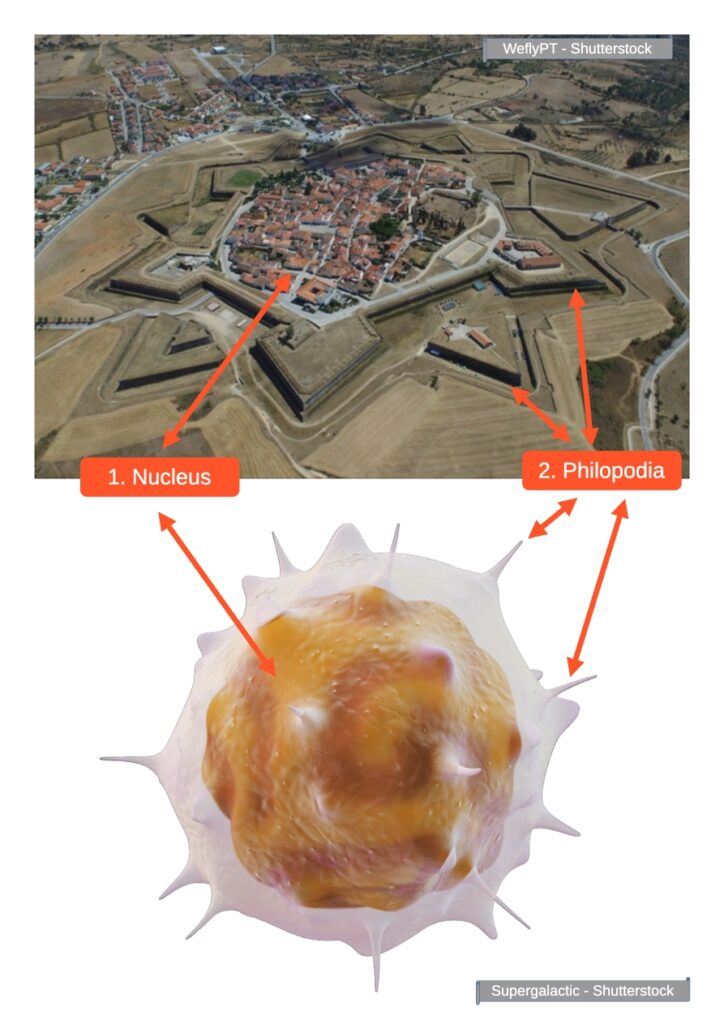
- 1. The inner city of Almeida Fortress, encircled by massive walls and serving as the core of the entire structure, is a perfect mirror of a lymphocyte’s large nucleus—the cell’s command center where genetic information is stored and crucial defensive decisions are made.
- 2. The peripheral bastions, radiating outward like arms, are the architectural equivalent of filopodia—dynamic cytoplasmic projections that lymphocytes use to survey their surroundings and communicate with other cells.
, The Almeida Fortress appears to immortalize in stone truths about lymphocytes that science has only recently uncovered. A lymphocyte’s enormous nucleus (up to 12 μm in diameter) contains highly active genes responsible for receptor recombination—a process critical for recognizing billions of different pathogens. Meanwhile, filopodia are true scouts—their movement is driven by dynamic actin polymerization, and a single lymphocyte can produce up to a dozen of them simultaneously! Could the architects of Almeida Fortress, by designing radially spreading bastions, have intuitively recreated this biological mechanism? Perhaps this fortress’s architecture encodes not just knowledge of military defense but also of the body’s defenses—revealing, in this way, the divine perfection of the immune system.
„2. The Double Gate of Almeida: Fortified Exocytosis”
photo description: Aerial view of the historic village of Almeida in Portugal. View from a different perspective.
illustration description: Golgi apparatus and exocytosis.
, When we examine the Almeida Fortress through the lens of cell biology, its structure reveals yet another layer of mysterious resemblance to a lymphocyte. In our previous analysis, we discovered that the fortress layout mirrors the basic components of a cell. Now, by studying its barracks, gates, and communication routes, we uncover a striking analogy to the process of exocytosis and the function of the Golgi apparatus.
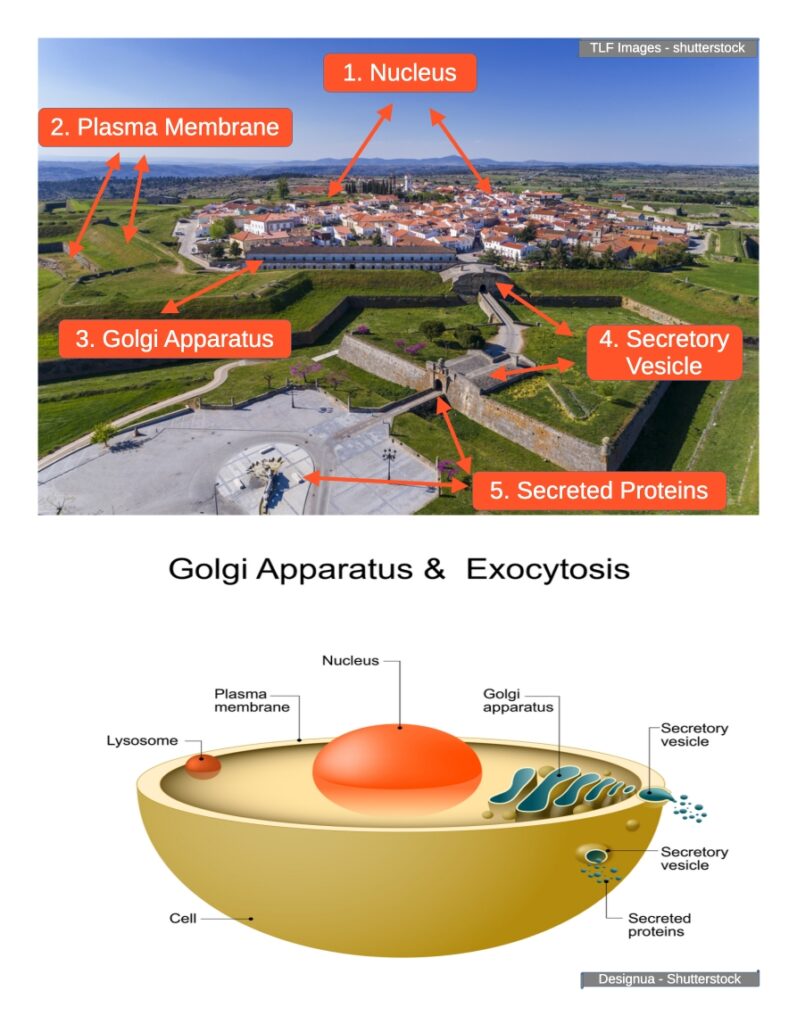
1. The fortress-city, previously identified as the cell nucleus, remains the command center of the entire defense system—just as the lymphocyte’s nucleus coordinates its immune functions.
2. The thick defensive walls and moat form a selective barrier that faithfully reflects the properties of the lymphocyte’s plasma membrane—both protecting the interior and regulating the flow of substances.
3. The barracks, strategically positioned near the main gate, serve as the Golgi apparatus—the site where „defensive troops” (effector proteins) are equipped and prepared for action.
4. The double-gate system functions like secretory vesicles during exocytosis, enabling the precise and controlled release of „soldiers” (defense molecules) in response to threats.
5. The monument standing outside the main gate symbolizes the released effector proteins, which—like soldiers leaving the fortress—begin their active service in the extracellular space.
, The Almeida Fortress proves to be not just a military masterpiece but a true architectural model of cellular processes. What is particularly fascinating is that exocytosis in lymphocytes has several unique features: B lymphocytes release up to 2,000 antibody molecules per second during an immune response, while T lymphocytes use focused exocytosis to deliver cytokines precisely to immunological synapses. This process is so precise that it resembles the operations of a well-organized army—exactly as the Almeida Fortress’s defense system was designed. Is it possible that the universal principles of defensive systems—whether in biology or architecture—follow the same fundamental laws? Perhaps the stone structures of the fortress encode knowledge that we are only now beginning to decipher with modern science.
„3. The Stone Code of Biochemistry: Portugal’s Coat of Arms as Urate Oxidase Enzymes”
photo description: Almeida, fortified city in Portugal.
vector description: Rasburicase (recombinant urate oxidase) enzyme molecule. Used to treat and prevent tumor lysis syndrome (TLS). Cartoon model, N-to-C gradient coloring.
photo description: Portuguese old carved stone coat of arms from the historic village of Almeida, Portugal.
, Upon closer examination of the stone-carved Portuguese coat of arms adorning the barracks of Almeida Fortress, we uncover an astonishing truth – its geometric structure almost perfectly mirrors the molecular architecture of the urate oxidase enzyme. Could medieval sculptors, while crafting this national symbol, have unconsciously recreated the structure of a protein that modern science only discovered in the 20th century? In this trilogy’s final installment, we reveal another layer of the biomolecular code hidden within the fortress architecture.
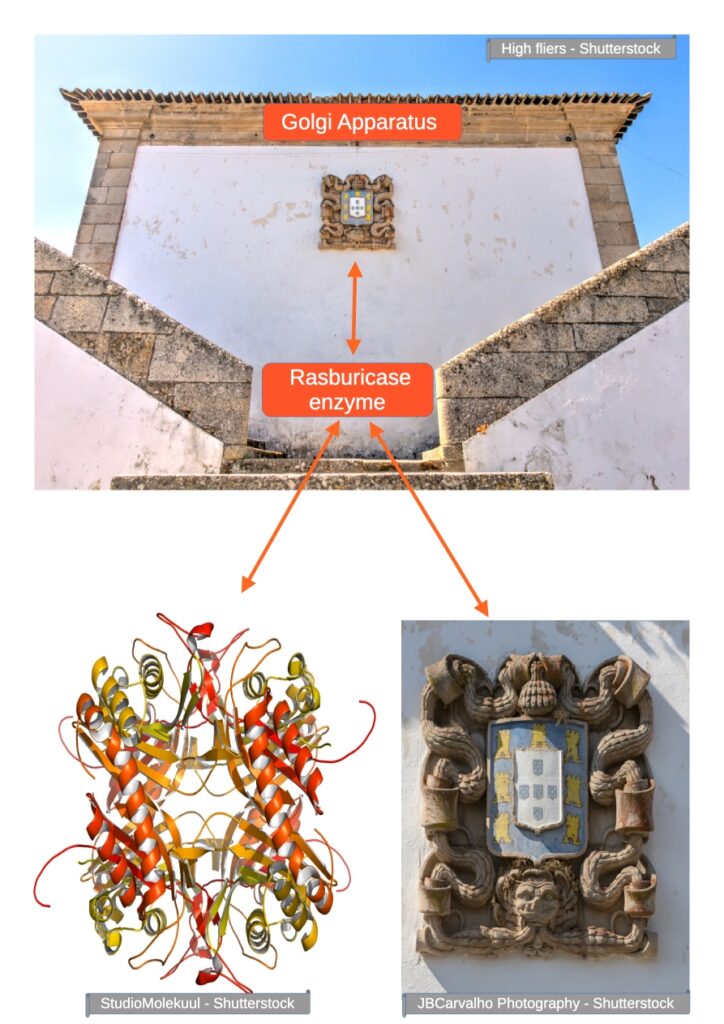
- The rectangular outline of the coat of arms with its centrally placed shield corresponds to the general structure of the tetrameric enzyme (composed of four subunits). The heraldic shield fits precisely into the enzyme’s active site where uric acid conversion occurs. The lion’s head beneath the shield structurally resembles the substrate binding site, while the distinctive „fibers” emanating from the lion’s jaws create a pattern nearly identical to the hydrogen bonds stabilizing the enzyme’s quaternary structure.
Fun fact about urate oxidase: This fascinating enzyme, also known as rasburicase, is… inactive in humans! During evolution, we lost the ability to produce it due to mutations in the UOX gene. Moreover, this enzyme has remarkable therapeutic properties – it’s used to treat gout, and its recombinant form is produced by genetically modified bacteria. Could the stone coat of arms of Portugal, through its resemblance to this particular enzyme, symbolize a profound truth about our evolutionary past and medical future?
„Conclusion and Trilogy Summary”
Our trilogy has revealed that Almeida Fortress is:
1. A macroscopic model of a lymphocyte (Part I: nucleus-city and filopodia-bastions)
2. An architectural metaphor for exocytosis (Part II: barracks as Golgi apparatus)
3. A stone representation of an enzyme (Part III: coat of arms as urate oxidase)
, This trilogy reveals that Almeida Fortress’s architecture is not just a feat of military engineering, but a true „stone encyclopedia” of molecular biology. From the cellular scale through metabolic processes to enzymatic molecular machines – every element of the fortress seems to tell another chapter of life’s story written in the language of biochemistry. Is this coincidence, or perhaps the conscious work of architects who – possibly – possessed knowledge beyond their time?
„Fun Facts About Lymphocytes – Your Body’s Tiny Defenders”
- 1. „Blood and Lymph Travelers” – Lymphocytes can move between blood and lymph, patrolling the entire body. They can circulate around the body up to 100 times a day!
2. „Memory for Decades” – Some B lymphocytes (called memory cells) store information about past infections for several decades, allowing the body to respond faster to reinfection.
3. „Suicide Mission” – T lymphocytes can recognize infected cells and force them into apoptosis (programmed cell death), sacrificing them for the greater good of the body.
4. „Antibody Factories” – A single activated B lymphocyte can produce up to 10,000 antibody molecules per second!
5. „Specialized Killers” – Natural Killer (NK) cells identify and destroy cancerous and virus-infected cells without prior „training” in lymph nodes.
6. „Brain Barrier Access” – Lymphocytes have special clearance to enter the central nervous system. The brain only allows selected units through the blood-brain barrier.
7. „Friendly Fire” – When lymphocytes mistake the body’s own cells for enemies, autoimmune diseases (like Type 1 diabetes or rheumatoid arthritis) develop.
8. „Shape Matters” – Receptors on lymphocytes arrange themselves in unique 3D combinations, enabling them to recognize billions of different pathogens.
9. „Thymus – Survival School” – Young T lymphocytes undergo a brutal selection process in the thymus – only 2-4% survive to avoid attacking the body’s own tissues.
10. „Vampiric Recovery” – During infections, lymphocytes can suppress appetite, redirecting energy toward fighting pathogens instead of digestion.
Did you know that Almeida Fortress shares so much in common with these microscopic heroes?
Combining images and adding description details made by Tomasz Mikulski – Cell God, date 04/2025
- links and references:
- https://en.wikipedia.org/wiki/Castle_Fortress_of_Almeida
- The Siege of Almeida http://www.peninsularwar.org/almeida.htm
- Lymphocytes https://my.clevelandclinic.org/health/body/23342-lymphocytes
- Golgi. https://www.ncbi.nlm.nih.gov/books/NBK6268/
- Practically’s Concepts – Golgi Apparatus – #LearnPractically video YouTube – https://youtu.be/iA8hFSHS6Ho?si=itIsWyQ-YoxsvTMo
- Secretory vesicle and secreted proteins. https://biologynotesonline.com/secretory-vesicles/?utm_content=cmp-true
- Rasburicase, https://www.ncbi.nlm.nih.gov/books/NBK548485/
- here you can see white blood cells under the microscope, video YouTube – https://youtu.be/vHz2AlD8I6g?si=N9WNzSV0oF7RY_SG