„Divine Geometry: The Gretna Green Maze as a Forgotten Model of Telophase”
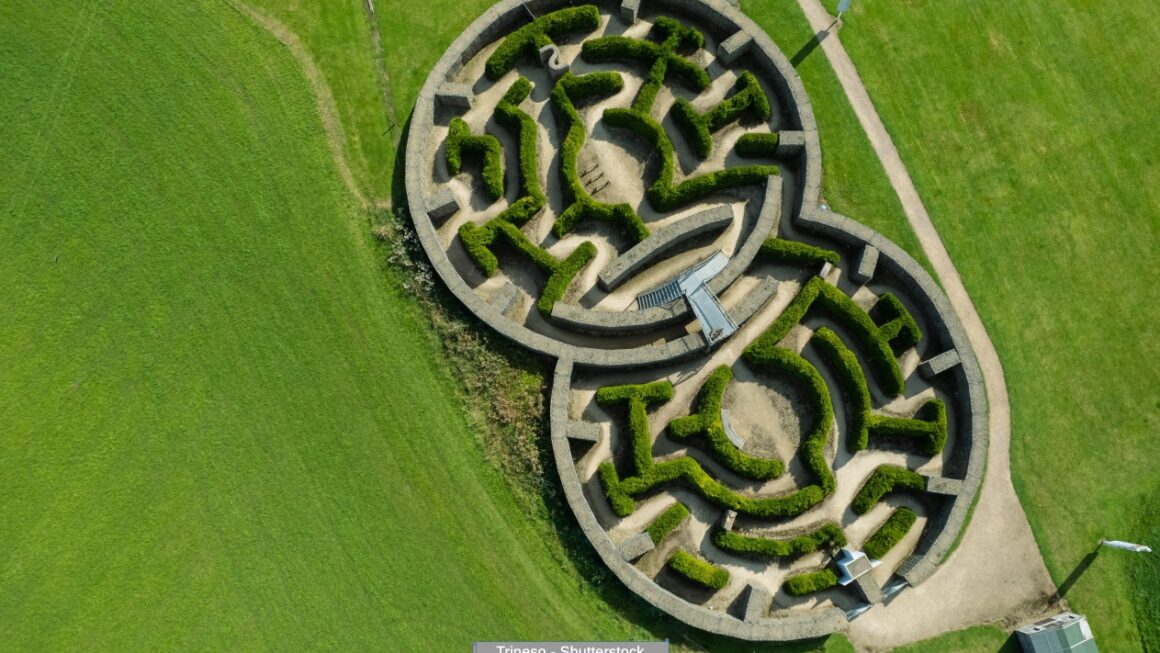
,Photo description: Scotland 07.10.2022 Garden Maze at Gretna Green aerial view (drone). The Courtship Maze.
,Vector description: Telophase. Cell division. Cell cycle.
, Did ancient builders have access to microscopes? Is it possible that monumental sacred and garden structures were precise representations of the microscopic world, which official science only discovered in the 17th century? On the „Cell God” blog, we reveal shocking similarities between architecture and biology. Today, we examine Garden Maze in Gretna Green—a labyrinth that, when viewed from above, replicates the structure of a cell in telophase, the final stage of division. This is no coincidence—it is a deliberate design hidden within hedges and pathways.
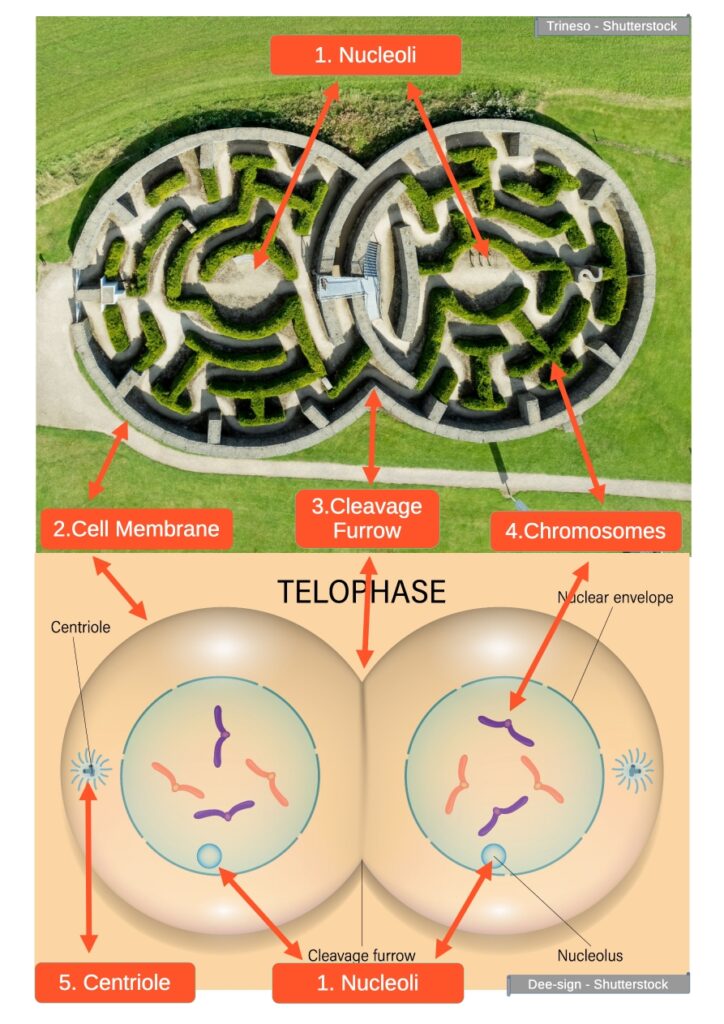
- 1. The Two Maze Centers as Nucleoli – The two central spaces of the maze are architectural counterparts of nucleoli – the metabolic activity centers that reappear in each newly forming cell during telophase.
- 2. The Maze’s Ring Walls as the Cell Membrane – The maze’s ring walls perfectly mirror the cellular membrane during telophase. Their compact structure precisely mimics how the nuclear membrane reforms around chromosomes, separating the newly forming cells.
- 3. The Intertwined Rings as the Cleavage Furrow – The area where the paths intertwine most densely corresponds to the cleavage furrow – the contractile ring of actin and myosin that physically divides the cell in two.
- 4. The Hedge Walls as Chromosomes – The hedge pathways arrange themselves in patterns identical to sister chromatids in the final stage of division. Every twist and turn corresponds to the precise arrangement of DNA that has just completed its journey to the cell’s poles.
- 5. The Vanished Centrioles – Hidden Meaning or Forgotten Elements? – Significantly, the maze lacks structures corresponding to centrioles. Yet this too aligns perfectly with biology – in the final stage of division, these spindle organizers degrade, as if the architect intentionally omitted now unnecessary elements.
,The Garden Maze in Gretna Green is more than just a tourist attraction—it is a stone-carved lesson in cell biology, encoded in hedges and pathways. Its resemblance to telophase is too perfect to be accidental. Did Scottish gardeners (or their mysterious predecessors) know the microscopic structure of cells and deliberately recreate it in the landscape? Or is this further evidence of ancient forgotten knowledge, where divinity was seen in life’s tiniest structures?
Here are some fascinating facts about cell division and telophase that show just how amazing our „divine” bodies are!
1. Telophase – The „Awakening” of New Cells – In telophase, the final stage of mitosis, the chromosomes relax, and nuclear membranes reform around them, creating two new cell nuclei. It’s as if the cell is „waking up” its DNA after an intense division!
2. Cells Divide Even While You Sleep – Your body is constantly renewing itself—millions of cells divide every day, regenerating tissues. At night, while you rest, repair processes are especially active, and telophase helps „seal” the division cycle, creating healthy new cells.
3. Telophase Is Like a Cellular Reset – During telophase, the mitotic spindle (the structure responsible for separating chromosomes) disappears, and the cell returns to its pre-division state. It’s like a system „reboot” before starting a new life cycle.
4. Without Telophase, Cells Would Be a Chaotic Mass of DNA – If telophase didn’t restore the nuclear envelopes, chromosomes would remain scattered in the cytoplasm, leading to genetic chaos and potentially cancer. Telophase is the guardian of order in the cell!
5. Cancer Cells „Ignore” Telophase – In cancerous cells, the cell cycle is disrupted—control mechanisms, including proper division completion in telophase, are often bypassed. That’s why tumors divide uncontrollably.
6. Telophase Also Happens in Meiosis—Creating Unique Reproductive Cells – Unlike mitosis, meiosis involves two rounds of telophase, resulting in egg and sperm cells with unique chromosome sets. This is why each of us is genetically one-of-a-kind!
7. Aging Is Linked to Disruptions in Cell Division – With age, telophase (and mitosis as a whole) becomes less precise, leading to accumulated DNA errors. This is one reason we age and become more susceptible to diseases.
Aren’t these proof that our bodies are true masterpieces of biology? 
Combining images and adding a description details made by Tomasz Mikulski – Cell God, date: 05/2025
- Links and references:
- Mitosis facts for kids, https://kids.kiddle.co/Mitosis
- Gretna Green, https://www.gretnagreen.com/fall-in-love-with-great-spaces-at-gretna-green-a1214?srsltid=AfmBOoqAwwCOzPCNcb5QGuiVkYI5OXMSVNYqtEdwcAbIjyWZTnoIYtUX