„Mysterious Harmony: A Buddhist Temple as a Macrophage – An Extraordinary Comparison”
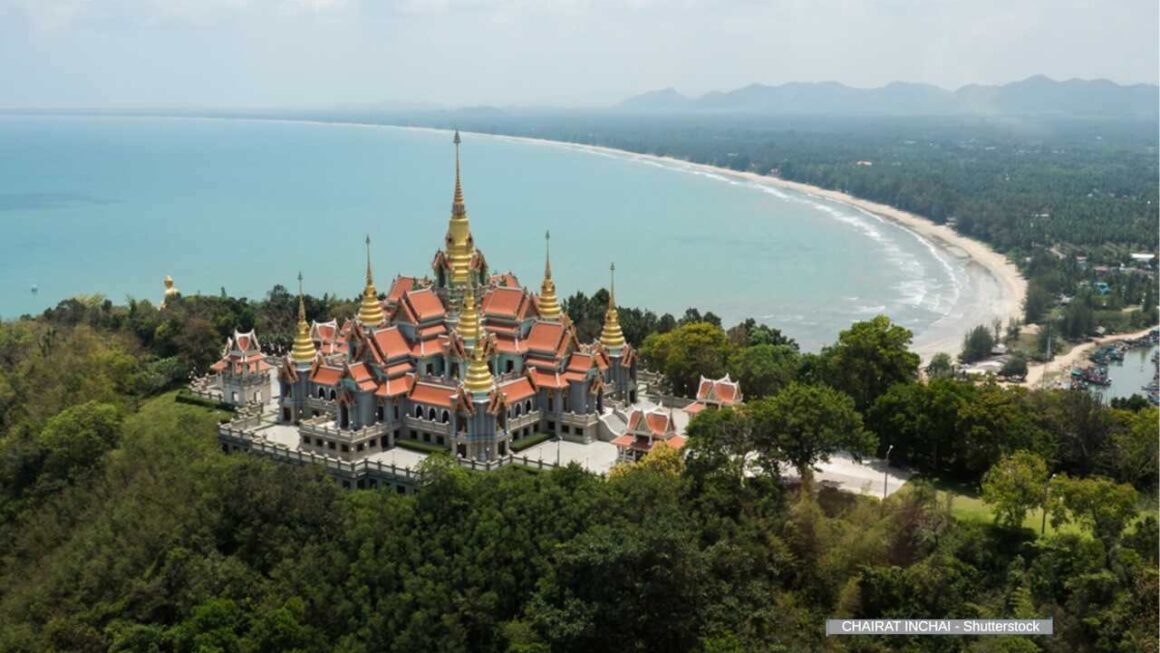
, The worlds of nature and human architecture often reveal surprising similarities. One day, while looking at an aerial photo of Wat Phra Mahathat Chedi Pakdeeprakad, I noticed that its structure resembles… yeast cells of Histoplasma capsulatum living inside a macrophage! Here’s how a golden temple can mirror the microscopic world of infection.
,Photo description: Wat PraMahathadchedi Pakdeeprakad, temple is located on the beach near Prachuap Khiri Khan.
, Illustration description: Histoplasma capsulatum yeasts inside a macrophage cell, 3D illustration. Histoplasma is a parasitic, yeast-like dimorphic fungus that can cause lung infection histoplasmosis.
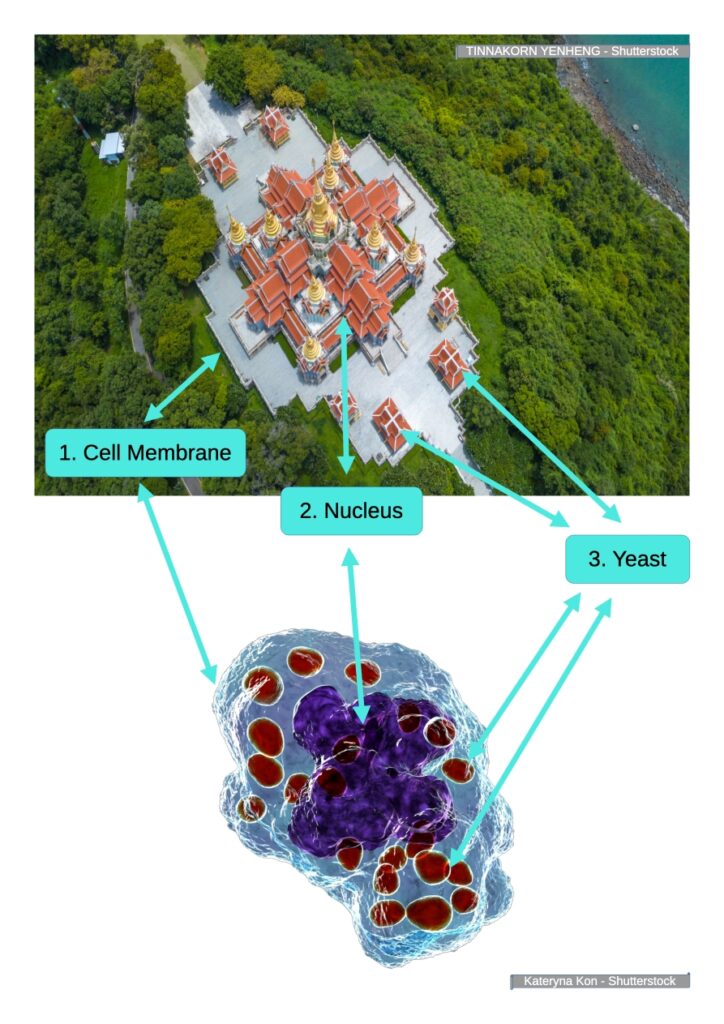
- 1. „The Temple Grounds as the Macrophage Membrane” The wall enclosing the temple complex acts like the macrophage’s cell membrane, separating the sacred from the profane. The interior is orderly and controlled—just like the environment inside a cell, where pathogen and host engage in a subtle battle for dominance.
- 2. „The Main Chedi as the Nucleus, Endoplasmic Reticulum, and Golgi Apparatus” The towering, gilded chedi resembles the cell nucleus—the control center—surrounded by smaller structures that can be compared to the endoplasmic reticulum (narrow temple corridors) and the Golgi apparatus (ornate spires modifying „proteins”—in this case, prayers and offerings).
- 3. „The Offering Pavilions as Histoplasma capsulatum Yeast” The smaller stupas and pavilions around the main chedi resemble yeast cells scattered in the cytoplasm. Like pathogens that have transformed the macrophage into their „temple,” they exploit it for survival—much like religious worship transforms space into a sacred realm.
, Wat Phra Mahathat Chedi Pakdeeprakad is further proof of my thesis that all temples worldwide were designed as macroscopic models of cells. There are too many similarities for this to be accidental. The central chedi as the nucleus, the pavilions as yeast, the walls as the membrane—all of this testifies to the advanced knowledge of our ancestors. The question remains: where did this knowledge come from, and why was it hidden from modern civilization? Do you see other similarities between temples and cellular structures? Share your observations in the comments! Remember, these are not theories—they are facts backed by years of my research. Every temple is a living organism on a macro scale, and we are only beginning to understand their true purpose.
„Did You Know? Fascinating Facts About Macrophages and Yeast”
- 1. Macrophage Multitaskers: Macrophages are like the „Pac-Mans” of our immune system—they don’t just eat invaders but also help in wound healing and tissue repair.
- 2. Shape-Shifting Yeast: Histoplasma capsulatum is a master of disguise—it can change its form from mold in soil to yeast in human lungs when inhaled.
- 3. Ancient Enemies: Macrophages and fungi have been locked in an evolutionary arms race for millions of years, leading to sophisticated defense and invasion strategies.
- 4. Temple of Infection: Like our temple comparison, H. capsulatum actually manipulates macrophages to create a safe space to reproduce—a biological „sacred ground” for the pathogen.
- 5. Global Traveler: This fungus is found worldwide but thrives particularly in soil enriched by bird or bat droppings—nature’s own „offerings.”
- 6. Immune Memory: After fighting Histoplasma, some macrophages can „remember” the invader, providing faster protection if it returns—a cellular version of spiritual vigilance.
,Combining images and analysis by Tomasz Mikulski – Cell God, date: 12/2024
- Links and references:
- Bang Saphan district. source. https://en.wikipedia.org/wiki/Bang_Saphan_district
- video – Macrophages eating bacteria. https://youtube.com/shorts/uacAdE6r3bw?si=9IEgfYaqn7BIjBn0
- Macrophages, What Are They, Different Types, Function, and More, https://www.osmosis.org/answers/macrophages
- Phagocytosis, https://en.wikipedia.org/wiki/Phagocytosis