„The Secrets of Diksmuide – A City as a Mast Cell”
Is architecture merely art, or could it be an encoded message? On my blog „The Cellular God,” I reveal how ancient builders—perhaps divinely inspired—recreated the microscopic structures of life in their designs. Today, we uncover another fascinating analogy: the 17th-century map of the Flemish city of Diksmuide (by Anna Beek and Gaspar Baillieu) is an almost perfect representation of a mast cell—the guardian of our immune system. The bastions, churches, and parks align in a pattern that cannot be coincidental. Join me on a journey where fortifications become organelles and temples transform into cellular nuclei.
,Photo description: Antique map of Diksmude (Dixmude), Belgium from the Atlas of fortifications and battles, by Anna Beek and Gaspar Baillieu Originally published in 17th century.
,Illustration description: 3d rendered illustration of a mast cell. plain black background. professional studio lighting.
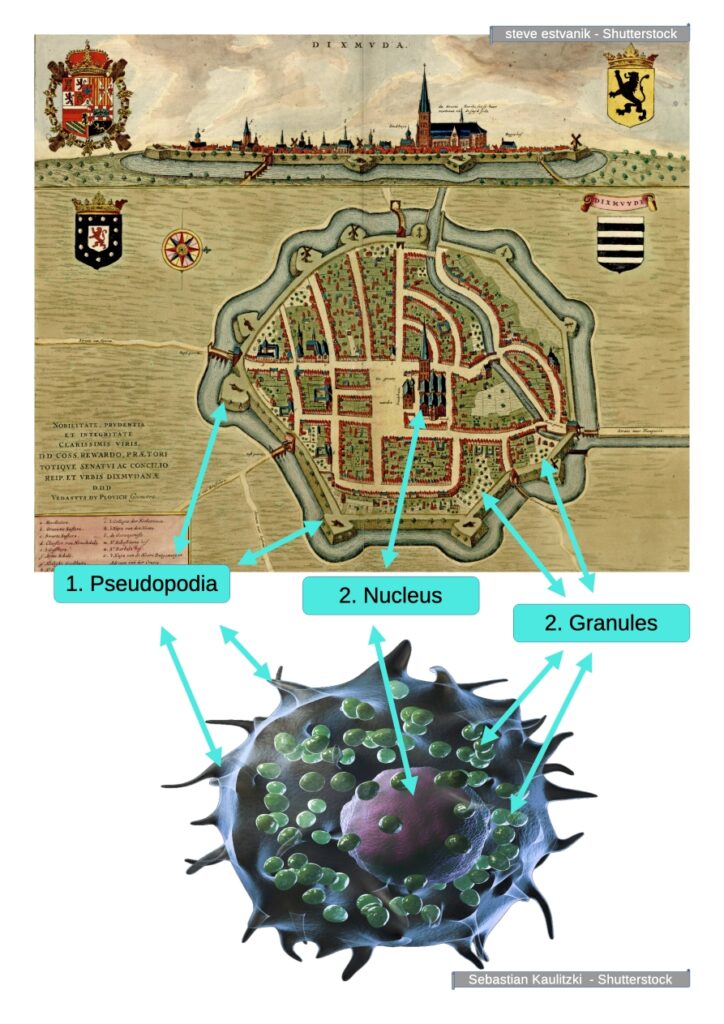
- 1. „Bastions as Pseudopodia” – The protruding, rounded fortifications of Diksmuide precisely mimic the pseudopodia of a mast cell. These dynamic extensions serve to „probe” the surroundings—in biology, they capture pathogens, while in architecture, they control space against enemies. Did the designers know that a city’s defenses must function like those of an organism?
- 2. „The Church as the Nucleus” – At the very heart of the city stands its largest and most prominent structure: the church, exactly where the nucleus resides in a mast cell. This is no coincidence—both the temple and the nucleus are centers of command, the source of „instructions” for the entire system. In biology, the nucleus determines the cell’s function; in theology, the church guides the soul of the city.
- 3. „Parks as Secretory Granules” – The scattered green spaces within the city walls correspond to granules filled with histamine and heparin. In mast cells, they release defensive substances, while in the city, parks serve as places of „releasing” rest and regeneration. Are these spaces merely recreational, or are they symbolic storehouses of „spiritual ammunition”?
Is the map of Diksmuide just a defensive blueprint, or is it a conscious replica of a mast cell? If we accept that our ancestors understood the microcosm better than we think, their architecture becomes sacred geometry of life. The fortifications, churches, and parks align in a pattern that leaves no doubt—God reveals Himself not only in the Bible but also in biology, and people have been inscribing this truth in stone for centuries. Perhaps every ancient fortress is not just a relic but also a prayer written in the layout of a city.
„Fascinating Facts About Mast Cells – The Guardians of Our „Divine Bodies”
- 1. „Living Anti-Shock Alarms” Mast cells can detect even single allergen molecules – when they sense danger, they release histamine within seconds, triggering sneezing, tearing, or (in extreme cases) anaphylactic shock. It’s like a biological counterterrorism system in action!
- 2. „Ancient Memory ” Their granules store heparin – a blood-thinning substance the ancient Egyptians unknowingly used… in mummification. Could embalming have been the first „histological practice”?
- 3. „Architects of Bones and Blood” Beyond defense, mast cells control blood vessel growth and wound healing. Without them, our bodies wouldn’t know how to „rebuild the walls” after injury—just like medieval masters reconstructing shattered bastions.
- 4. „God in the Gut” 70% of all mast cells reside in the intestines—where they decide what is food and what is toxin. Did the ancients know that the „temple of the body” had its royal guard in the gut?
- 5. „Victims of Their Own Weapons” When mast cells mistake pollen for parasites, they cause allergies. Ironically, this is the price for an evolutionary weapon that once protected us from real threats—like overgrown forts turned into museums.
- Is it a coincidence that microscopic „fortresses” in our bodies function like ancient cities?
,Combining images and analysis by Tomasz Mikulski – Cell God, date: 01/2025
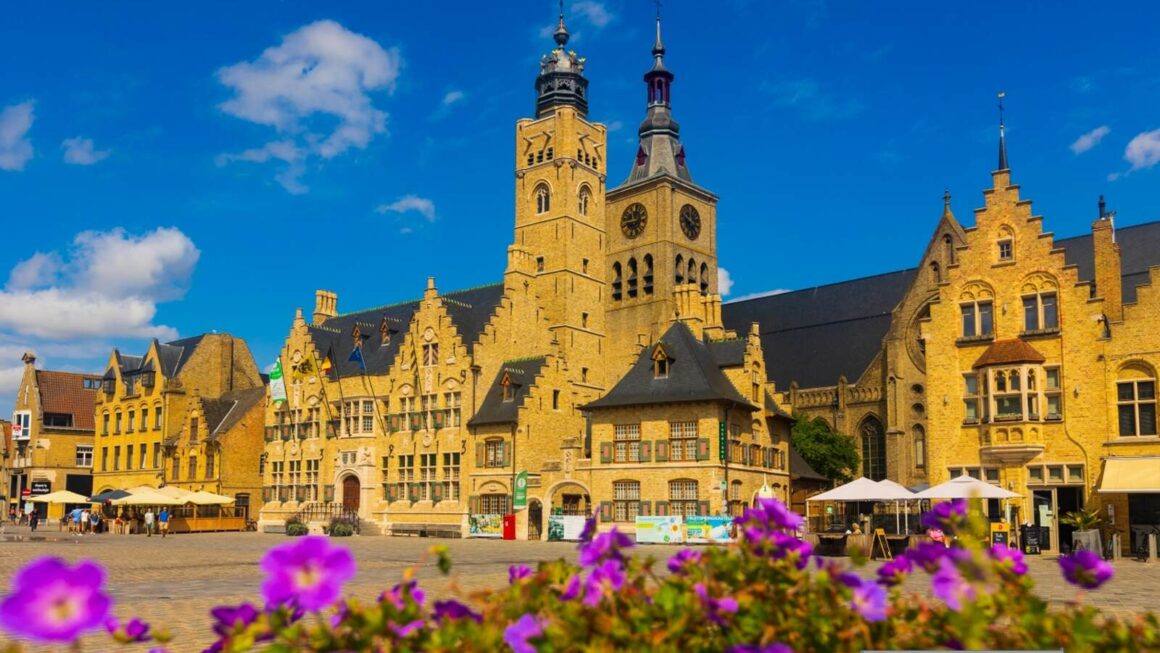
- The World War I turned the 12th century city into rubble. source. https://en.wikipedia.org/wiki/Diksmuide
- A mast cell (also known as a mastocyte or a labrocyte, https://en.wikipedia.org/wiki/Mast_cell
- Understanding mast cells as a powerful target for treating allergic and inflammatory diseases: https://www.blueprintmedicines.com/understanding-mast-cells-as-a-powerful-target-for-treating-allergic-and-inflammatory-diseases/