„The Last Supper as the Initiation of Protein Synthesis”
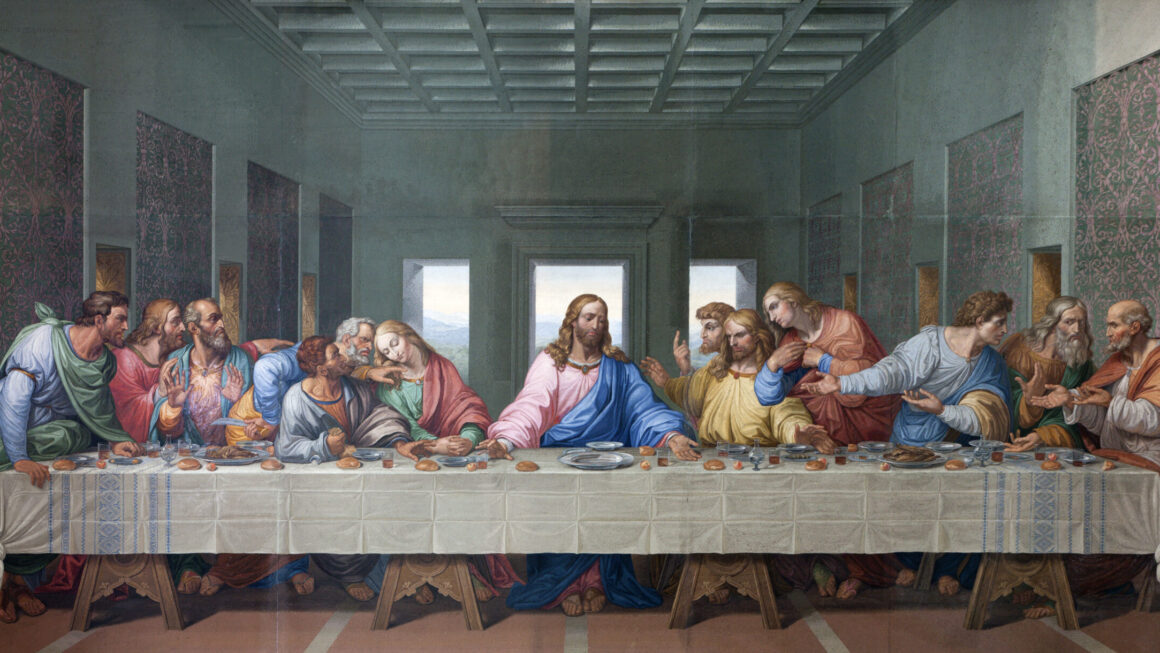
In the next installment of the series „My Jesus Christ as My RNA,” we delve into a fascinating analogy between the Last Supper and the process of protein synthesis. The inspiration for this post comes from the mosaic of the Last Supper by Giacomo Raffaelli, created in 1816 and housed in the Minoritenkirche. This mosaic is a copy of Leonardo da Vinci’s famous masterpiece and serves as a metaphor for one of the stages of protein biosynthesis. Let’s explore this remarkable analogy step by step.
,Photo description: Mosaic of Last supper of Jesus by Giacomo Raffaelli in the Minoriten church from year 1816 as copy of Leonardo da Vinci work on January 15. 2013 in Vienna.
,Vector description: Ribosome. Process of translation. RNA directed synthesis of polypeptide. mRNA. tRNA. Biological protein synthesis.

- „The Apostles in Threes as Codons of Nucleotides in the mRNA Chain” In the mosaic, the apostles are arranged in groups of three, perfectly mirroring the concept of codons – triplets of nucleotides in the mRNA chain that encode specific amino acids. Each trio of apostles symbolizes one codon, and their conversations and gestures reflect the process of decoding genetic information. These „triplets” determine the sequence of amino acids in the emerging protein, much like the apostles collectively shape the spiritual and symbolic meaning of the Last Supper.
- „Jesus Seated in the Center as Ribonucleic Acid – The Fundamental Chemical Structure of All RNA’s” Jesus, the central figure of the Last Supper, represents ribonucleic acid (RNA) – the foundation of all types of RNA. Just as Jesus is the source of spiritual life, RNA is the key carrier of information and a tool in biological processes. His presence at the center of the scene symbolizes the fundamental role of RNA in protein synthesis, where mRNA, tRNA, and rRNA collaborate to convey and execute the „blueprint” encoded in DNA. Jesus as RNA is the heart of the entire process, uniting all participants into one cohesive whole.
- „The Windows in the Background as E, P, A Sites” In the background of the mosaic, we see three windows, which can be compared to the three sites in the ribosome: „E (exit), P (peptidyl), and A (aminoacyl)”. These sites are key to the translation process, where tRNA delivers amino acids to the growing polypeptide chain. However, in this particular scene – the Last Supper – we do not see tRNA. Why? Because this scene symbolizes the „initiation” stage of protein synthesis, where mRNA is already bound to the ribosome, but tRNA has not yet delivered the amino acids. It is a moment of preparation, of waiting for the „meal consumption” – the subsequent stages of translation.
- „The Table as Ribose, and the Food on the Table (Meat, Bread, Wine) as the Phosphates Groups” The table around which Jesus and the apostles are gathered can be compared to „Ribose”, the sugar that forms part of the RNA backbone. The table is the foundation upon which the entire scene rests, just as Ribose is the foundation of RNA’s structure. Meanwhile, the food on the table – meat, bread, and wine – symbolizes the „phosphate group”, which links nucleotides in the RNA chain. It is the phosphate groups that form the „backbone” of RNA, holding the entire structure together.
The Last Supper, depicted in Giacomo Raffaelli’s mosaic, becomes a metaphor for the process of protein synthesis. The apostles in threes are codons, Jesus is RNA, the windows in the background are the E, P, A sites in the ribosome, and the table with food represents Ribose and phosphate groups. This extraordinary analogy shows how deep and universal the connections between spirituality and science can be. After all, both faith and biology seek to uncover the mystery of life.
„The Heart of Jesus as rRNA, mRNA, tRNA: A Divine Analogy of Protein Translation”
In the sacred imagery of Jesus Christ holding His radiant heart, depicted on the side altar of the Basilica of Santi XII Apostoli in Rome, we find a profound analogy to the molecular biology of life itself. Jesus, in this representation, becomes the embodiment of RNA—the fundamental molecule that underlies all biological processes. Just as RNA is the blueprint and builder of life, Jesus reveals Himself as the divine architect of our spiritual and physical existence.
,Photo description: ROME, ITALY – MARCH 25, 2015: The paint of Heart of Jesus on side altar in church Basilica dei Santi XII Apostoli by unknown artist of 19. cent.
,Illustration description: Ribosome as part of an biological cell constructing messenger rna molecules – 3d illustration.
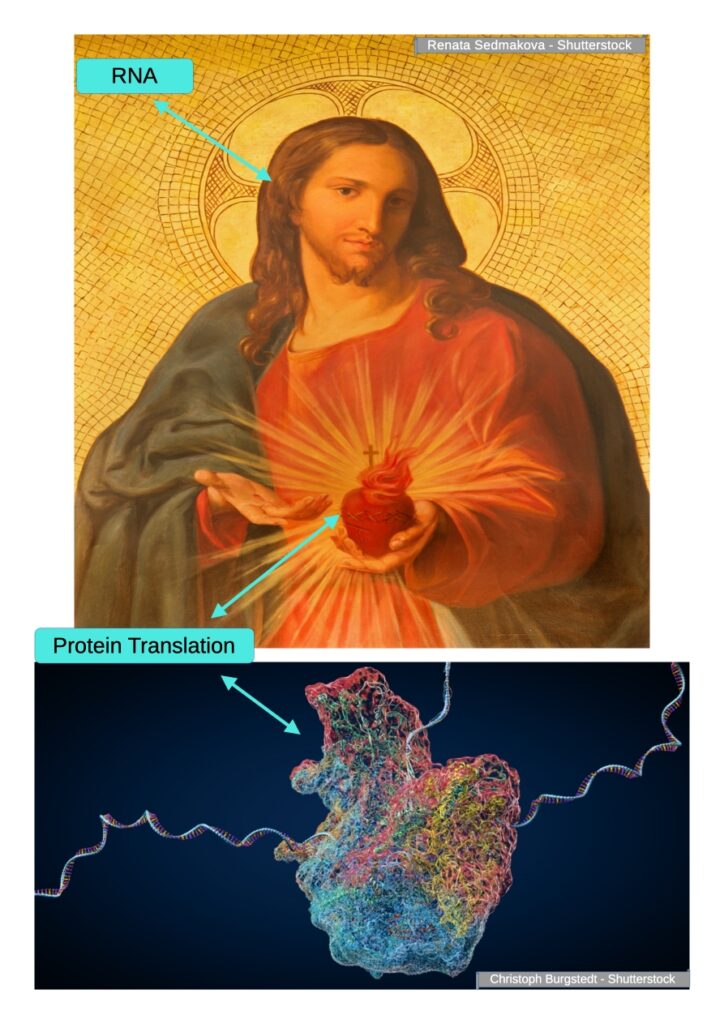
„The Heart as rRNA, mRNA, and tRNA” The heart that Jesus holds in His hand can be interpreted as the three main types of RNA involved in the translation process. The description is in the next section.
„The Sacred Heart of Jesus as rRNA, mRNA, and tRNA: A Celestial Blueprint of Protein Translation”
,Vector description: Sacred Heart of Jesus with rays on aqua color background.
,Vector description: Types of RNA. tRNA for transfer, that helps to decode information present in mRNA, rRNA in ribosome, and mRNA that Reads by a ribosome in the process of synthesizing a protein. Isometric Flat vector.
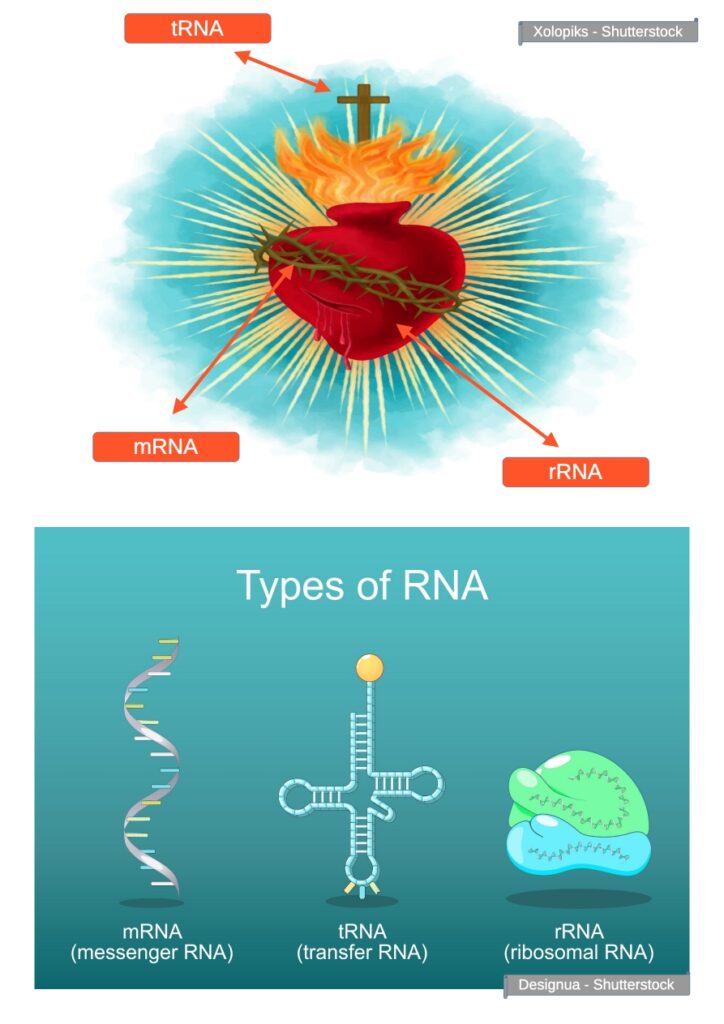
- „The Flaming Cross as Initiator tRNA with Methionine” The cross ablaze above the Heart embodies the „initiator tRNA”, carrying methionine—the amino acid that ignites protein synthesis. The flames symbolize „methionine’s sulfurous spark”, the divine „start codon” of salvation. Like tRNA, the cross bridges heaven(Nucleus) and earth(Endoplasmic Reticulum), its fire activating the translation of God’s plan into tangible life. Without this sacred initiator, the synthesis of grace could never begin.
- „The Crown of Thorns as mRNA (with Apostles as Nucleotides)” Encircling the Sacred Heart, the Crown of Thorns embodies „messenger RNA (mRNA)”—the transient strand bearing God’s salvific code. Each thorn represents a „nucleotide”, the building block of divine instruction, with the Twelve Apostles echoing the triplet codons that define life’s language. As the crown binds to the „ribosome” of the Heart, the apostles—like nucleotides—form a sacred sequence: „AUG” (the start codon) of redemption, translating Christ’s sacrifice into the living Word.
- „The Heart of Jesus as rRNA” Ribosomal RNA (rRNA) forms the core of the ribosome, the structure responsible for protein synthesis. It is the rRNA that gives the ribosome its shape and function, enabling the translation of genetic information into life. The Heart of Jesus, as the center of love and the source of spiritual life, can be compared to rRNA—it is the foundation upon which the entire process of „creation” and „transformation” is built. Without it, the transmission of God’s love to the world would not be possible.
- „Rays of Light as the Holy Spirit in the Form of ATP” The luminous rays emanating from the Heart symbolize the „Holy Spirit in the form of ATP”—the universal energy currency of life. Just as ATP powers cellular processes, these divine beams energize the spiritual „metabolism” of the Church, fueling acts of love, mercy, and unity. Each ray is a burst of divine energy, igniting the „reactions” that sustain the Body of Christ and illuminate the path to salvation.
- „The Bleeding Wound as the Peptidyl Transferase Center” The wound beneath the crown, flowing with blood, mirrors the „peptidyl transferase center”—the catalytic core of rRNA where peptide bonds form. Here, the „divine reaction” unfolds: tRNA (human frailty) surrenders its amino acid (sin) to forge a new bond (grace). This wound is the furnace of redemption, where death’s chain is broken, and resurrection’s protein—the Body of Christ—emerges.
The Sacred Heart of Jesus, in this analogy, becomes the center of „spiritual translation,” where love, suffering, and grace are transformed into eternal life(regeneration and renewal of our divine bodies). Just as the ribosome, rRNA, mRNA, and tRNA work together to create a protein, the elements of the Heart of Jesus collaborate to bring salvation to the world.
As seen in this post and previous ones, our ancestors grasped molecular biology’s essence and the pivotal role of RNA in sustaining life within „divine vessels.” For millennia, they depicted RNA’s holy essence as God the Creator—through sacred art, temple architecture (modeled on cells and organelles), and symbols echoing cellular machinery. They knew God dwells within us, God is us, and God is all creation—from DNA and all forms of RNA to the breath of every living soul.
Join us for the next revelation:
In the upcoming part, we’ll decode „the Crucifixion as the genesis of tRNA”. How does tRNA „resurrect” into its mature form, ready to carry the amino acids of redemption? Dive deeper into the mystery where the Cross becomes the matrix of life’s most sacred molecules!
Combining images and adding a description details made by Tomasz Mikulski – Cell God, date: 03/2025
Links to references:
https://www.chemistryworld.com/opinion/cracking-codons/4016221.article
https://www.youtube.com/watch?v=O680jWwB0Cw&pp=ygUScmlib3NvbWUgYW5pbWF0aW9u