„Antwerp as a Megakaryocyte: Thrombopoiesis in the Architecture of Fortifications”
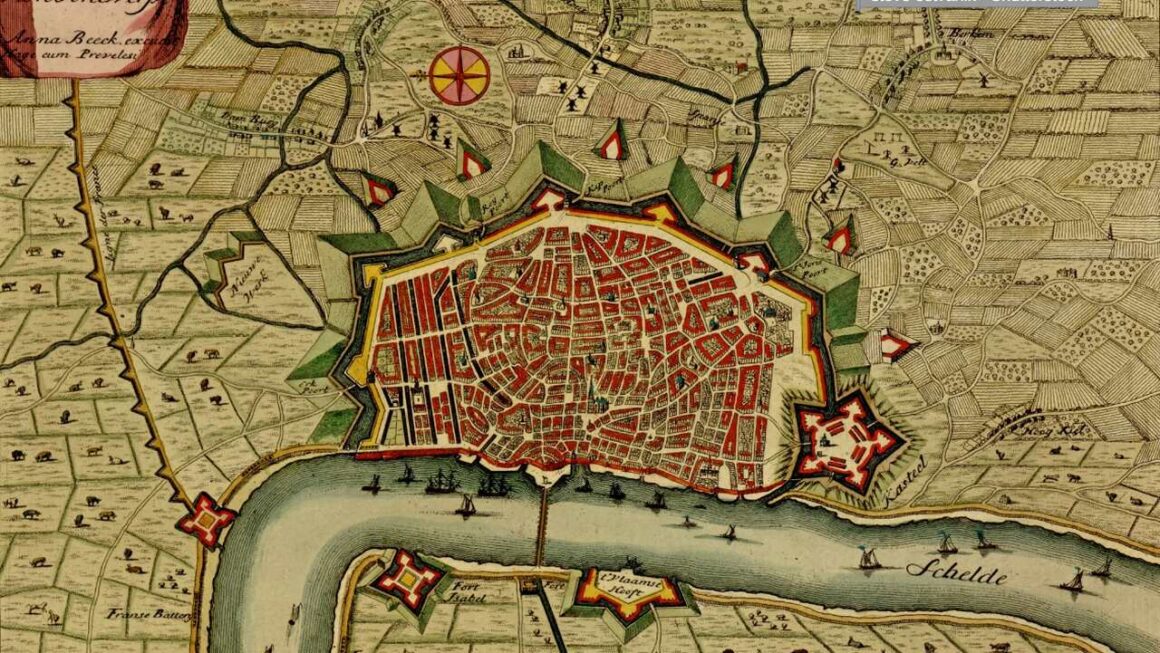
, Photo description: Antique map of Antwerp, Netherlands from the Atlas of fortifications and battles, by Anna Beek and Gaspar Baillieu Originally published in 17th century.
, Illustration description: Histology blood cells illustrations with various cells. Megakaryocyte and Platelets.
, In Anna Beek and Gaspar Baillieu’s „Atlas of Fortifications and Battles”, the 17th-century map of Antwerp emerges not only as a masterpiece of military engineering but also—through the lens of hematology—as a vivid allegory of „thrombopoiesis”, the process by which platelets are born from megakaryocytes. Here, the city itself becomes a „megakaryocyte”, its cytoplasm spilling along the yellow fields and River Scheldt like pseudopods ready to release future guardians of hemostasis.
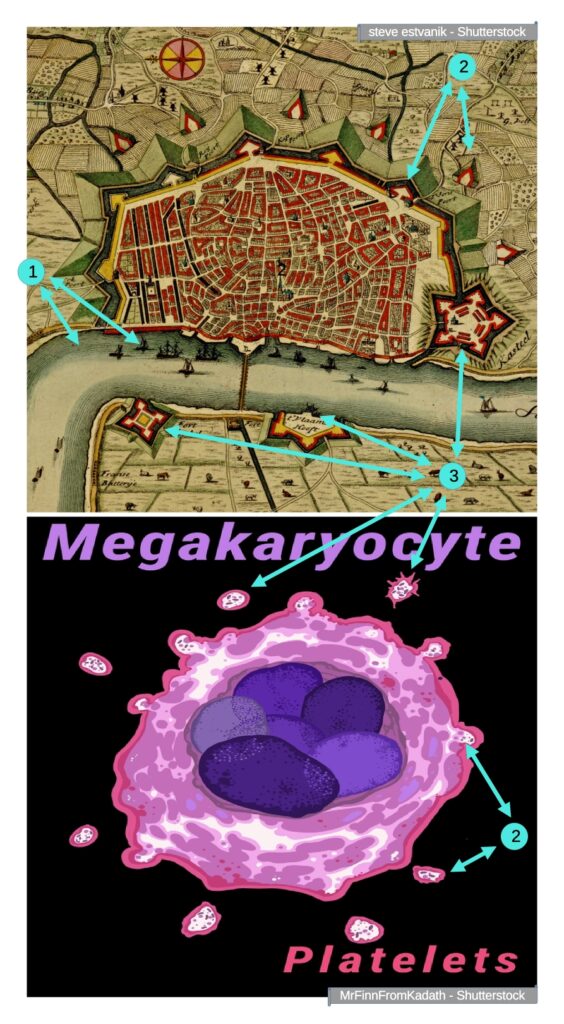
- „The Megakaryocyte – A City Encircled by Walls” In human bone marrow, „megakaryocytes” are giant cells responsible for producing platelets. Their cytoplasm extends, forming protrusions that release fragments which later become platelets. Antwerp, as depicted in Beek and Baillieu’s map, resembles such a megakaryocyte—encased by massive walls, with numerous bastions and defensive outworks resembling cytoplasmic extensions.
- 1. „The Scheldt as a Blood Vessel” The River Scheldt, winding along the northern walls of the city, becomes a „vein transporting plasma proteins”. Its waters, bustling with merchant ships and cargo boats, resemble molecules of fibrinogen and albumin flowing in the rhythm of a pulsing bloodstream. Here, at the border between the „megakaryocyte” and the „vessel,” a crucial process begins „platelet release”.
- 2. „Cytoplasmic Protrusions: Lunettes and Ravelins” Antwerp’s defensive line—intermittent, reinforced with „double-layered lunettes”—represents the „megakaryocyte’s protrusions”, from which platelets are shed. Each bastion, like a fragment of cytoplasm, detaches to become a „fortress-platelet”, poised to repair breaches in the „endothelium”.
- 3. „Forts as Platelets: Adhesion and Activation” Antwerp’s fortifications symbolize „platelets” in different functional states:
– „The Radiant Fortress” (e.g., a star-shaped citadel or bastion) represents an „activated platelet”, extending pseudopods and ready to engage in hemostasis.
– „The Fortress Clinging to the Damaged Rampart” (e.g., a riverside outpost) mirrors a „platelet in adhesion”, attaching itself to the site of endothelial injury (in this case, a breach in the Scheldt’s defenses). - „Yellow Fields as Bone Marrow” The surrounding „meadows, pastures, and farmlands”, teeming with livestock, serve as a metaphor for „bone marrow”—the fertile microenvironment where megakaryocytes mature. The map’s yellow hues evoke the fatty tissue of marrow, while scattered homesteads resemble hematopoietic stem cells gradually differentiating into the megakaryocytic lineage.
, The Beek and Baillieu atlas is more than a collection of fortification maps—it is a hidden treatise on biology, where our ancestors encoded the types, structures, and functions of cells within urban design. Antwerp as a megakaryocyte, the Scheldt as a blood vessel, the forts as platelets—all reveal that „our bodies mirror the world we’ve built over centuries”.„Do you not know that you are God’s temple and that God’s Spirit dwells in you?” (1 Cor 3:16). Our „Divine Bodies” are the „House of God”—a temple where every cell fulfills its sacred purpose. And the cities we constructed were but reflections of this perfection.
May Antwerp forever stand as a symbol of „thrombopoiesis”—a process in which even the smallest fragment of cytoplasm can become a shield, protecting life from chaos.
- More over „Platelets”
- „Platelets„: small but powerful clotting agents. Platelets are small but extremely important blood elements that play a key role in the process of clotting and repairing damage to blood vessels. Although they are much smaller than other blood cells, their importance to the body is enormous. Here’s everything you need to know about blood pressure! What are platelets? Platelets are fragments of the cytoplasm of megakaryocytes – large bone marrow cells. They are not full-fledged cells, since they do not have a cell nucleus, but contain numerous granularity with substances necessary for blood clotting. – Size: 2-4 microns (they are much smaller than red and white blood cells). – Shape: at rest, they resemble disks, but when activated, they change shape, forming protrusions. – Number: in a healthy person is 150,000-400,000 platelets per microliter of blood. — How are platelets formed? The process of platelet formation is called „thrombopoiesis” and occurs in the bone marrow.
- „Functions of platelets” platelets play a key role in maintaining the body’s homeostasis. Their main tasks are: „Blood clotting (Haemostasis)” – when a blood vessel is damaged, platelets immediately adhere to the damaged wall (adhesion). – Then they activate and release substances that attract other platelets, forming a platelet (aggregation). – The platelet cap temporarily stops the bleeding before a stable clot forms. „Release of growth factors” – platelets contain grains with growth factors such as „PDGF” (platelet-derived growth factor) and „TGF-β” (transforming growth factor beta). – These substances stimulate tissue regeneration and wound healing. „Involvement in inflammatory reactions” – platelets can interact with immune cells to help fight infections and inflammation.
- „How do platelets work?” The process of platelet action can be divided into several stages: ” Adhesion”: the tiles adhere to the damaged vessel wall. „Activation”: they change shape, releasing chemicals that attract other tiles. „Aggregation”: form a platelet-like pin that stops bleeding. „Coagulation”: interact with plasma proteins to form a stable clot.
- „Platelet-related disorders” abnormalities in the number or function of platelets can lead to serious health problems: „Thrombocytopenia”: too low platelet count, which increases the risk of bleeding. „Platelet count (thrombocytosis)”: too many platelets in the blood, which can lead to blood clots. „Platelet dysfunction”: even with the right number of platelets, their improper operation can cause clotting problems.
- „Interesting facts about platelets” – platelets live only 7-10 days”, after which they are removed by the spleen and liver. – They are necessary not only for coagulation, but also for tissue regeneration and wound healing. – In case of serious injuries, platelets can be transfused as a platelet concentrate.
- „Summary” platelets are the true guardians of our body. Although they are small, their role in maintaining health is enormous. Thanks to them, our body can quickly respond to damage, prevent blood loss and regenerate tissues. This is another proof of how perfectly designed the human body is! 🩸✨
Combining images and adding a description details made by Tomasz Mikulski – Cell God, date: 03/2025