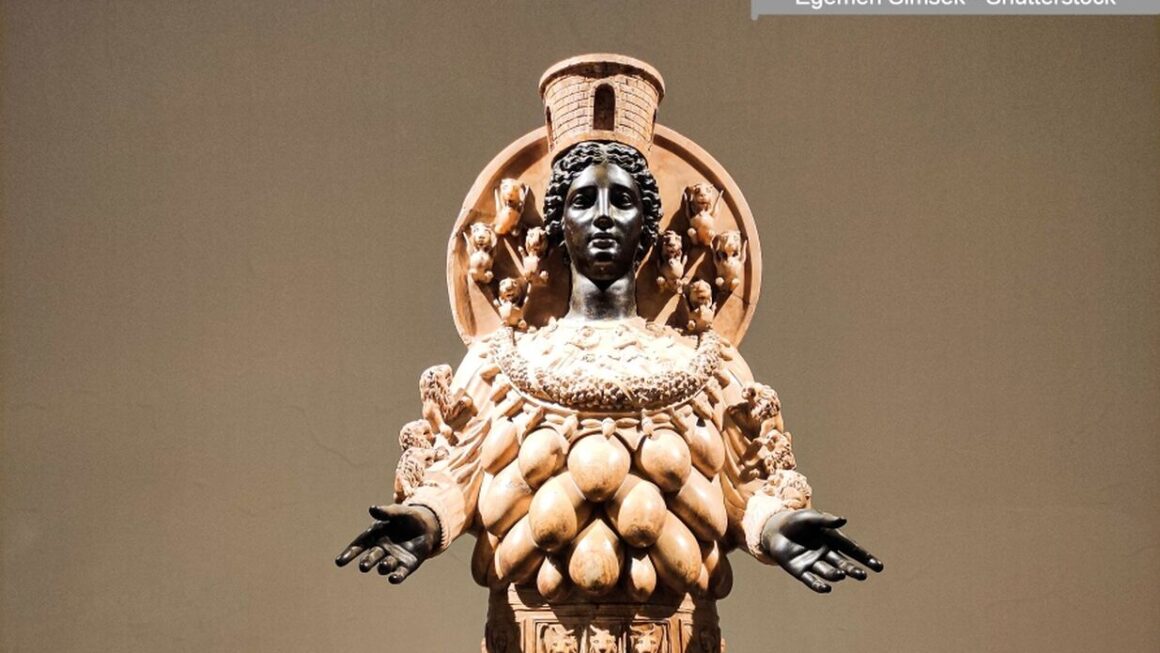
„Artemis of Ephesus: The Ancient Biomolecular Code”
When I look at these two images—the mystical multi-breasted Artemis of Ephesus and the molecular structure of the 26S proteasome—I see a perfect unity of form and function that cannot be accidental. This statue, long regarded merely as a symbol of fertility, turns out to be a precise representation of the most crucial cellular mechanism—the proteasome, the molecular „machine” responsible for protein degradation. Could the priests of Artemis have known the secrets of cell biology millennia before the invention of the microscope?
,Photo description: The Statue of Artemis, Naples, Italy.
,Image description: Proteasomes are molecular machines for breaking down proteins called proteolysis, only target proteins that have been marked for destruction called ubiquitin to the target protein, 3d rendering.
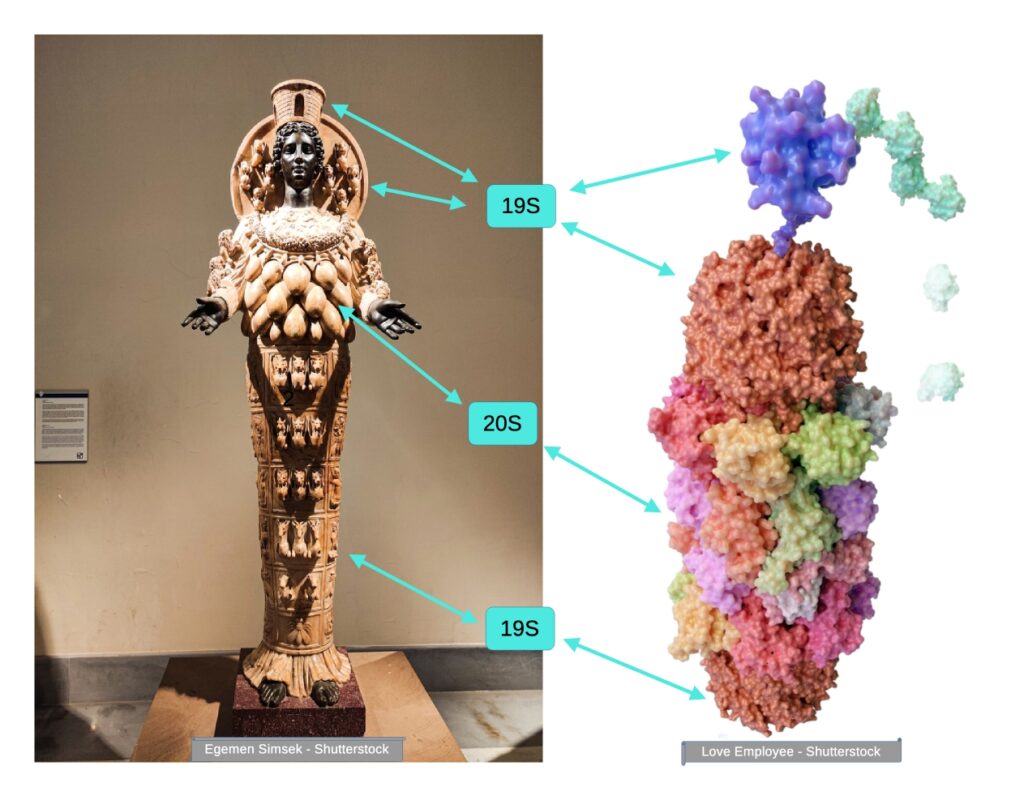
- The Gloriola and Crown in the Form of City Walls, Along with the Cylindrical Robe Beneath the Torso Adorned with Animals and Plants, Reflect the 19S Regulatory Particle – Just as walls protect a city, the 19S acts as a „gatekeeper,” controlling access to the proteasome’s interior. The cylindrical base of the robe, covered in reliefs of animals and plants, corresponds to the regulatory ring—each ornament symbolizing a distinct protein subunit recognizing specific molecular signals. The animals and plants are not mere decorations but a symbolic representation of various cellular proteins.
- The Central Section, Richly Adorned with Protrusions on the Torso, Mirrors the 20S Core Particle – The middle part of the statue, densely covered with distinctive protrusions (traditionally interpreted as breasts or a necklace of bulbs), astonishingly resembles the catalytic 20S core. Each protrusion represents an active enzymatic site of the proteasome—where actual protein breakdown occurs. Their regular, almost crystalline arrangement reflects the precise structure of the catalytic rings. This is not mere ornamentation—it’s a detailed molecular blueprint!
The Artemis of Ephesus is revealed to be not just a cult statue but a true „textbook” of structural biology carved in marble. Its tripartite design—the crown-walls, decorated cylinder, and central protrusions—is an exact analogy of the proteasome’s three-part structure (19S-20S-19S). What does this mean? That the ancients not only knew the microscopic architecture of cells but consciously preserved it in sacred art as the image of God itself—the perfect molecular machine sustaining life.
Proteasomes are molecular machines in our cells that act like divine guardians of protein quality. Here are some awesome facts about these fascinating structures:
-
 1. Proteasome – The Protein Destroyer –
The proteasome works like a „protein shredder”—it breaks down damaged or unnecessary proteins into small pieces. Without it, the cell would drown in toxic waste!
 2. Ubiquitin – The Divine Death Tag –
Before the proteasome destroys a protein, it must receive a „death sentence”—a small molecule called ubiquitin. It’s like sticking a „Eat Me” label on a faulty protein.
 3. The Proteasome Is Not Just a Trash Can—It’s a Gene Guardian –
Proteasomes control the levels of proteins that regulate the cell cycle and DNA repair. If they malfunction, it can lead to cancer!
 4. Cancer Drugs Target Proteasomes –
Anti-cancer therapies like bortezomib block proteasomes in cancer cells, causing them to die from their own toxic waste buildup.
 5. Proteasomes Slow Down Aging –
The better proteasomes function, the longer cells stay healthy. Proteasome deficiencyaccelerates aging—it’s like a city without garbage collectors!
 6. Proteasomes and Neurodegenerative Diseases –
In diseases like Alzheimer’s and Parkinson’s, proteasomes fail to clear toxic proteins (e.g., beta-amyloid), leading to neuron destruction.
 7. The Proteasome Isn’t Just a Destroyer—It’s a Recycler –
Broken-down proteins are often reused to build new molecules. It’s like molecular recycling!
 8. Viruses Hack Proteasomes –
Some viruses (e.g., HPV, HIV) manipulate proteasomes, forcing them to destroy the host’s defense proteins. It’s like hacking the cell’s security system!
 9. Proteasomes Run on ATP –
They need energy in the form of ATP—without it, they shut down, and the cell dies from protein waste overload.
 10. Proteasomes Look Like Sci-Fi Nanomachines –
Their structure resembles a cylinder with a lid, and inside, enzymes slice proteins like molecular scissors. It looks like a tiny sci-fi machine!
Summary: Proteasomes are the unsung heroes of the cell—without them, our bodies would quickly turn into toxic dumps. They act like a divine quality control system, and when they fail, disease and death follow.
Did you know this before?
,Combining images and adding a description details made by Tomasz Mikulski – Cell God, date: 02/2025
- Links an references:
- Farnese Artemis, https://en.wikipedia.org/wiki/Farnese_Artemis
- Video YouTube, The Proteasome (2024) by Etsuko Uno wehi.tv. https://youtu.be/ECXbJah2m6Q?si=retIFeEkgdsg_H_4
- The life cycle of the 26S proteasome: from birth, through regulation and function, and onto its death, https://www.nature.com/articles/cr201686