„Frýdlant Castle: A Stone Cell. How Medieval Builders Replicated Our Divine Bodies in Architecture?”
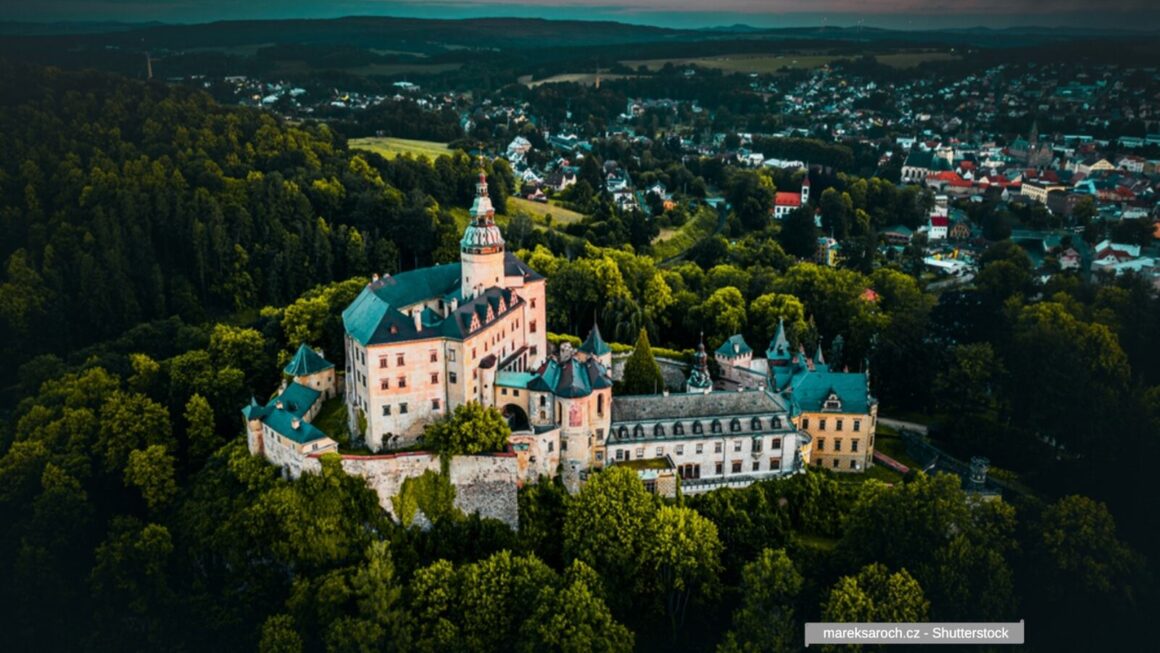
When we look at Frýdlant Castle from a bird’s-eye view, we see more than just a medieval fortress. We see a living, breathing human cell, reflected in stone with remarkable precision. The high walls filled with windows like the endoplasmic reticulum, bastions resembling cellular cilia, the chapel as a peripheral nucleus – this cannot be coincidence. In this post, I reveal how our ancestors consciously preserved the sacred geometry of life in castle architecture, creating a three-dimensional map of a human cell.
,Photo description: picturesque castle Frýdlant in the Czech Republic.
,Vector description: The Structure Of Human Cell.
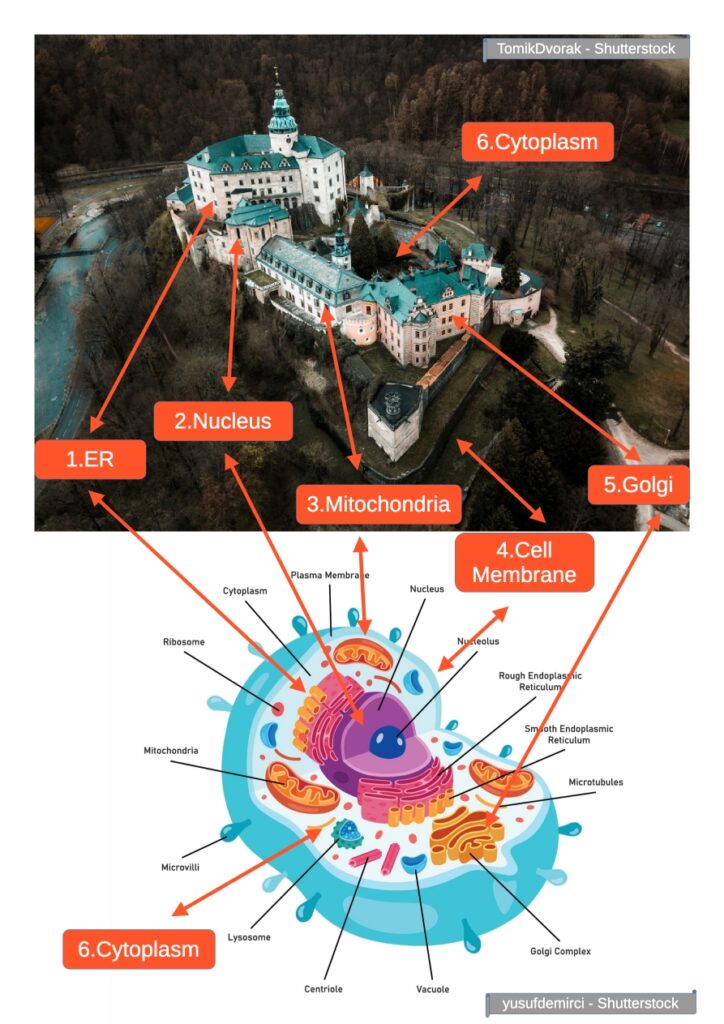
- 1. The old castle with its high, window – filled walls and main tower precisely mirrors the structure of the rough endoplasmic reticulum (RER), where each window resembles a ribosome attached to membranes, and the tower represents the characteristic protrusions seen in cells actively producing proteins.
- 2. The castle chapel, positioned to the side of the complex, represents the cell nucleus in cells with peripherally located nuclei, such as goblet cells in intestines or megakaryocytes in bone marrow – crucial yet not centrally positioned.
- 3. The long building between the chapel and palace serves as a living metaphor for mitochondria – the cell’s power plant, which in the castle was responsible for energy production and storage (kitchens, pantries).
- 4. The double defensive walls and moat function like a cell membrane, selectively controlling flow, while the bastion with its turret perfectly mimics a cellular cilium – a structure responsible for receiving signals from the environment.
- 5. The new palace located by the main gate performs the function of the Golgi apparatus – sorting, modifying and distributing „packages” (documents, goods) to other parts of the castle and beyond its walls.
- 6. The central courtyard with surrounding buildings represents cytoplasm with organelles: the armory as peroxisomes neutralizing threats, dungeons as lysosomes digesting waste, and guard towers as centrioles organizing space.
Frýdlant is not just a castle – it’s a stone prayer, a hymn to the divine order hidden in the human body. Its architecture, so perfectly reflecting cellular structure, suggests that medieval builders possessed knowledge beyond their time. Was this intuition, divine revelation, or perhaps heritage from a forgotten civilization? These magnificent castles are not only testaments to human genius but also reminders that our bodies are living temples housing a divine spark. Every stone, every tower, every courtyard of Frýdlant tells the story of our origin – a story written in the language of biology that our ancestors understood better than we might think.
„Fascinating Facts About Organelles in Our Divine Bodies”
- 1. Mitochondria – The Ancient Power Plants – Your mitochondria have their own DNA, inherited only from your mother! – They were once free-living bacteria that formed a symbiotic relationship with our cells over 1.5 billion years ago. – A single liver cell can contain up to 2,000 mitochondria.
- 2. Endoplasmic Reticulum – The Cellular Highway System – The rough ER stretches over 30,000 miles if laid end-to-end – enough to circle the Earth! – It produces about 13 million proteins per minute in active cells.
- 3. Golgi Apparatus – The Post Office of the Cell – Can process up to 1 million protein molecules per hour. – The „cis” side receives while the „trans” side ships – just like a real distribution center.
- 4. Lysosomes – The Suicide Sacs – Contain 50 different digestive enzymes. – If all lysosomes burst simultaneously, they could digest the entire cell in minutes.
- 5. Peroxisomes – The Detox Centers – Neutralize about 2 million free radicals per second. – Break down 25% of the alcohol you consume.
- 6. Nucleus – The Sacred Library – Contains 2 meters of DNA packed into just 10 microns of space. – The nuclear pores act like bouncers, allowing only certain molecules to enter.
- 7. Centrioles – The Architects of Division – These tiny structures guide the formation of the mitotic spindle with perfect precision during cell division. – Just two centrioles can organize thousands of microtubules.
- 8. Cilia – The Cellular Antennas – A single cell can have up to 200 cilia. – They beat in coordinated waves up to 40 times per second.
- Did You Know? Your body contains about 37 trillion cells, each with approximately 100 million protein molecules working in perfect harmony. This divine complexity suggests we are truly „fearfully and wonderfully made”!
,Combining images and analysis by Tomasz Mikulski – Cell God, date: 01/2025
- Links and references:
- Built. 13th century, source. https://en.wikipedia.org/wiki/Frýdlant
- Frýdlant, https://www.visitczechia.com/en-us/things-to-do/places/landmarks/chateaux/c-frydlant-chateau
- Organelle facts for kids, https://kids.kiddle.co/Organelle