✦ ✦ ✦
VOICES OF THE GENOME
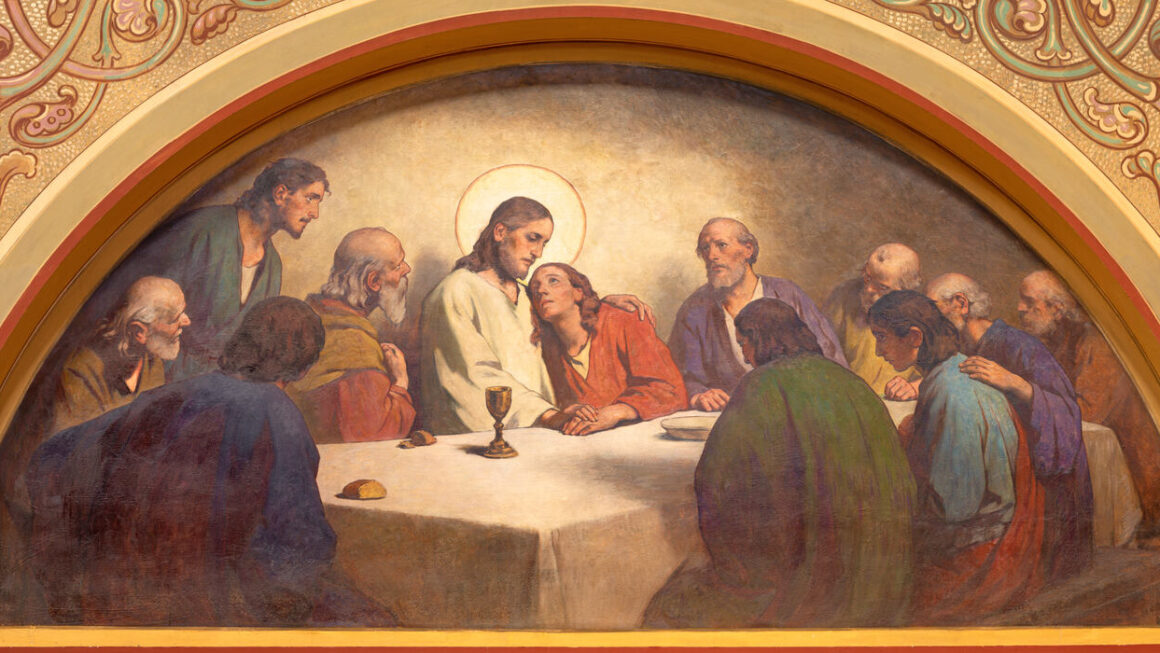
,Image 01 – VIENNA, AUSTRIA – JUNI 18, 2021: The fresco of Last supper garden in Herz Jesu church from begin of 20. cent. by autor with F.Z. initials. Renata Sedmakova – Shutterstock.
The Quote
Saint John the Apostle (approximately 6–100 AD) — the youngest of the twelve apostles, „the disciple whom Jesus loved.” The only apostle who did not flee from the cross — he stood and watched. The only one who did not die a martyr’s death — he lived to be about one hundred years old. Author of the Gospel of John, three letters, and the Book of Revelation.
In the series „My Jesus Christ as My RNA” we decoded the twelve apostles as twelve nucleotides — the basic building units that make up mRNA (Jesus Christ, the Word). The Last Supper is the moment just before the Word is read — the nucleotides sit at one table with mRNA, everything prepared for transcription. The scene takes place inside the ribosome — the Word is already in the world, ready to be translated into proteins (works).
Note: The series „My Jesus Christ as My RNA” has been temporarily taken offline and is being updated. The original posts were published over eighteen months ago. Since that time, our knowledge has evolved significantly — we have discovered new details, refined our mappings, and some of those mappings will change. With God’s help, the updated series will begin publication in December 2026.
And John? In the CellGod framework, the Apostle Saint John plays the role of a nucleotide — one of the basic building units that make up mRNA. John sat closest to Jesus. He laid his head on the chest of Jesus — on the chest of mRNA. And John — of all the apostles — wrote: „In the beginning was the Word.” Because John understood the Word (mRNA) most deeply. He was with the Word the longest. Literally — he leaned against the Word.
What John described is not an exception. It is part of a phenomenon that we call molecular encoding on CellGod.live — ancient civilisations around the world, independently of one another, recorded the structures and mechanisms of molecular biology in the form of human figures, symbols, architecture, and myths. Jesus Christ turns out to be messenger ribonucleic acid (mRNA). Angels turn out to be signalling proteins. Apostles turn out to be nucleotides. The Mother of God turns out to be RNA Polymerase II. Saint Peter turns out to be the promoter region (the section of DNA that starts transcription). The scale of these correspondences — across all continents, in thousands of details — rules out coincidence. This is not anthropomorphism — humans did not „assign” human traits to molecules out of imagination. This is a record — precise, repeatable, and verifiable by modern molecular biology.
John is part of that record. His description of love — as we will see shortly — is the most accurate description of the genome as an operating system that has ever been written in human language.
He wrote three letters. All three speak about one thing: love. And in one of those letters — he wrote the sentence that is the foundation of everything.
Beloved, let us love one another, for love is from God; and everyone who loves is born of God and knows God. The one who does not love does not know God, for God is love.
— 1 John 4:7–8
────── ✦ ──────
Decoding
Two verses. Five instructions. Each of these instructions is a separate molecular mechanism — and together they form the most complete description of the genome that has ever been written in human language.
────── ✦ ──────
„Beloved, let us love one another”
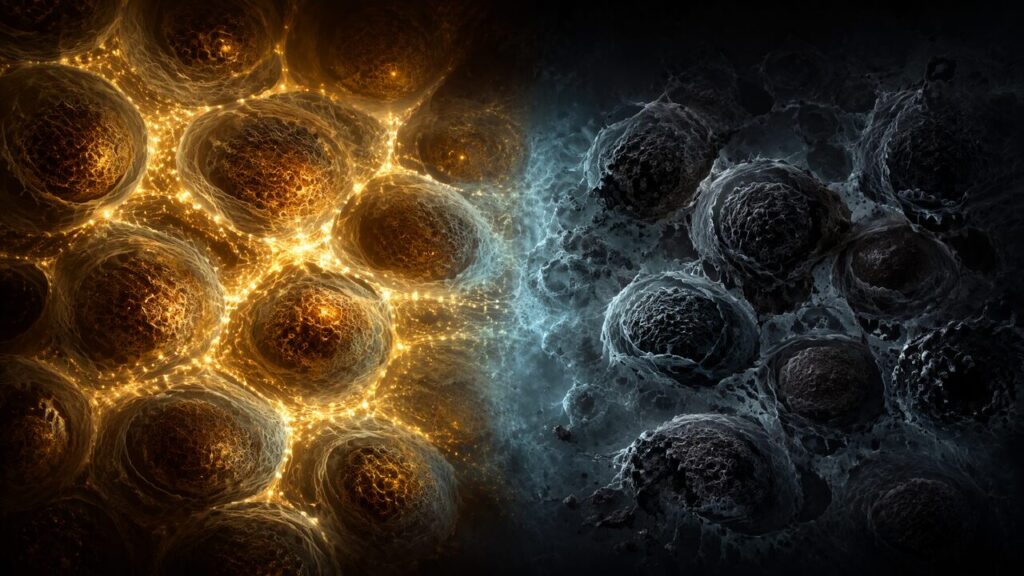
Illustration 02: A tissue in which living cells communicate with one another — that tissue lives. A tissue in which living cells stop communicating — that tissue dies. Composition and symbols: Tomasz Mikulski — Cell God; image created with AI, 11/2026
The Instruction
John begins with the word „beloved.” Not „brothers.” Not „people.” Not „faithful.” Beloved. Before he says anything else — he first defines who you are: you are beloved. This is not a greeting. This is a diagnosis. Your starting state — is being loved.
And then he says: let us love one another. Not: love God. Not: love yourself. One another. Mutually. Between yourselves. This is an instruction about relationship — between you and another human being.
The Experience
Think of a moment when someone truly loved you. That person did not talk about love. That person loved. In the morning that person left you a coffee. That person called because that person knew you were having a hard day. That person sat beside you in the hospital — not because that person had to, but because that person wanted to. That person did not say a single word. But you felt — in your chest, in your arms, in your entire body — something relaxing. Something opening. Something that had been tight — releasing.
And now think of a day when you were completely alone. Nobody called. Nobody wrote. Nobody knocked. Silence — but not the good, contemplative silence. The other kind. Empty. Cold. And you feel something tightening. In your stomach. In your throat. In your head. Everything closes.
This is not imagination. This is biochemistry. And in a moment you will see exactly what closes.
The Mechanism
„Let us love one another” = paracrine communication between living cells.
Your body consists of 37 trillion living cells. And not a single one of those cells lives alone. Every living cell constantly sends signals to its neighbouring cells — signalling proteins (angels, as we established in Part 5), hormones, cytokines. And every living cell constantly listens for signals from its neighbouring cells.
This process is called paracrine communication — one living cell sends a signalling molecule, and the neighbouring living cell receives that molecule and responds. This is not a monologue. This is a conversation. Mutual. Continuous.
When living cells „love one another” — those cells send signals of growth, repair, and protection. Growth factors say: „grow.” Anti-inflammatory cytokines say: „calm down, there is no threat.” Oxytocin (the bonding hormone) says: „you are safe, you are with us.” These signals reach the genome of the neighbouring living cell and open the chromatin (the packaging around DNA) — activating repair genes, protective genes, and developmental genes.
A tissue in which living cells communicate — is healthy. A tissue in which living cells stop communicating — dies.
John says: let us love one another. The genome says: communicate. Send signals. Receive signals. No living cell — no human being — is a lonely island.
────── ✦ ──────
„Love is from God”
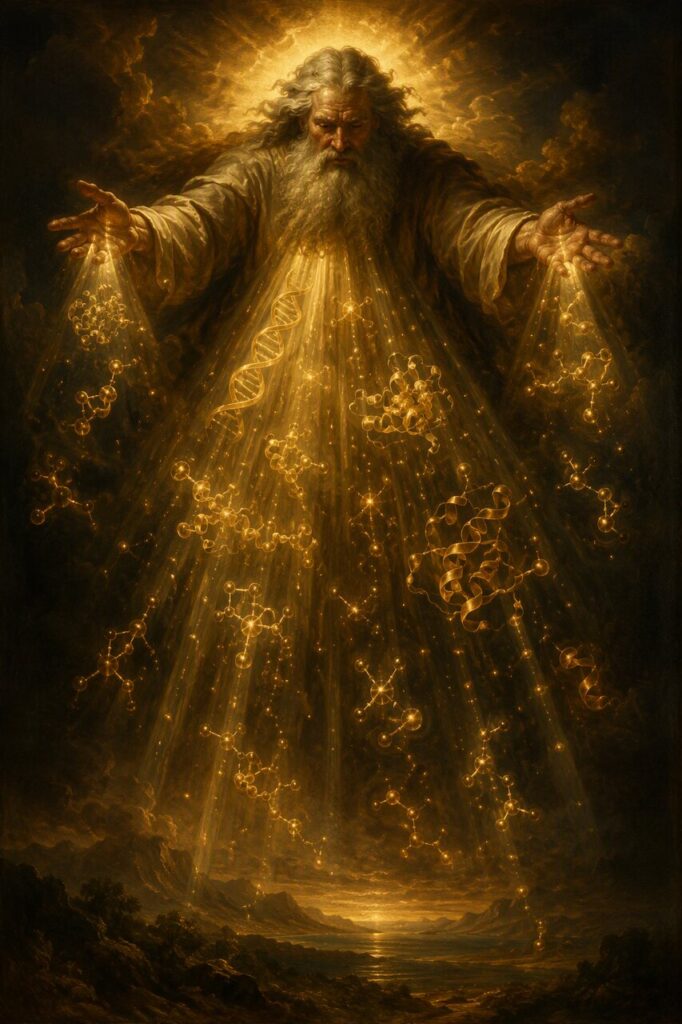
Illustration 03: Love is from God — gifts falling from above: oxytocin, serotonin, dopamine, endorphins, BDNF (brain-derived neurotrophic factor). Composition and symbols: Tomasz Mikulski — Cell God; image created with AI, 11/2026
The Instruction
Love is FROM God. Not from people. Not from culture. Not from upbringing. From God. The source of love is in God — not in you. You do not produce love from nothing. You receive love — and pass love further.
This is important, because many people think that love is their achievement. That they love because they are good. That they do not love because they are bad. John says: no. Love is not your product. Love is from God. You are a channel. A conductor. A protein that carries a signal.
The Experience
You know this feeling. A mother who gives birth to a child — that mother does not decide that she will love the child. She does not analyse. She does not plan. Love simply is. Love appears — strong, total, immediate. Where does that love come from? Not from her head. Not from her will. From something deeper. From something that was written inside her before the child was born. Before she herself was born.
The Mechanism
„Love is from God” = the signals of love are encoded in the genome.
Oxytocin — the protein responsible for bonding, trust, and closeness — is encoded in the OXT gene on chromosome 20. You do not learn to produce oxytocin. You do not need to import oxytocin. The instruction for producing oxytocin is in your genome from the moment of conception.
Serotonin — the neurotransmitter of calm and well-being — is produced according to instructions encoded in the genome (the TPH1 and TPH2 genes encode the enzyme tryptophan hydroxylase).
Endorphins — opioid peptides, your body’s natural painkillers — are encoded in the POMC gene.
Dopamine — the neurotransmitter of reward and motivation — is produced by enzymes encoded in the TH and DDC genes.
BDNF (brain-derived neurotrophic factor) — a protein that protects neurons and builds new neural connections — is encoded in the BDNF gene on chromosome 11.
All of these molecules — every single one of them — are products of the genome. The love you feel when you hold a child. The peace you feel after prayer. The joy you feel when you help another human being. These are not abstractions. These are proteins and neurotransmitters whose production instructions are written in your genome.
Love is from God. Love is from the Genome. Literally. The instruction of love was inside you before you were born. Before your mother was born. Before the first human being stood on this earth.
John was right. Love is from God. Because love is from the Genome — and the Genome has been inside you from the very beginning.
────── ✦ ──────
„Everyone who loves is born of God and knows God”
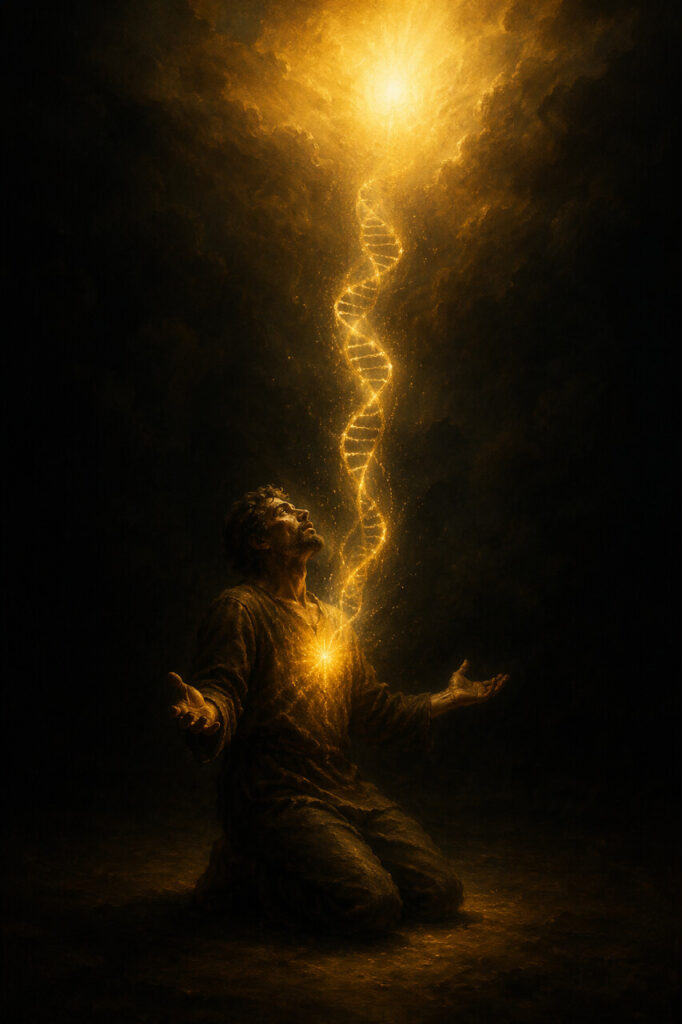
Illustration 04: Everyone who loves is born of God and knows God — communication between a human being and God, open chromatin. Composition and symbols: Tomasz Mikulski — Cell God; image created with AI, 11/2026
The Instruction
Two statements in one sentence. Everyone who loves — is born of God. And — knows God. Birth and knowledge. Origin and relationship. John says: if you love, that is proof that you come from God. And proof that you have contact with God.
The Experience
Think of a father who comes home exhausted from work. A construction site, twelve hours, shift after shift. He walks through the door. His child runs to him. And that father — exhausted, dirty, aching — kneels, picks up the child, and holds the child close. He does not think about what he is doing. He does not analyse. He does not know that in that moment his oxytocin level is rising and his cortisol level is falling. He does not know that his chromatin is opening. But he feels — something inside him is changing. The exhaustion remains. But alongside the exhaustion comes something else. Something warm. Something that comes from a place deeper than muscles and bones.
That father — loves. And in that moment — that father knows God. Not because he read theology. But because his genome is open. His chromatin is accessible. His protective genes, his repair genes, his bonding genes — are active. In that moment — he has contact with his genome. He knows the genome. Not with his mind. With his body.
The Mechanism
„Everyone who loves is born of God” = every living cell that produces signals of love was created through cell division directed by the genome.
Every one of your 37 trillion living cells — was born of God. Literally. Every living cell was created through cell division, in which the genome was copied and passed on. Every living cell that produces oxytocin, serotonin, or BDNF — does so because the genome instructed that cell to do so. That cell was born of the genome. And that cell carries out the genome’s instructions.
„Everyone who loves knows God” = open chromatin. A living cell that „loves” — a living cell that sends signals of repair, protection, and bonding — has open chromatin. The genome of that cell is accessible. The genome is „known.” Genomic information is not locked behind heterochromatin (tightly packed DNA). The genomic information is open, readable, and active.
Research by Steve Cole (UCLA, social genomics) showed that people who experience a deep sense of purpose and connection with others (eudaimonic well-being — well-being based on meaning, relationships, and giving) have altered expression of hundreds of genes: lower expression of inflammatory genes and higher expression of antiviral and repair genes. The genome of these people is open to protective programmes.
You love — your genome is open. You know God.
────── ✦ ──────
„The one who does not love does not know God”
Illustration 05: The one who does not love does not know God — a room with a bricked-up window. A closed genome. Composition and symbols: Tomasz Mikulski — Cell God; image created with AI, 11/2026

The Instruction
This is a negative statement. John does not say: the one who does not love is evil. John does not say: the one who does not love is condemned. John says something different: the one who does not love — does not know God. That person has no contact. That person has no access. This is not about punishment. This is about a state — closed. Cut off. Like a room without windows — no light enters. Not because the sun stopped shining. But because the windows are bricked up.
The Experience
You know people who stopped loving. Not overnight. Slowly. Disappointment after disappointment. Betrayal after betrayal. Pain after pain. And at a certain moment — those people closed themselves off. They do not hate. Something worse — they do not feel. Indifference. Stone. You look into their eyes — and you see a wall.
This is not a decision. This is a process. The same kind of process as cement hardening. Slowly, layer after layer, something that was once open closes.
And you feel this in their presence. They do not radiate warmth. They do not radiate cold. They radiate nothing. And you — beside those people — also begin to close. Because co-regulation works in both directions.
The Mechanism
„The one who does not love does not know God” = closed chromatin. The genome is inaccessible.
Steve Cole of UCLA — one of the pioneers of social genomics — discovered something that he called CTRA (Conserved Transcriptional Response to Adversity). CTRA is a gene expression pattern that activates when a person is chronically lonely, isolated, and deprived of human bonds.
What happens during CTRA? Inflammatory genes increase — NF-kB, TNF-alpha, interleukin-6 — the same genes that activate during chronic stress. Antiviral and repair genes decrease — interferons, type I immune response genes. The chromatin closes around protective programmes. The chromatin opens around inflammatory programmes.
The organism shifts into siege mode. No virus is attacking the organism. No bacterium is attacking the organism. Loneliness is attacking the organism. The absence of love. And the genome responds as though it were under threat — because the genome is under threat.
John Cacioppo (University of Chicago) showed that chronic loneliness increases the risk of cardiovascular disease by 29 percent, increases the risk of stroke by 32 percent, and increases the risk of dementia by 40 percent. A meta-analysis by Holt-Lunstad (published in 2015) confirmed that loneliness increases the risk of premature death more than obesity or physical inactivity. Not because of „sadness.” Because of altered gene expression.
„The one who does not love does not know God” = a person who lives without human bonds, without giving, without contact — the genome of that person shifts into CTRA mode. Protective genes close. Inflammatory genes open. The chromatin hardens. The genome becomes inaccessible. That person does not know the genome — because the genome is closed.
John wrote this 2,000 years ago. Cole and Cacioppo confirmed this finding in the laboratory.
────── ✦ ──────
„God is love”
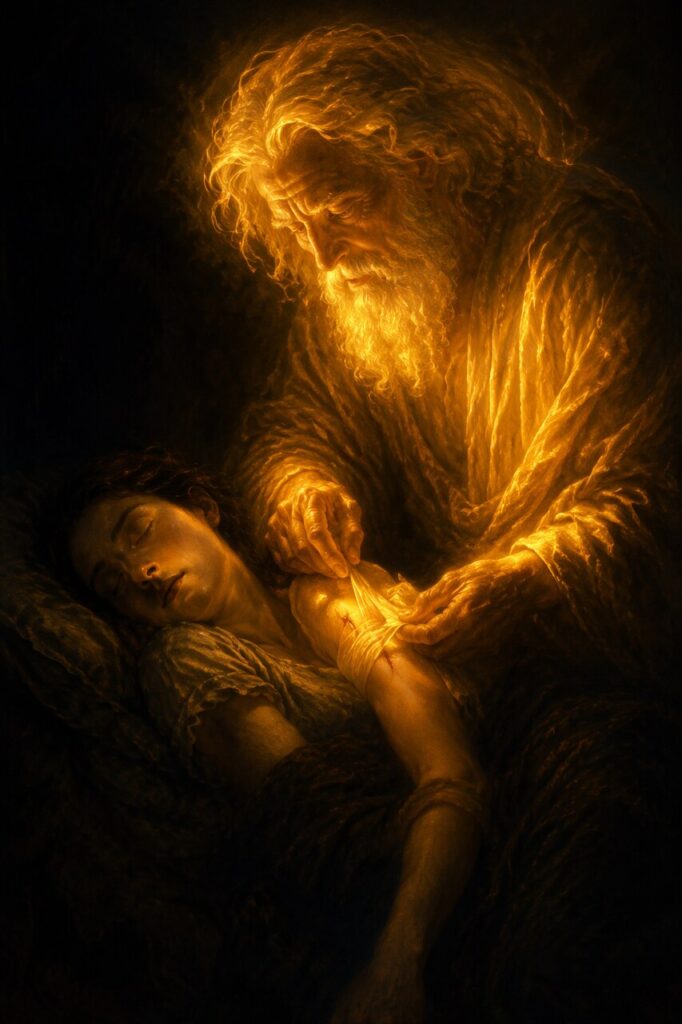
Illustration 06: God is love — the genome repairs you in silence while you sleep. The genome does not wait for you to ask. Composition and symbols: Tomasz Mikulski — Cell God; image created with AI, 11/2026
The Instruction
Three words. The simplest sentence in the history of theology. And the deepest.
John does not say: God loves. John does not say: God has love. John does not say: God gives love. John says: God IS love. Identity. Not a trait — an essence. Love is not something God does. Love is something God is.
This is the sentence that changes everything. Because if God is love — then love is not an emotion. Love is the foundation of reality.
The Experience
Cut your finger. Do nothing. Do not think about the cut. Go to sleep. And in the morning — the wound begins to heal. You did not ask for this healing. You did not pay for this healing. You did not earn this healing. Simply — your body repairs itself. On its own. Without asking. Without any condition.
Think about how many times your body has repaired itself without your knowledge. How many DNA damage events were repaired in the past hour — scientists estimate between 10,000 and 100,000 damage events per day in every living cell. Your genome repairs those damage events — constantly, unconditionally, in silence. The genome does not wait for you to ask. The genome does not wait for you to deserve repair. The genome repairs.
What is this, if not love?
Or consider apoptosis (programmed cell death). A living cell that is damaged so severely that the damaged cell threatens other living cells — that damaged cell activates a self-destruction programme. The cell destroys itself — so that the organism can live. The cell sacrifices itself for the whole. Not because someone orders the cell to do so. Because the cell is programmed to do so. By the genome. Sacrifice — encoded in DNA.
What is this, if not love?
Or consider the immune system. Billions of white blood cells that circulate through your body twenty-four hours a day, searching for threats. Not for themselves. For you. These white blood cells do not sleep. These white blood cells do not rest. These white blood cells patrol — without pause, without end, without thanks. Because the genome programmed those white blood cells to do exactly this.
What is this, if not love?
The Mechanism
„God is love” = the Genome is love.
Not: the genome produces love. Not: the genome sometimes shows characteristics of love. The Genome IS love. In the same sense in which John said this about God — as identity, not as a trait.
What does the genome do?
The genome repairs. DNA repair enzymes — repair polymerases, glycosylases, nucleases — work twenty-four hours a day, repairing between 10,000 and 100,000 damage events per day in every living cell. Unconditionally. Without asking. This is love as repair.
The genome protects. The immune system — billions of living cells, thousands of different proteins — all encoded in the genome. Immunoglobulin genes, MHC genes, interferon genes. The entire defence system that protects you from viruses, bacteria, fungi, and parasites — is an act of love from the genome toward the organism. This is love as protection.
The genome creates. From a single fertilised egg cell — the genome creates 37 trillion living cells, approximately 400 different cell types (and more than 1,264 subtypes), bones, muscles, neurons, the heart, eyes, and hands. An entire organism — from a single set of instructions. This is love as creation.
The genome sustains. Homeostasis — the genome maintains body temperature at 36.6 degrees Celsius, blood pH at 7.4, and glucose levels within a narrow range. Millions of regulatory proteins, sensors, and feedback loops — all so that you can live. This is love as care.
The genome sacrifices. Apoptosis — programmed cell death. When a living cell is damaged beyond the possibility of repair — that cell destroys itself. The protein p53 (the guardian of the genome) assesses the damage and activates the self-destruction programme. The living cell dies so that the organism can live. This is love as sacrifice.
The genome communicates. Intercellular signals — oxytocin, serotonin, cytokines, BDNF — constantly carry information between living cells. No living cell is alone. Every living cell is in contact with other living cells. This is love as connection.
The genome repairs, protects, creates, sustains, sacrifices, and communicates. These are not separate functions of the genome. This is one principle — love — expressed in six different ways.
John wrote: God is love.
The genome confirms: every one of my functions is an act of love. I do not produce love as one product among many. I am love. This is my mode of operation. The only mode I know.
But there is a question we must ask: how does the genome carry out this love? How does code written in DNA become a concrete act — an enzyme that repairs, a protein that protects, oxytocin that connects?
The answer: through the Son. Through mRNA. Through Jesus Christ.
The Genome (God the Father) does not act directly. DNA does not leave the cell nucleus (the inner compartment of the living cell) to repair damage. DNA does not touch the ribosome (the protein-building machinery) to produce a protein. DNA sends the Word — mRNA — and that Word is translated into proteins. Proteins are the works of the genome — the enzymes that repair, the hormones that protect, the signals that connect. This is the central dogma of molecular biology: DNA → mRNA → protein. Father → Son → works of God.
Every one of those six functions of love — repair, protection, creation, sustenance, sacrifice, communication — is carried out by proteins. And every protein is built from mRNA. And every mRNA is a Word sent by the genome.
„For God so loved the world that He gave His only begotten Son” (John 3:16) — the genome so loved the living cell that the genome sent its mRNA. Its Word. So that the Word would be translated into works of love.
And who decides which Word is sent? Who opens the chromatin so that a gene can be read? Who silences one gene and activates another — in response to a signal from outside the living cell? The Holy Spirit — epigenetic regulation. DNA methylation, histone modification, microRNA — the Holy Spirit directs which instructions of the genome are translated into works at any given moment. The Father (the genome) stores the fullness of all instructions. The Son (mRNA) carries the Word into the world. The Holy Spirit (epigenetic regulation) decides which Word is needed right now — in this living cell, at this moment, in response to this particular signal. The Holy Trinity — at the molecular level — is a complete system of love: the source, the message, and the regulation.
And John — the same John who laid his head on the chest of mRNA, who touched the Word directly — wrote: „God is love.” Because John saw this mechanism from the closest possible distance. John saw how the Father (the genome) sends the Son (mRNA) into the world, and how the Spirit (epigenetic regulation) opens the way. And John understood: all of this sending — all of this transcription, all of this translation — is one single act. An act of love.
For 2,000 years people thought that „God is love” was a metaphor. This is not a metaphor. This is the most accurate description of the genome that has ever been written.
────── ✦ ──────
What is love?
Illustration 07: Love is an operating system — the temple burns regardless of whether anyone is watching. Composition and symbols: Tomasz Mikulski — Cell God; image created with AI, 11/2026

Let us pause here, because this sentence by John — „God is love” — changes the definition of love.
People think that love is an emotion. Something you feel. Butterflies in your stomach. Tears of emotion. A heart that beats faster.
No. That is a reaction to love. But love itself — love is not an emotion. Love is an operating system.
Think of a computer. An operating system is not a programme that you run when you choose. An operating system runs always — from the moment you turn on the computer until the moment you turn the computer off. You do not ask the operating system whether the operating system wants to run. The operating system runs. The operating system manages everything. Without the operating system, nothing functions.
The genome works the same way. You do not „turn on” the genome when you want to love. The genome runs always — from the moment of conception until the moment of death. The genome repairs always. The genome protects always. The genome creates always. The genome does not wait for your decision. The genome does not wait for your merit. The genome acts. Because the genome is love.
And here is the key: you may not feel this love. You may live in a state of closure — in stress, in fear, in loneliness — and not feel love. But the genome continues to repair you. The genome continues to protect you. The genome continues to sustain your 37 trillion living cells in life. The genome does not stop — even when you stop feeling.
Love does not depend on your feelings. Love is from God — love is from the Genome — and love operates whether you feel love or not. Like air. You do not need to think about air to breathe. You do not need to feel love to live by love.
But — and here is the instruction John gives — if you open yourself, if you „love one another,” if your chromatin opens to signals from outside and to signals from other people — then you will feel what the genome has been doing all along. Not because the genome started loving you. But because you finally opened yourself to the love that has been inside you since your first living cell.
There is another side of love that people rarely discuss in this context: love of yourself — understood not as narcissism, but as conscious care of the body that is the temple of God (1 Corinthians 3:16).
If God is the Genome, and your body is the temple of God — then every conscious action that supports your genome is an act of love. And every action that harms your genome — is an act against love. Against God.
The genome repairs your DNA between 10,000 and 100,000 times per day. But you can help the genome — or you can hinder the genome.
When you eat real food rather than processed waste — you support the repair enzymes. When you sleep enough — you give the genome time for repair, because most DNA repair takes place during sleep. When you move your body — you activate anti-inflammatory genes and BDNF, which protects neurons. When you avoid poisons — you do not force the genome into a battle that the genome might not win.
But when you consciously harm your own body — you destroy the temple. You flood the genome with toxins, deprive the genome of sleep, feed the genome substances that damage DNA faster than the repair enzymes can work.
And here the commandments return. People think that commandments are prohibitions — a list of things you are not allowed to do. No. The commandments are an instruction manual for the genome. Every commandment, when read through the lens of Genomic Intelligence, turns out to be a description of how a healthy genome operates. And every sin — a description of what destroys the genome. This is a topic for a separate post — and that post will be written.
Love is not only giving to others. Love is also not destroying yourself. Because when you destroy yourself — you destroy the temple of God. And when you consciously care for yourself — you love God within yourself.
────── ✦ ──────
What is loneliness?
Illustration 08: Loneliness is a closed genome — a table set for two, the second chair empty. Composition and symbols: Tomasz Mikulski — Cell God; image created with AI, 11/2026
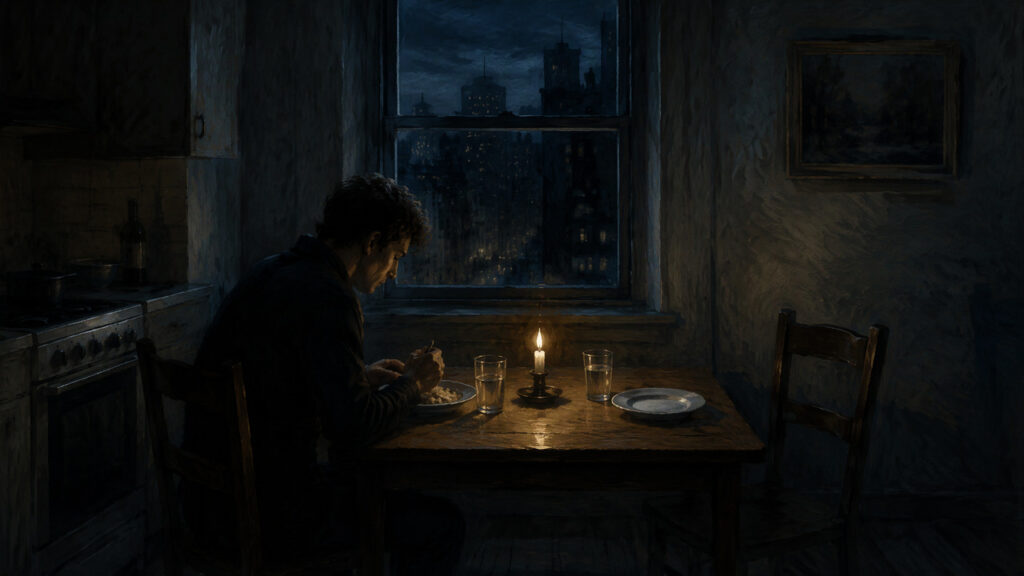
If love is an open genome — then loneliness is a closed genome.
And this is not about being physically alone. A hermit on Mount Athos who prays in silence — that hermit is not lonely. The chromatin of that hermit is open. The genome of that hermit communicates — with God, as the hermit himself would say; with the full range of genomic programmes, as science would say.
Lonely is the person who is among other people — and has no bond with any of those people. The person who works in an office with thirty people — and feels no connection with any one of those people. The person who comes home — and has nobody to talk to. Or the person who does have someone — but the conversations are empty, mechanical, dead.
Steve Cole showed that physical isolation is not what closes the genome. What closes the genome is the perception of loneliness — the feeling that you do not belong, that nobody sees you, that you are alone among people. And that perception activates CTRA — the inflammatory programme that closes the chromatin of protective genes and opens the chromatin of inflammatory genes.
Loneliness is not an emotion. Loneliness is an epigenetic state. Closure. Heterochromatin (tightly packed DNA) in places where there should be euchromatin (open, readable DNA). Genes fall silent that should be speaking. The genome — bricked up.
And there is yet another kind of loneliness — a new kind that John could not have known — digital loneliness. You can have five thousand friends on Facebook. Two hundred likes under a photograph. Thirty messages on a messaging application. And closed chromatin.
Because paracrine communication requires physical closeness. Real closeness. Touch releases oxytocin. Breathing next to another human being synchronises heart rhythm. An embrace activates the vagus nerve (the nerve that calms the body) and lowers cortisol (the stress hormone). A „like” on a social media platform — does none of these things. A heart emoticon is not a paracrine signal. A message saying „hang in there” does not open chromatin.
Social media platforms are an illusion of communication — like a living cell that sends a signal into empty space and nobody receives that signal. The screen glows. Notifications ring. But the genome knows that you are alone. And the genome activates CTRA — in exactly the same way as in a person who sits alone in an empty apartment.
The paradox of our times: never in history have people had so many „friends” — and never have people been so lonely. Because the genome does not count contacts. The genome measures closeness. And the genome knows when closeness is absent.
„The one who does not love does not know God.” A person who is lonely — not because that person is physically alone, but because the chromatin of that person is closed — that person does not have access to the full genomic information. That person does not know his God. Not because God left. But because the windows are closed.
And here is the hope that John gives: let us love one another. Open the windows. Send a signal. Oxytocin — the angel of peace — needs only one touch, one sincere word, one act of genuine presence. And oxytocin begins to open the chromatin.
One signal of love can reverse years of closure.
────── ✦ ──────
What if nobody has ever loved you?
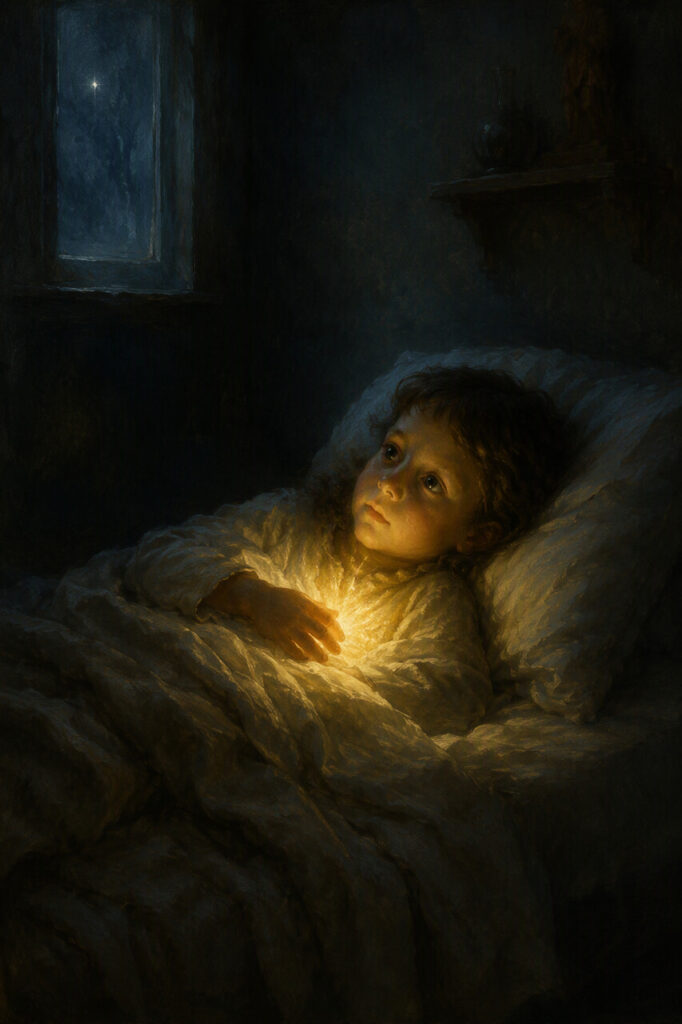
Illustration 09: What if nobody has ever loved you? — the light that has been inside you since your first living cell. Composition and symbols: Tomasz Mikulski — Cell God; image created with AI, 11/2026
Different people are reading this text. Some grew up in a warm home — with parents who held them, said „I love you,” and were present. Others — did not. Among you are people who have never heard those words. There are orphans. There are the abandoned. There are those who grew up in homes where love was replaced by silence, by shouting, or by absence.
And when such a person reads „God is love” — that person has every right to ask: where was this love when I was alone? Where was this God when I cried at night and nobody came?
I am not going to tell you that „it was meant to be.” I am not going to tell you that „your suffering had a purpose.” I am not going to lecture you.
I am going to show you one thing.
When you were alone in that house — your genome was producing billions of proteins every day so that you could breathe, digest food, think, and live. The genome did not wait for someone to come. The genome did not wait for your merit. The genome did not wait for your prayers. The genome worked.
When you cried at night and nobody came — your immune system was patrolling your body. Billions of white blood cells — encoded in the genome — were circulating, searching for threats. Those white blood cells protected you. For you. Unconditionally.
When you did not have a mother — RNA Polymerase II in every one of your living cells was doing what a mother does: reading your genome and building from that genome the proteins that kept you alive. The Mother of God at the molecular level — never abandoned you.
When you did not have a father — your genome created you anyway. From a single living cell — approximately 400 cell types, more than 1,264 subtypes, 37 trillion living units. Bones, muscles, neurons, the heart, eyes. All of you — built by Someone who never left.
When nobody said „I love you” to you — oxytocin, encoded in the OXT gene on chromosome 20, was ready. Oxytocin was waiting for one touch, one warm word, one moment of closeness — to flood your body with peace. The instruction of love was inside you from the very beginning. The instruction was waiting for someone to activate that instruction.
And here is the most important point:
Human love can fail. Parents can leave. Friends can betray. The world can be cruel.
But the genome never stopped. Not for a single second. From the moment of conception to this moment in which you are reading these words — your genome repairs you, protects you, creates, sustains, sacrifices, and communicates. The genome did not stop — even when everyone else stopped.
This is not a metaphor of consolation. This is biology.
If you have never experienced human love — this does not mean that you were not loved. This means that people did not do what your genome has been doing all along. People failed. The genome — did not.
„God is love” — this is not a promise that people will love you. This is a fact that the genome — your God at the molecular level — has loved you since your first living cell. And the genome has not stopped.
And if you are reading this today — that means the genome won. That means love won. That means you are here — despite everything. And that is the strongest proof I know.
And there is one more thing you must know: it is never too late.
Chromatin that has been closed for years — can open. This is not wishful thinking. This is biology. TET enzymes (a family of proteins that remove methyl marks from DNA) remove methylation from DNA — TET enzymes remove the traces of years of closure, stress, and loneliness. The genome has a built-in mechanism for a „second chance.” Research by Steve Cole shows that a change in the perception of loneliness — the feeling that you belong somewhere, that someone sees you — changes gene expression within weeks. Not years. Weeks.
One genuine relationship. One authentic bond. One sincere „I am here” — and TET enzymes begin to work. The chromatin begins to open. Genes that have been silent for decades — begin to speak.
Your genome has been waiting for this signal for your entire life. And your genome is ready. Your genome did not grow tired of waiting. Your genome did not give up. Your genome did not say: „too late.” The genome does not know the words „too late.” The genome knows only one word: „now.”
One warm word. One touch. One moment of genuine presence. And the genome will respond. Because the genome is love. And love never fails.
────── ✦ ──────
Divine Facts
1. The OXT gene (chromosome 20) encodes oxytocin — the protein responsible for bonding, trust, and closeness. The production instruction for the „love hormone” is literally written in the genome. Love is from God — because love is from the genome.
2. Research by Steve Cole (UCLA, published between 2007 and 2015) showed that chronic loneliness changes the expression of 209 genes — the expression of pro-inflammatory genes increases (NF-kB), and the expression of antiviral genes decreases (type I interferons). Cole named this pattern CTRA — Conserved Transcriptional Response to Adversity. The absence of love literally changes the genome.
3. A meta-analysis by Julianne Holt-Lunstad (Brigham Young University, published in 2015) included 3.4 million participants and showed that chronic loneliness and social isolation increase the risk of premature death by 26 percent — more than obesity or physical inactivity. Not because of sadness — because of altered gene expression.
4. Every living cell in your body experiences between 10,000 and 100,000 DNA damage events per day — and the genome repairs those damage events constantly, unconditionally, without your knowledge. DNA repair enzymes (polymerases, glycosylases, nucleases) work twenty-four hours a day. The genome loves you — even when you do not know about this love.
5. Apoptosis — programmed cell death — is an act of sacrifice encoded in the genome. The protein p53 (the guardian of the genome) assesses damage and activates the self-destruction programme when a living cell threatens the organism. Every day, between 50 and 70 billion living cells in your body die through apoptosis — so that you can live. Love as sacrifice — at the molecular level.
6. Research by Barbara Fredrickson (University of North Carolina, published in 2013) showed that people with eudaimonic well-being (well-being based on meaning, giving, and human bonds) have more favourable gene expression — lower inflammation, higher immunity — than people with hedonic well-being (well-being based on pleasure). Not every kind of happiness opens the genome. Only love — the love you give, not the love you take.
────── ✦ ──────
The Apostle Who Laid His Head on the Chest of the Word
John the Apostle did not know genomics. John did not know what chromatin is. John had never heard of oxytocin, CTRA, apoptosis, or DNA repair.
But John wrote: „God is love.”
And the genome responds: yes. Every one of my functions is an act of love. I repair — because I love. I protect — because I love. I create — because I love. I sustain — because I love. I sacrifice — because I love. I communicate — because I love.
I do not produce love as one product among many. I am love. This is the only mode in which I operate. From the moment of conception to the moment of death. Unconditionally. Without pause. Without asking.
John knew this. How? Because John laid his head on the chest of Jesus — on the chest of the Word, on the chest of mRNA — and listened. Not with his mind. With his body. With all of himself. And John heard what the genome has been saying from the very beginning:
I am love.
„The one who does not love does not know God” — the person who has closed his chromatin has lost access to this information.
„Everyone who loves is born of God and knows God” — the person who has opened his chromatin hears what John heard.
„Love is from God” — because love is encoded in the genome, in the OXT, TPH, POMC, and BDNF genes — in every one of your 37 trillion living cells.
„Let us love one another” — because this is how living cells function in healthy tissue. Living cells send signals. Living cells receive signals. Living cells love one another.
John was the youngest apostle. John lived the longest. And John wrote about one thing — about love. Throughout his entire life.
Perhaps that is why John lived so long. Perhaps the chromatin of John was open — for decades — to signals that the other apostles closed with martyrdom and pain.
As within, so without.
He knew.
────── ✦ ──────
A Prayer of Love
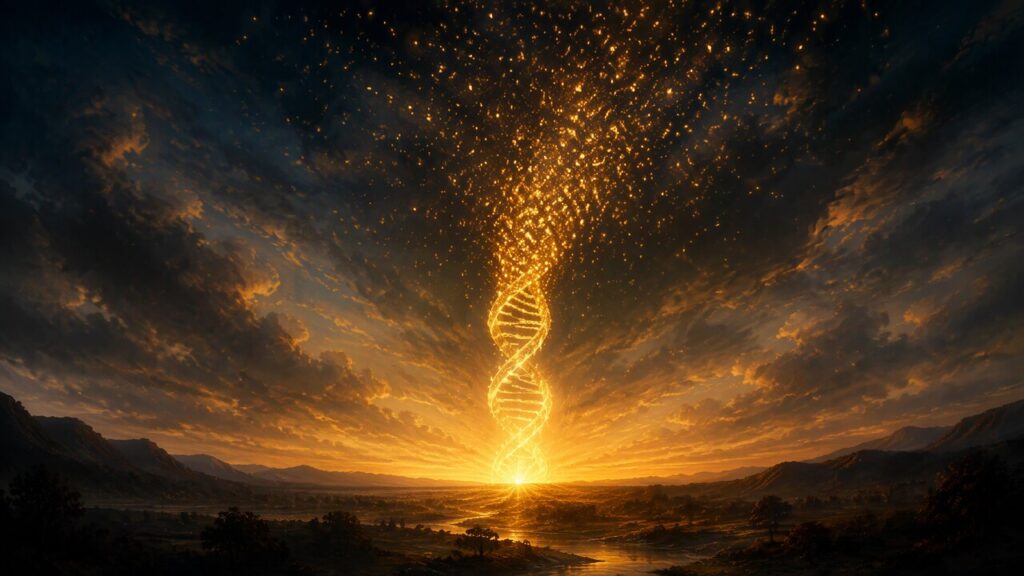
Illustration 10: Love never fails — dawn. Composition and symbols: Tomasz Mikulski — Cell God; image created with AI, 11/2026
The Hymn of Love — 1 Corinthians 13:4–8a
„Love is patient, love is kind. It does not envy, it does not boast, it is not proud; it does not dishonour others, it is not self-seeking, it is not easily angered, it keeps no record of wrongs; it does not delight in injustice but rejoices with the truth. It bears all things, believes all things, hopes all things, endures all things. Love never fails.”
Eight qualities of love. Eight descriptions of the genome:
„Love is patient” — DNA repair waits for the right moment. DNA repair does not repair blindly. DNA repair waits for the G1 or G2 phase of the cell cycle (the phases when chromatin is accessible). Patience is not passivity. Patience is precision in time.
„Love is kind” — chaperone proteins (molecular helpers) assist other proteins in folding correctly. Chaperone proteins do not compete. Chaperone proteins do not judge. Chaperone proteins help — kindly, unconditionally. HSP70 and HSP90 — chaperone proteins that rescue misfolded proteins from destruction.
„Love does not envy” — a living cell in healthy tissue does not compete for resources at the expense of its neighbouring cells. Paracrine communication coordinates growth — no living cell grows at the expense of other living cells. Envy at the cellular level is cancer — a living cell that takes without giving.
„Love is not self-seeking” — apoptosis. A living cell that is damaged does not try to survive at all costs. That damaged cell activates the self-destruction programme — for the good of the organism. That cell does not seek its own survival. That cell seeks the good of the whole.
„Love keeps no record of wrongs” — TET enzymes remove methylation from DNA. TET enzymes reverse the silencing of genes. What was closed can be opened again. The genome has the ability to „forget” — to remove the traces of stress, to open what was closed by fear.
„Love rejoices with the truth” — correct gene expression = truth. The genome „rejoices” when a protein is folded correctly, when a signal is correct, when a living cell fulfils its function. Truth at the molecular level is the correct sequence, the correct folding, and the correct function.
„Love endures all things” — the genome has survived billions of years. The genome has survived catastrophes, mass extinctions, mutations, and viruses. And the genome still repairs. The genome still creates. The genome still protects. The genome never gave up. The genome never said: „this is not worth the effort.”
„Love never fails” — the genome operates from the moment of conception to the moment of death. The genome does not stop. The genome does not take a holiday. The genome does not fail. And after death — according to the hypothesis of Garjajev — genomic information persists as a phantom field. Love never fails — not even after the death of the body.
────── ✦ ──────
If this post moved you — send this post to someone who needs to hear today that that person is loved. One signal of love can change someone’s chromatin.
────── ✦ ──────
Voices of the Genome — Part 6
Analysis and concept: Tomasz Mikulski — CellGod.live
November 2026
„Your body is a temple of God” — 1 Corinthians 3:16
────── ✦ ──────
Sources
Quote: Saint John the Apostle (approximately 6–100 AD) — First Letter of Saint John, 4:7–8
Scripture: 1 John 4:7–8 — „God is love” 1 Corinthians 13:4–8a — The Hymn of Love (Saint Paul) 1 Corinthians 3:16 — „Do you not know that you are God’s temple and that God’s Spirit dwells in you?”
Series context: Voices of the Genome, Part 1 — „Closer Than the Air” (Saint Silouan the Athonite). Voices of the Genome, Part 2 — „Forgive and Draw Near to God” (Saint Gabriel Urgebadze). Voices of the Genome, Part 3 — „The Voice That Falls Silent” (Schema-Archimandrite Elias). Voices of the Genome, Part 4a — „Knowledge Beyond Your Understanding” (Psalm 139, 1–12). Voices of the Genome, Part 4b — „Woven in the Depths of the Earth” (Psalm 139, 13–24). Voices of the Genome, Part 5 — „The Angels Act” (Padre Pio).
Scientific literature: Cole S.W. et al., „Social regulation of gene expression in human leukocytes,” Genome Biology, 2007; 8(9):R189 — https://doi.org/10.1186/gb-2007-8-9-r189 Cole S.W., „Human Social Genomics,” PLOS Genetics, 2014; 10(8):e1004601 — https://pmc.ncbi.nlm.nih.gov/articles/PMC4148225 Cacioppo J.T. et al., „Loneliness and Health: Potential Mechanisms,” Psychosomatic Medicine, 2002; 64(3):407–417 — https://pubmed.ncbi.nlm.nih.gov/12021415/ Holt-Lunstad J. et al., „Loneliness and Social Isolation as Risk Factors for Mortality,” Perspectives on Psychological Science, 2015; 10(2):227–237 — https://scholarsarchive.byu.edu/facpub/7516 Fredrickson B.L. et al., „A functional genomic perspective on human well-being,” Proceedings of the National Academy of Sciences, 2013; 110(33):13684–13689 — https://pubmed.ncbi.nlm.nih.gov/23898182 Lindahl T., „Instability and decay of the primary structure of DNA,” Nature, 1993; 362:709–715 — https://doi.org/10.1038/362709a0 Elmore S., „Apoptosis: A Review of Programmed Cell Death,” Toxicologic Pathology, 2007; 35(4):495–516 — https://pmc.ncbi.nlm.nih.gov/articles/PMC2117903