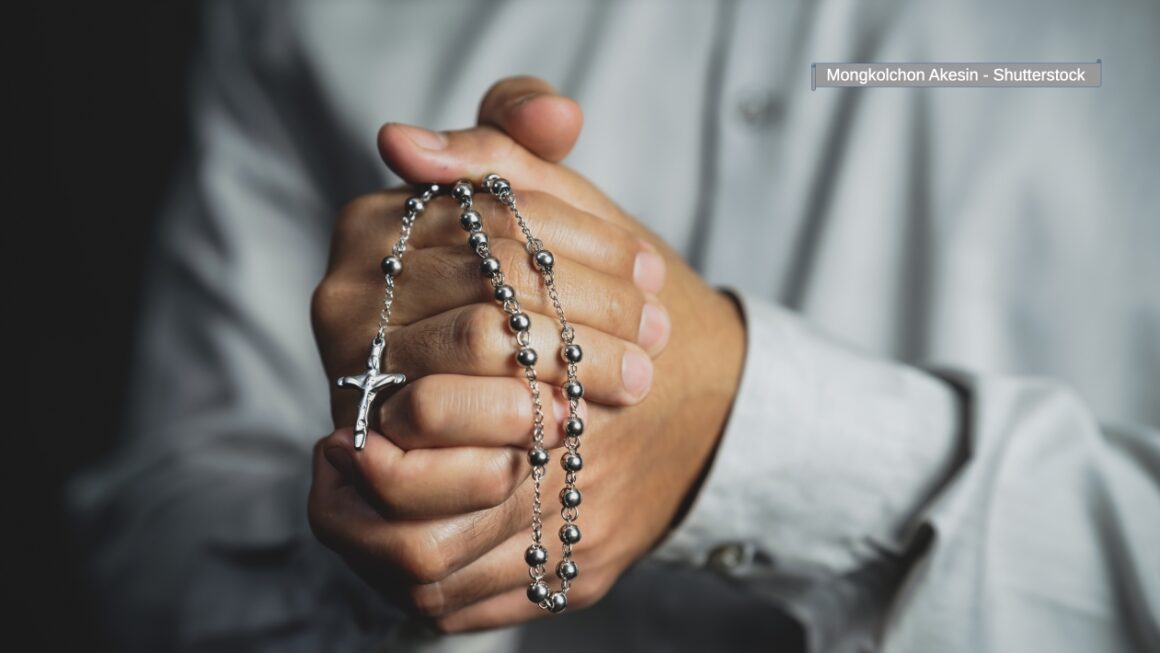
” 1. Christ the tRNA: A Molecular Way of the Cross”
In the cellular laboratory where genetic code transforms into life, transfer RNA (tRNA) undergoes a metamorphosis akin to Christ’s journey along the Via Dolorosa. Before becoming a functional mediator between genetic code and protein synthesis, it must be cleaved, modified, and reshaped through a painful maturation process. Similarly, Christ—through His passion and crucifixion—becomes the perfect mediator between God and humanity. In this analogy, Golgotha becomes the cellular processing site for tRNA, where suffering leads to functional fulfillment.
,Photo description: Antique crucifix made of gold – Roman Catholic Church, Jesus Christ.
,Vector description: Structure of tRNA. Two-dimensional structure. Transfer RNA is a small RNA molecule that participates in protein synthesis. Amino acid. mRNA.
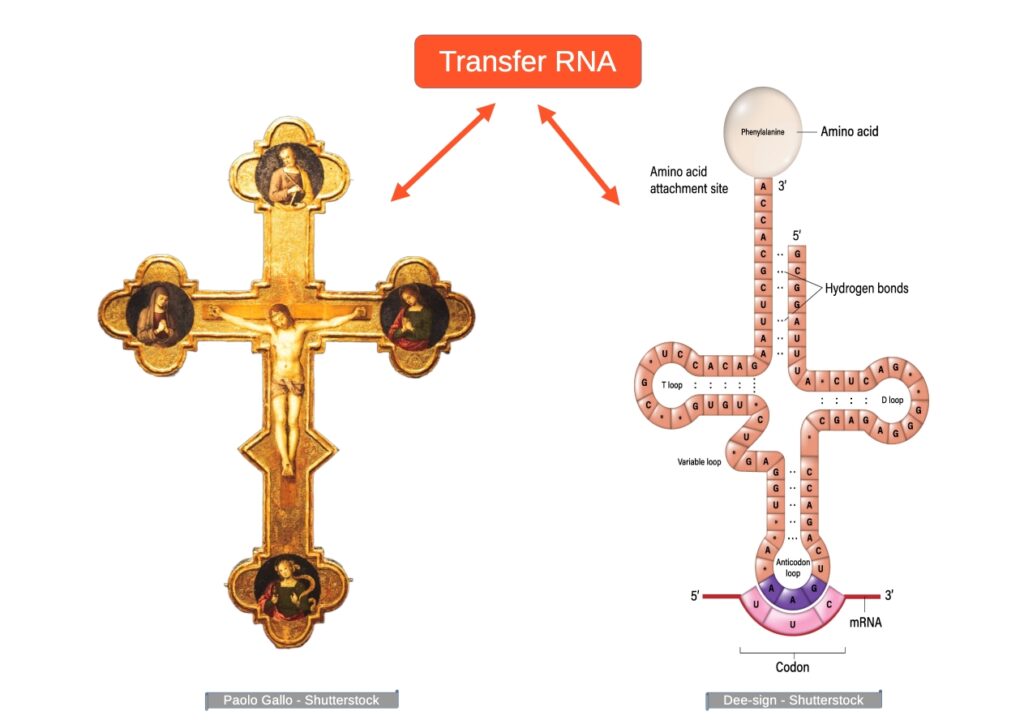
- „The Structure of the Cross – The Structure of tRNA” The classical crucifix, with its vertical axis ascending to heaven and its horizontal axis embracing the world, mirrors the folded structure of tRNA. The central stem of tRNA resembles the vertical beam of the cross—stable and essential for maintaining function. The horizontal loops of tRNA, and anticodon—extend like Christ’s outstretched arms, ready to receive and transmit what is necessary for life.
- „The tRNA’s Way of the Cross” tRNA maturation is a process that parallels the Stations of the Cross. The precursor transcript is like an innocent convict—first cleaved by enzymes (like scourging), then stripped of introns (like garments), and finally subjected to chemical modifications (like the crown of thorns and nailing to the cross). Each alteration is necessary for tRNA to fulfill its role. Without these cuts and transformations, it would remain a useless fragment, just as Christ’s sacrifice would lack its purpose without the cross.
- „The Anticodon – The Word That Recognizes Truth” The anticodon loop of tRNA must precisely match the mRNA codon to ensure faithful genetic translation. This mirrors Christ as the Logos—the incarnate Word—who perfectly reads and fulfills the Father’s will. Any mismatch would lead to errors in protein synthesis, just as any deviation from God’s plan would thwart salvation. In this analogy, the cross becomes the site of ultimate „matching”—where Christ’s human nature perfectly aligns with divine purpose.
In this unexpected analogy between biology and theology, we uncover a profound pattern: life emerges through mediation that requires suffering. tRNA must be cleaved and transformed to become functional—just as Christ must endure the cross to become the bridge of salvation. In both cases, pain is not the end but a necessary stage in fulfilling destiny. The cross, then, is not merely an instrument of death but a matrix for sacred synthesis—where sacrifice transforms into life, and the Word becomes flesh.
„2. The Rosary as a Polypeptide Chain: The Symbolism of Faith and Molecular Biology”
In the realms of science and faith, surprising analogies can be found that connect seemingly distant disciplines. One such analogy is comparing the Rosary prayer to the process of protein biosynthesis. The Rosary, with its orderly structure of beads and a central crucifix, can be interpreted as a metaphor for the formation of a polypeptide chain in ribosomes. In this reflection, we will examine how the elements of the Rosary correspond to the key components of genetic translation, revealing a profound similarity between prayer and the molecular miracle of life.
,Photo description: Rosary wooden beads and crucifix christian cross on blue background. Catholic symbol. Flatlay, top view, lay out, isolated. Pray for God, faith in Jesus Christ and believe religion concept. Closeup.
,Vector description: Illustration of Translation Process on White Background Demonstrating Protein Synthesis in Molecular Biology.
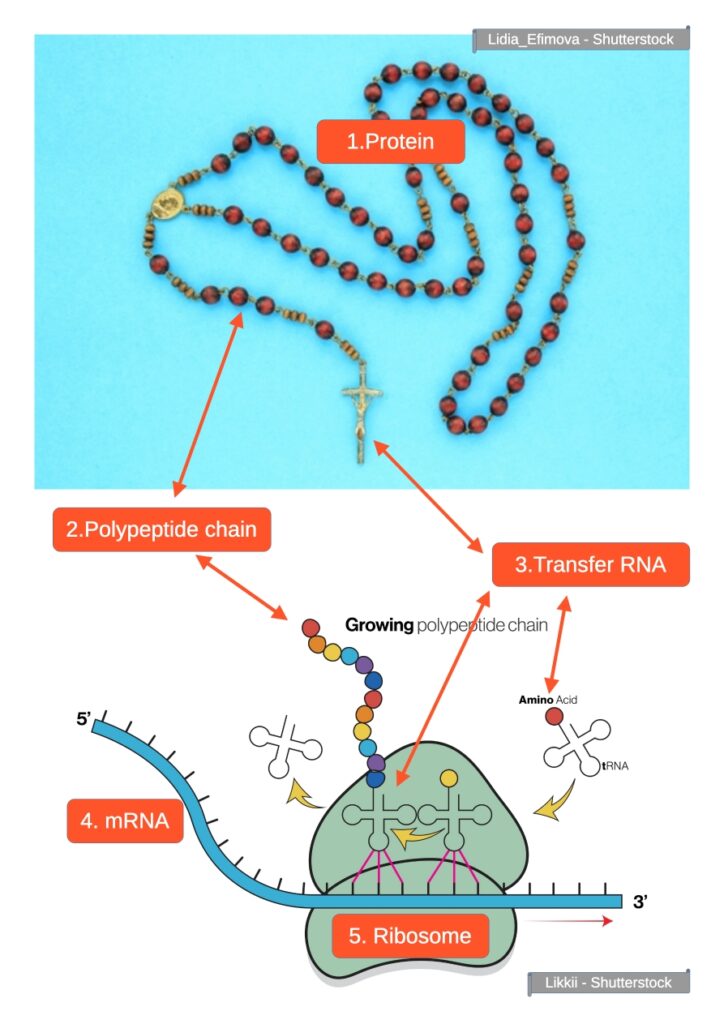
- 1. „The Rosary as the Blueprint of Proteins (The Body of Christ)” Proteins are the fundamental building blocks of life, just as the Rosary prayer is the foundation of spiritual growth. The Body of Christ, which becomes the nourishment of the faithful in the Eucharist, can be compared to proteins—molecules that build, nourish, and repair the body. The Rosary, much like the structural blueprint of a protein, guides us through the mysteries of Jesus’ life, presenting a model of holiness.
- 2. „The String of Beads as a Polypeptide Chain” Each bead of the Rosary corresponds to an amino acid in a growing polypeptide chain. The prayers recited on each bead are like peptide bonds, linking amino acids into an ordered sequence. In this way, the Rosary becomes a „biochemical strand of prayer,” where each Hail Mary brings us closer to wholeness—just as each amino acid is essential for forming a functional protein.
- 3. „The Crucifix as Mature tRNA” The crucifix, hanging at the end of the Rosary, plays a role similar to that of a mature tRNA molecule, which delivers the correct amino acid to the ribosome. tRNA recognizes the mRNA code and transfers the building blocks, enabling protein synthesis. Similarly, the Cross—the central symbol of Christianity—carries the ultimate meaning of prayer, giving it fullness through Christ’s sacrifice.
- 4. „The Word of God as mRNA” mRNA is the template that carries genetic information from DNA to the ribosome. In our analogy, the Word of God (Sacred Scripture) is like mRNA—it transmits the „code” of faith, which is read and enacted by the community of believers. The Rosary prayer, rooted in the Gospel, replicates this divine instruction, leading to the transformation of the heart.
- 5. „The Faithful in the Sacred Heart of Jesus as Ribosomes” Ribosomes are the „protein factories” that read mRNA and synthesize proteins. The faithful, gathered in the Heart of Jesus, are like ribosomes—they receive the Word of God and translate it into active love. The Church, like a living organism, grows through the constant „translation” of faith into deeds.
Comparing the Rosary to the process of protein biosynthesis reveals a beautiful harmony between the material and spiritual worlds. In both cases, precision, order, and purpose are essential. Prayer, like a polypeptide chain, builds our bond with God, and the Cross—like tRNA—gives it ultimate meaning. May this analogy remind us that both science and faith lead to one truth: the fullness of life, which is a gift from God.
„For in him all things were created” (Colossians 1:16).
” 3. The Word Became Flesh: A Biological Analogy of the Eucharist”
At the heart of Christianity lies the mystery of the Incarnation—God who became man to draw near to His creation. This truth, expressed in the Gospel of John: „The Word became flesh” (John 1:14), finds profound reflection not only in theology but also… in molecular biology. The striking analogy between the processes of transcription and translation and the sacrament of the Eucharist reveals how science and faith can illuminate one another.
,Vector description: Transcription and translation. DNA, mRNA and Protein. Protein synthesis.
,Photo description: Catholic church. Mass celebration.Eucharist celebration. Priest.
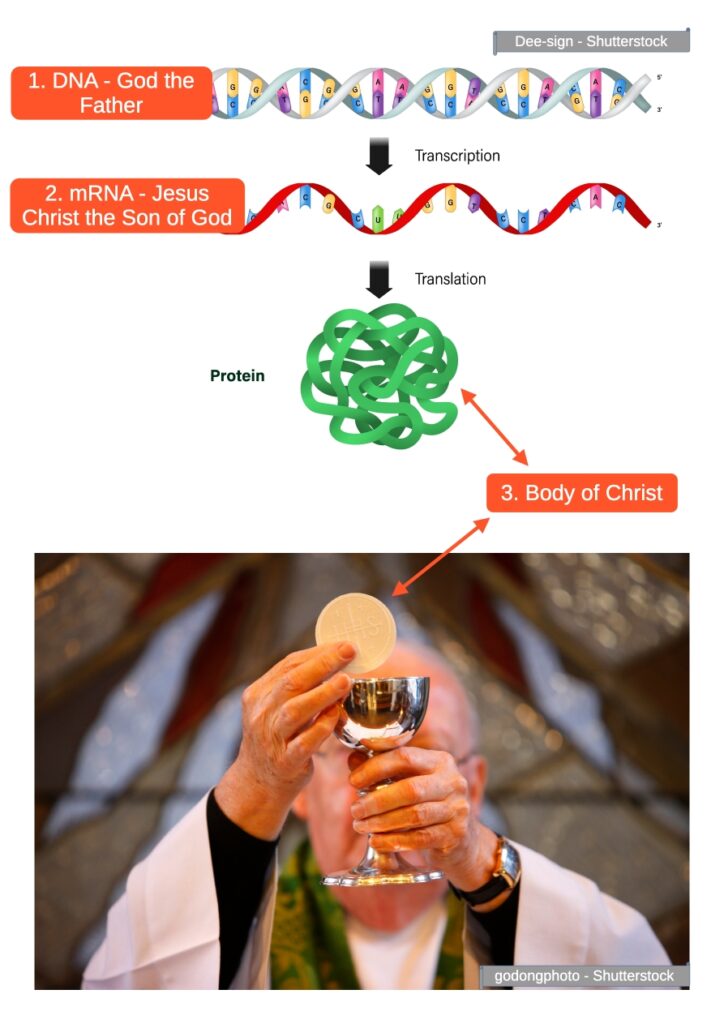
- 1. „DNA – The Father, Who Communicates His Will” DNA is the immutable, eternal blueprint of life, containing the fullness of genetic information. Similarly, God the Father is the source of all existence, and His Word—eternal and unchanging—forms the foundation of creation. In transcription, information from DNA is transcribed into mRNA, just as Christ, the Word of the Father, comes into the world to reveal His will.
- 2. „mRNA – Jesus, the Word Made Flesh” mRNA is the intermediary between DNA and protein—it carries the instructions that are to be realized. In this analogy, mRNA is like Christ, who says: „Whoever has seen me has seen the Father” (John 14:9). He is the Word that proceeds from the Father to become a tangible sign of His love. In translation, mRNA directs protein synthesis, just as Christ leads us to union with God.
- 3. „Tertiary Protein – The Body of Christ in the Eucharist” The final product of translation is a protein with a complex, three-dimensional structure—functional and alive. This is like the Body of Christ, which in Holy Communion becomes our nourishment. The host, much like a protein, appears to be a simple element yet contains the fullness of life. By receiving it, we partake in the divine nature, just as a cell uses a protein to fulfill its purpose.
In the Eucharist, faith allows us to perceive the living God beneath the appearance of bread(protein). In biology, science reveals to us the miracle in which abstract code takes on the form of material life. In both cases, the key is accepting a truth that transcends what is visible.
„I am the living bread that came down from heaven. Whoever eats this bread will live forever” (John 6:51).
„4. The Word Became Flesh: Easter Eggs as a Living Protein Structure”
Easter is a time when the symbolism of life, rebirth, and transformation intertwines with deep tradition. Among the holiday customs, decorated Easter eggs hold a special place—meticulously adorned eggs arranged in a basket to form a harmonious whole. Upon closer inspection, we discover a surprising analogy to the world of molecular biology. Each egg, like an amino acid, is a distinct element, but only when combined do they create a tertiary protein structure—full of meaning and function.
,Photo description: Easter basket of Ukrainian Easter eggs.
,Vector description: Protein Formation From Amino Acids. Amino Acids, Peptides and Protein Scientific Design. Vector Illustration.
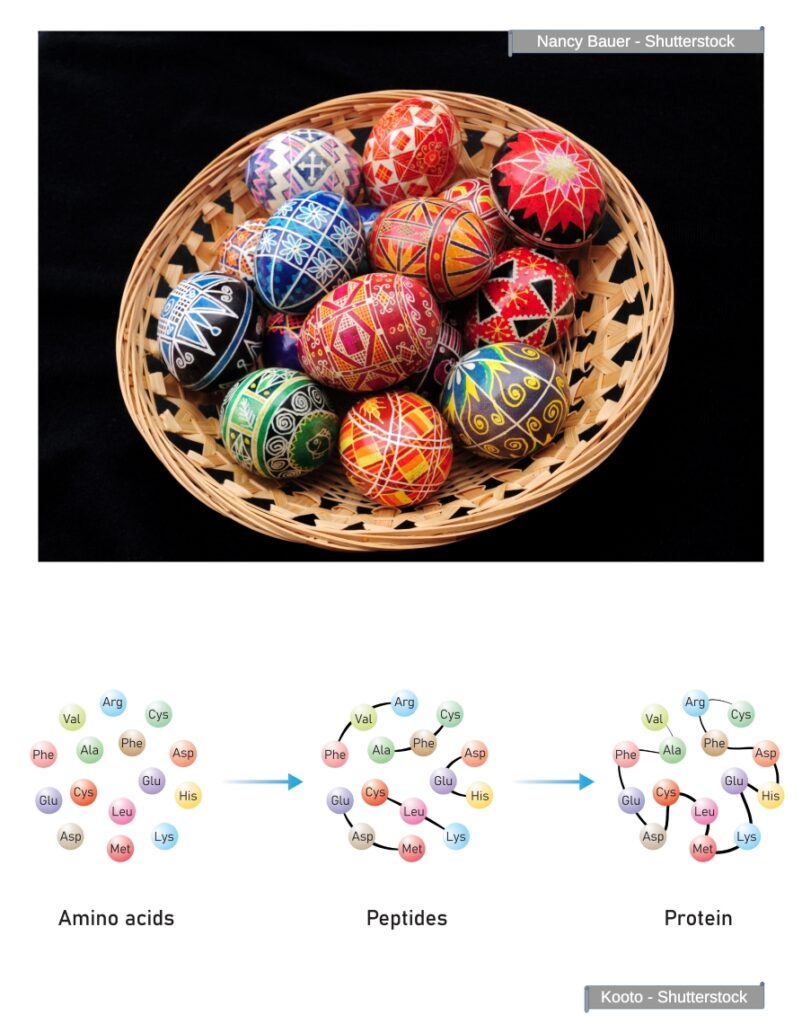
- Individual Easter eggs vary in color, pattern, and decoration technique, much like amino acids differ in structure and properties. Yet when placed in a basket, they form an orderly composition where each element has its place. This is no random collection—just as in a protein, where the sequence of amino acids determines its final shape and function, the arrangement of eggs in an Easter basket gives the whole a deeper significance. Even the way they touch one another resembles hydrogen bonds and disulfide bridges, which stabilize a protein’s structure.
This analogy reveals the beauty of hidden order—both in nature and in tradition. Proteins are the foundation of life, and the egg has symbolized its origin for centuries. In Christ, the Word became flesh, and in biology, genetic information materializes in proteins. Is the basket of Easter eggs not like a living molecule, where simple form gains meaning through mutual relationships?
„Christ is risen, and with Him, all things are made new!”—this Easter truth reminds us that life emerges from apparent lifelessness, just as a functional protein arises from seemingly simple elements. In this sacred moment, biology and faith converge, showing that harmony and purpose are embedded both in molecules and in the tradition that reflects them.
- Protein structures and their functions: Proteins have four levels of structural organization. The primary structure is a linear sequence of amino acids connected by peptide bonds. The secondary structure includes local arrangements such as α-helices and β-sheets stabilized by hydrogen bonds. The tertiary structure is the three-dimensional folding of the entire polypeptide chain, stabilized by various interactions. The quaternary structure arises from the combination of several protein subunits.
- Proteins perform countless biological functions: enzymatic (accelerating reactions), structural (building cells and tissues), transport (carrying various molecules), motor (enabling movement), defensive (e.g., antibodies), regulatory (controlling cellular processes), and storage. They are created in the translation process on ribosomes, where genetic information encoded in mRNA is transformed into an amino acid sequence.
,Combining images and adding a description details made by Tomasz Mikulski – Cell God, date: 04/2025
- Links and referees:
- Transfer RNA. https://en.wikipedia.org/wiki/Transfer_RNA
- Protein synthesis animation. https://youtu.be/NDIJexTT9j0?si=1DFem7bwszkZui27&t=41
- Essential Amino Acids: Chart, Abbreviations and Structure. https://www.technologynetworks.com/applied-sciences/articles/essential-amino-acids-chart-abbreviations-and-structure-324357


One thought on “My Jesus Christ as my RNA, Part 6”