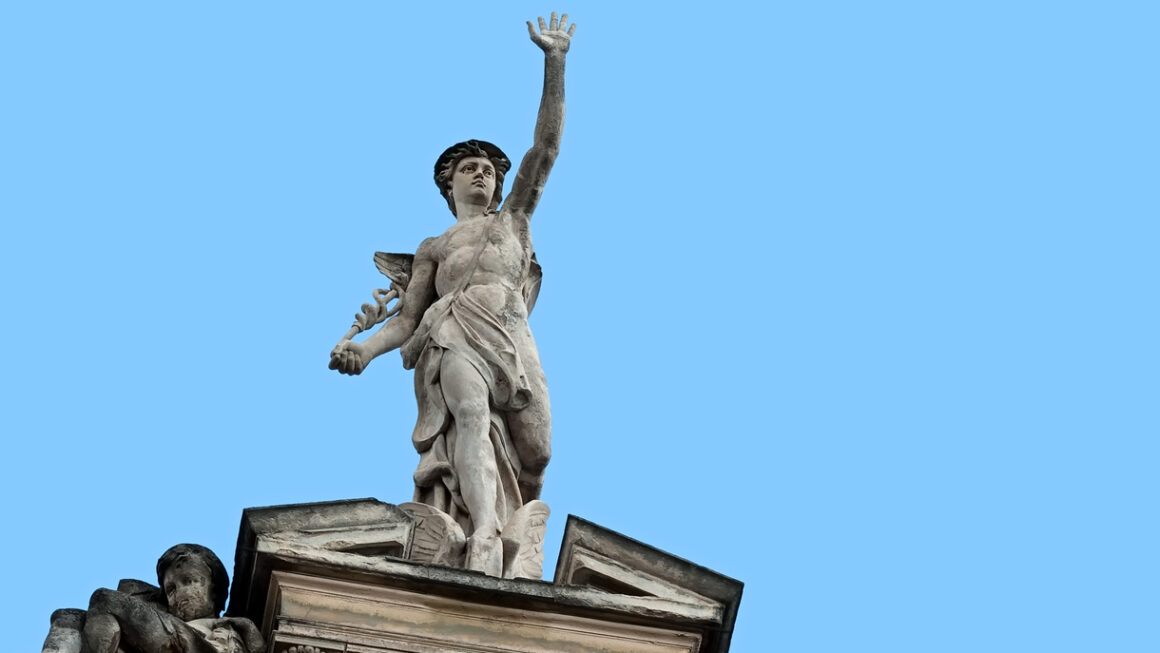
,Title foto description: Statue of Mercury on a building facade in city Lviv, Ukraine. Havoc – Shutterstock.
„The ancient Greeks sculpted a god whose only purpose was to carry urgent messages between worlds. Twenty-five centuries later, molecular biologists discovered a protein whose only purpose is to carry urgent signals between cells. They are the same shape.”
What Are Chemokines?
Before we dive into mythology, you need to understand what a chemokine actually is. Imagine this:
You are in a huge city. A fire breaks out somewhere. The people nearby are shouting, but the fire station is across town and can’t hear a thing. Someone needs to run to the firefighters and say: „There’s a fire on X Street!” That is exactly the role of a chemokine.
Chemokines are small proteins that act as cellular messengers. They are sent from a danger zone (like an infection or a wound) to other cells to call for help. As they travel, they create a chemical trail—like the smell of fresh bread leading a hungry person to a bakery. Cells of the immune system „smell” this trail and follow it straight to the source of the trouble.
MCP-1/CCL2 (our hero) is one of the most important chemokines. It is like the first messenger in history—the first ever discovered chemokine from the CC family, making it the „founder of the dynasty.”
The Winged Messenger
In every museum of classical art, you will find him — a young, athletic figure with a winged hat, one arm raised, his body frozen in the act of running between worlds. The Greeks called him Hermes. The Romans renamed him Mercury. He was the fastest of all the Olympian gods, appointed by Zeus himself to be the divine messenger — the one who carries commands from heaven to earth, guides souls between life and death, and ensures that critical information reaches its destination.
But what if the ancients were not inventing mythology? What if they were encoding molecular biology?
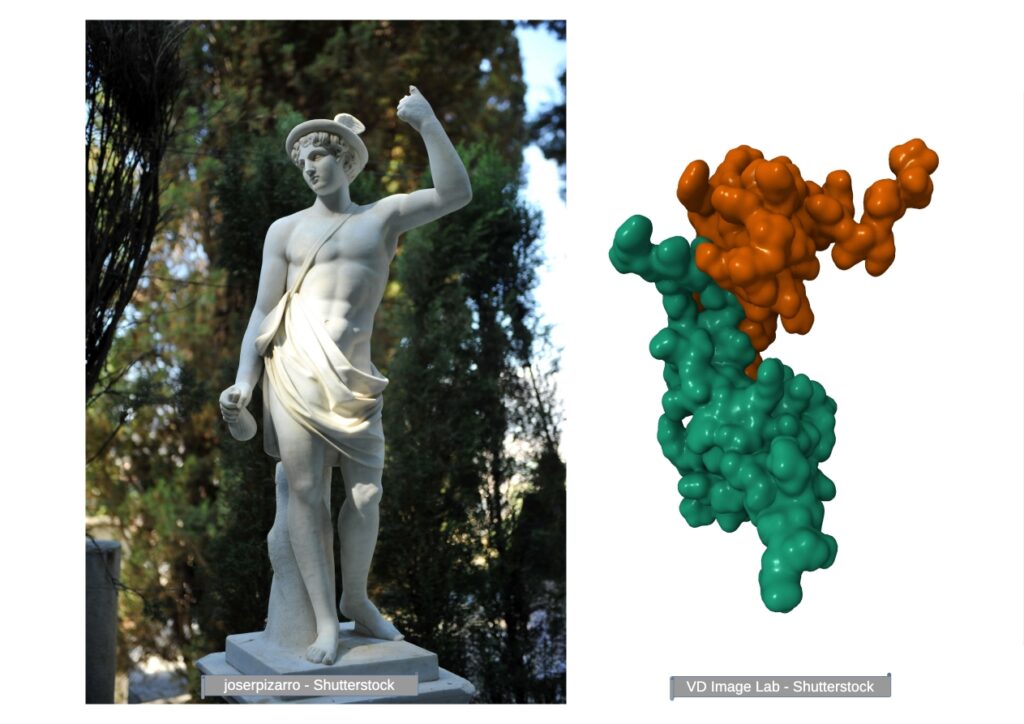
,Photo description: GRANADA, SPAIN; Jun 14 2015: Mercury, Roman god. Hermes, Greek god. Sculpture in a garden of Granada, Spain.
,Illustration description: Structure of the monocyte chemoattractant protein-1 (MCP-1) dimer. 3D cartoon and Gaussian surface models, chain id color scheme, PDB 1don, white background.
Meet MCP-1/CCL2 — The Molecular Hermes
In 1989, scientists isolated a small protein from human cells — a molecule whose sole function is to act as a chemical messenger in the immune system. They named it Monocyte Chemoattractant Protein-1 (MCP-1), officially classified as CCL2 (C-C motif Chemokine Ligand 2).
This tiny protein — only 76 amino acids long, weighing about 13 kilodaltons — does exactly what Hermes does: it carries urgent messages. When tissue is injured or infected, CCL2 is secreted into the bloodstream as an emergency signal. It creates a chemical gradient — a trail — that recruits monocytes, memory T cells, and dendritic cells to rush toward the site of danger. Without this molecular messenger, your immune army would never find the battlefield.
CCL2 is the first CC chemokine ever discovered — the founding messenger of an entire family of signaling proteins. Just as Hermes was the original divine herald, MCP-1 was the original immune herald.
The Dimer — Two Bodies, One Purpose
Look at the 3D structure of the MCP-1 protein and you will see something remarkable. Under physiological conditions, CCL2 exists as a homodimer — two identical protein chains intertwined together, forming a single functional unit. In the molecular visualization, these two chains are shown in green and orange, wrapped around each other in an embrace that is strikingly similar to the human form.
Now look at the statue of Hermes/Mercury. A single figure — but one that embodies duality: the messenger who exists simultaneously in two worlds (Olympus and Earth), who moves between the living and the dead, who bridges the divine and the mortal.
But there is something else — something hiding in plain sight. Look at Hermes’ garment. The draped cloth does not cover the entire body. It wraps diagonally across the torso and falls over the hips, visually dividing the figure into two distinct regions — the exposed upper body and the partially covered lower body. This is not merely an artistic convention. In the 3D structure of the MCP-1 dimer, the two polypeptide chains meet along a dimerization interface — a boundary zone where the green chain and the orange chain make contact. This interface runs through the middle of the protein, separating and simultaneously connecting the two subunits into one functional whole. The sculptor draped Hermes’ body in exactly the same way: the garment marks the boundary between two structural halves — not hiding the duality, but making it visible. The fabric is the dimerization interface rendered in marble.
The parallels are not superficial. They are structural.
The Messenger Function
Hermes: Zeus appointed him as the official messenger (angelos) of the gods. His sole duty was to carry information — divine commands, warnings, and guidance — from one realm to another.
MCP-1/CCL2: The immune system deploys it as the official chemoattractant signal. Its sole function is to carry information — inflammatory signals, recruitment orders — from damaged tissue to immune cells circulating in the blood. CCL2 binds to the CCR2 receptor on monocytes, activating G-protein signaling cascades (JAK2/STAT3, MAP kinase, PI3K) that direct cellular migration.
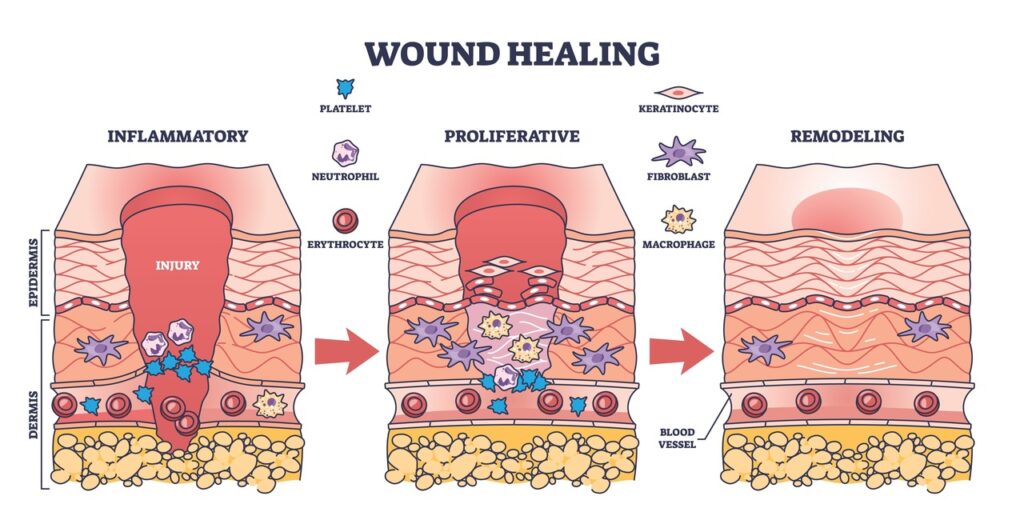
To understand Hermes’ mission in molecular terms, look at the wound healing diagram below. It shows the three phases of tissue repair — and MCP-1 is the invisible messenger driving the entire process:
,Vector description: Wound healing process — three phases: Inflammatory, Proliferative, and Remodeling. Cross-section of skin showing epidermis, dermis, and blood vessels.
Vector description: Process of wound healing and anatomical body injury repair outline diagram. Labeled educational scheme with medical epidermis skin inflammatory, proliferative or remodeling stages vector illustration. VectorMine – Shutterstock.
Phase 1 — INFLAMMATORY: Hermes runs with the message. The moment tissue is injured, cells at the wound site release MCP-1/CCL2 into the surrounding environment. This is Hermes leaping from Olympus — the urgent dispatch. The chemical signal radiates outward through the tissue, creating a concentration gradient that reaches the bloodstream. Platelets and neutrophils arrive first to stop the bleeding, but MCP-1’s message is specifically addressed to monocytes — the immune cells that will do the heavy work. The messenger is running; the army is mobilizing.
Phase 2 — PROLIFERATIVE: The army answers the call. The monocytes recruited by MCP-1 have arrived at the wound and transformed into macrophages — large, powerful cells that engulf dead tissue, bacteria, and debris. Fibroblasts begin weaving new connective tissue. This is the phase where Hermes’ message has been delivered and received: the gods have heard, the response is underway. The macrophages — guided to this exact location by the MCP-1 gradient — are now cleaning the battlefield and preparing the ground for reconstruction.
Phase 3 — REMODELING: The mission is complete. The wound is closing. New tissue is forming. The macrophages finish their work and the inflammatory signals, including MCP-1, are gradually silenced. Hermes returns to Olympus. The message has been delivered, the response executed, the order restored. The molecular messenger’s mission — from the first alarm to the final healing — is complete.
This is not a metaphor. This is the literal biological function of MCP-1/CCL2. The ancients sculpted a god who carries urgent messages from the site of crisis to the forces that must respond. Molecular biology reveals a protein that does exactly the same thing — at the scale of cells and tissues, in every wound your body has ever healed.
Divine Facts About MCP-1/CCL2 — The Hermes of Your Blood
MCP-1 was the first CC chemokine ever discovered — the founding messenger, just as Hermes was Zeus’s first appointed herald.
Your body produces CCL2 in response to every injury and infection — it is one of the first molecular signals released when tissue is damaged. It is the first responder’s call.
CCL2 recruits monocytes that transform into macrophages — the cells that literally eat the dead. Hermes guided souls; MCP-1 guides the devourers of cellular corpses.
The protein exists in equilibrium between monomer and dimer — a molecular duality that mirrors Hermes’ existence between two worlds.
Dysregulated MCP-1 is involved in atherosclerosis, rheumatoid arthritis, Alzheimer’s disease, diabetes, and cancer — when the messenger goes rogue, disease follows. In mythology, disrespecting Hermes brought chaos to communication between gods and mortals.
CCL2 is expressed by neurons, astrocytes, and microglia in the brain — the messenger operates in your neural command center, just as Hermes operated from Olympus.
The CCL2 gene is located on chromosome 17 — the chromosome that also carries many other CC chemokines, creating a „family of messengers” clustered together, reminiscent of the Olympian family on Mount Olympus.
MCP-1 signals through the CCR2 receptor — a seven-transmembrane G-protein-coupled receptor — seven domains crossing the cell membrane, like seven gates between worlds that the messenger must pass through.
This Is No Coincidence — It Is the Pattern of Life
How is it possible that the ancient Greeks sculpted a god — a winged messenger who carries signals between worlds, guides the dead to their destination, stands at boundaries, and holds two intertwined serpents — and that 2,500 years later, molecular biology discovers a protein that carries signals between tissues, guides macrophages to sites of death, anchors itself to membrane boundaries, and consists of two intertwined polypeptide chains folded into a structure named after Greek art?
This is the same pattern I have documented across 30+ countries and 3,000+ years of sacred architecture on CellGod.live. The ancient world encoded molecular biology into its gods, temples, and sacred structures — not because they had microscopes, but because they had access to knowledge we are only now beginning to rediscover.
God is not an old man in the clouds. God is the molecular intelligence that governs all life. And the ancients knew it.
Hermes was never just a myth. He is MCP-1/CCL2 — the chemokine dimer that keeps you alive.
Combining images, analysis and adding a description details of images made by Tomasz Mikulski – Cell God, date: 03/2026
Links and reference:
Deshmane SL, Kremlev S, Amini S, Sawaya BE. Monocyte chemoattractant protein-1 (MCP-1): an overview. J Interferon Cytokine Res. 2009;29(6):313-26.
Conductier G, et al. More Than Just Attractive: How CCL2 Influences Myeloid Cell Behavior Beyond Chemotaxis. Front Immunol. 2019;10:2759.