” The entry of Jesus to Jerusalem as Preparing for mRNA Export”
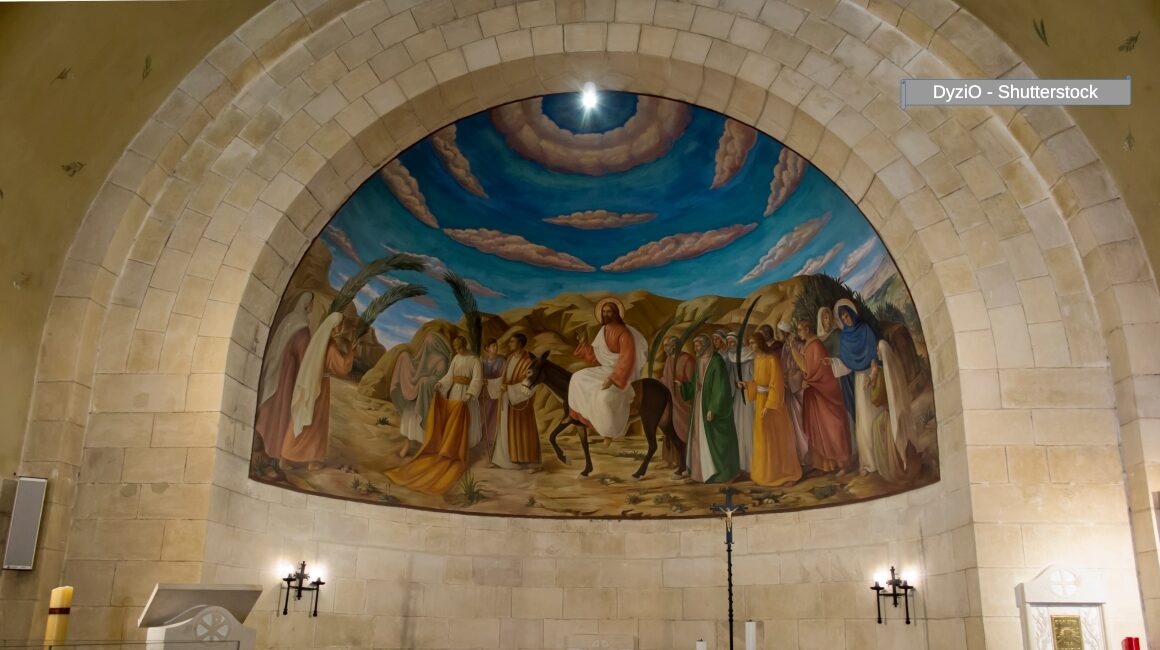
In today’s post, I invite you on an extraordinary journey where the world of molecular biology intersects with spiritual symbolism. We will examine the fresco in Bethphage on the Mount of Olives, depicting Jesus riding a donkey into Jerusalem, and interpret this scene as an allegory for the process of mRNA export from the nucleus to the cytoplasm, where ribosomes await to translate it into protein. The entire scene becomes a metaphor for the interior of the cell nucleus, with each element of the fresco representing a biological counterpart.
, Photo description, Bethphage, Israel, January 30, 2020: Fresco at Betfage on the Mount of Olives showing the entry of Jesus to Jerusalem, Israel.
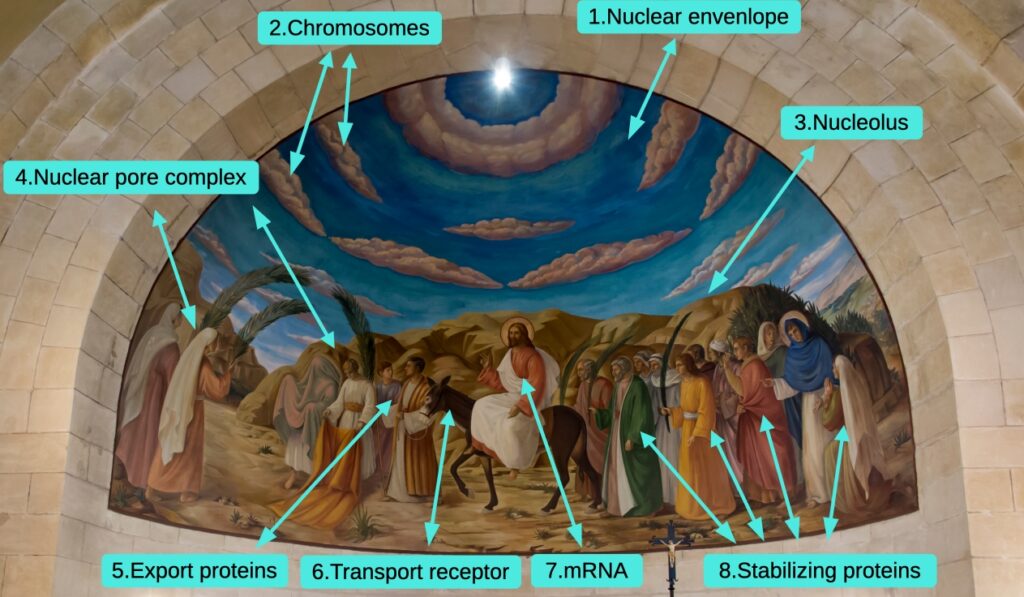
- „The Fresco Scene as the Interior of the Cell Nucleus (The Father’s House)”
- 1. „The Sky as the Nuclear Envelope” In the fresco, the sky stretches above the scene, much like the nuclear envelope surrounding the cell nucleus. The nuclear envelope is a barrier separating the nucleus from the cytoplasm, but it is also a gateway through which mRNA must pass to reach the ribosomes. The sky in the fresco symbolizes this boundary, which is both a protector and a passageway.
- 2. „The Clouds as Chromosomes” The clouds floating in the sky resemble chromosomes suspended within the nucleus. Chromosomes are structures that store DNA, and their „cloud-like” arrangement in the fresco symbolizes the dense chromatin surrounding the mRNA export process.
- 3. „The Rocky Mountain as the Nucleolus” In the background of the fresco, we see a rocky mountain, which can represent the „nucleolus” – a structure within the nucleus responsible for producing ribosomes. The nucleolus is like a mountain, stable and full of life, providing a backdrop for the dynamic processes occurring in the nucleus.
- 4 and 5. „The Group of People in Front of Jesus as Nuclear Pore Complexes and Export Proteins” In front of Jesus, on both sides of the road, stand people. In our interpretation, they represent the „nuclear pore complexes” and „export proteins” that enable mRNA to pass through the nuclear envelope. Nuclear pores are like gates that control what can leave the nucleus, and export proteins, such as „exportins”, assist in the transport process.
- 6. „The Donkey as the Transport Receptor” The donkey on which Jesus rides symbolizes the „transport receptor”, the molecular vehicle that carries the mRNA through the nuclear pore complex. Just as the donkey ensures a safe and steady journey, the transport receptor ensures the mRNA is delivered intact to the cytoplasm.
- 7. „Jesus as mRNA” The central figure of the fresco is Jesus, riding a donkey and preparing to enter Jerusalem. In our analogy, Jesus represents „mRNA” – the messenger RNA that carries genetic information from DNA to the ribosomes, where it will be translated into protein. Jesus, as mRNA, is the key messenger who must leave the nucleus to fulfill his mission.
- 8. „The Group of People Following Jesus as mRNA-Stabilizing Proteins and the Poly-A Tail” Behind Jesus in the fresco, we see a group of people accompanying Him on His journey. In our analogy, they represent „mRNA-stabilizing proteins” and the „poly-A tail”, which protect the mRNA from degradation and ensure it safely reaches the cytoplasm. These proteins, such as „hnRNP (heterogeneous nuclear ribonucleoproteins)” or „SR proteins”, are essential for the proper functioning of mRNA, while the poly-A tail acts as a protective shield, safeguarding the mRNA from destruction.
- „The Road to Jerusalem as the Path to the Cytoplasm (Sea) and the Rough Endoplasmic Reticulum (Land)” The road that Jesus travels symbolizes the process of mRNA export from the nucleus to the cytoplasm – the „sea,” where ribosomes await, and to the rough endoplasmic reticulum – the „land,” where protein synthesis begins. It is a journey full of challenges but necessary for the mRNA to meet the ribosomes – the „people of God,” who will translate it into protein.
The fresco in Bethphage on the Mount of Olives, depicting Jesus’ journey to Jerusalem, becomes in our interpretation a beautiful metaphor for the process of mRNA export from the cell nucleus. Jesus as mRNA, the donkey as the transport receptor, the companions as stabilizing proteins and the poly-A tail, and the road as the export process – all come together to tell an extraordinary story of how the life of a cell reflects profound spiritual truths.
I invite you to reflect on this remarkable analogy and share your thoughts in the comments! Stay tuned for the next part, „Translation – The Last Supper,” where we will explore how mRNA meets the ribosomes to begin the process of protein synthesis – a spiritual feast reminiscent of the Last Supper. See you in „Part 5”!
Combining images and adding a description details made by Tomasz Mikulski – Cell God, date: 03/2025
Links and References: https://pmc.ncbi.nlm.nih.gov/articles/PMC7074880/
Church of Bethphage: https://en.wikipedia.org/wiki/Church_of_Bethphage