1. „Masjid Wilayah Persekutuan: Divine Biology in Architecture”
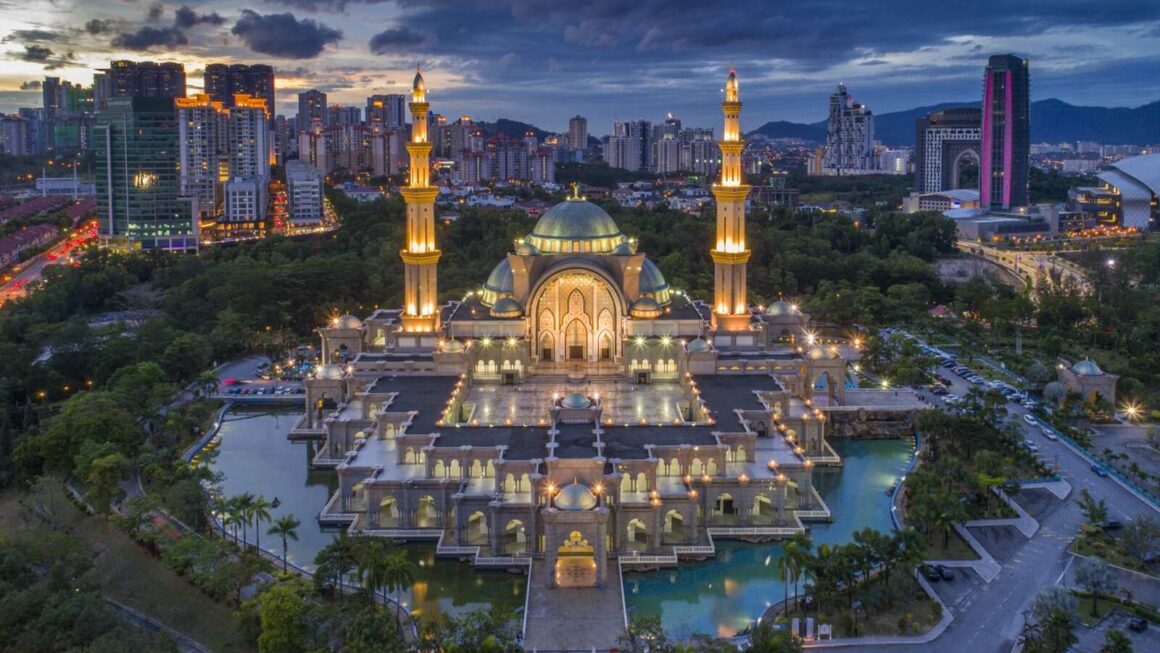
When viewed from above, the Masjid Wilayah Persekutuan in Kuala Lumpur reveals a geometric perfection that mirrors the structure of a living cell. Is it mere coincidence that this Islamic place of worship and contemplation resembles the microscopic world of molecular biology? In this striking analogy, architecture becomes a metaphor for life, where faith and science converge in harmonious order.
, Photo description: KUALA LUMPUR, MALAYSIA – JUNE 5, 2016: An aerial shot of the Federal Territory Mosque or Masjid Wilayah in the daytime.
, Illustration description: 3D rendering of the human cell cross section, detailed colorful anatomy, top view, white background.
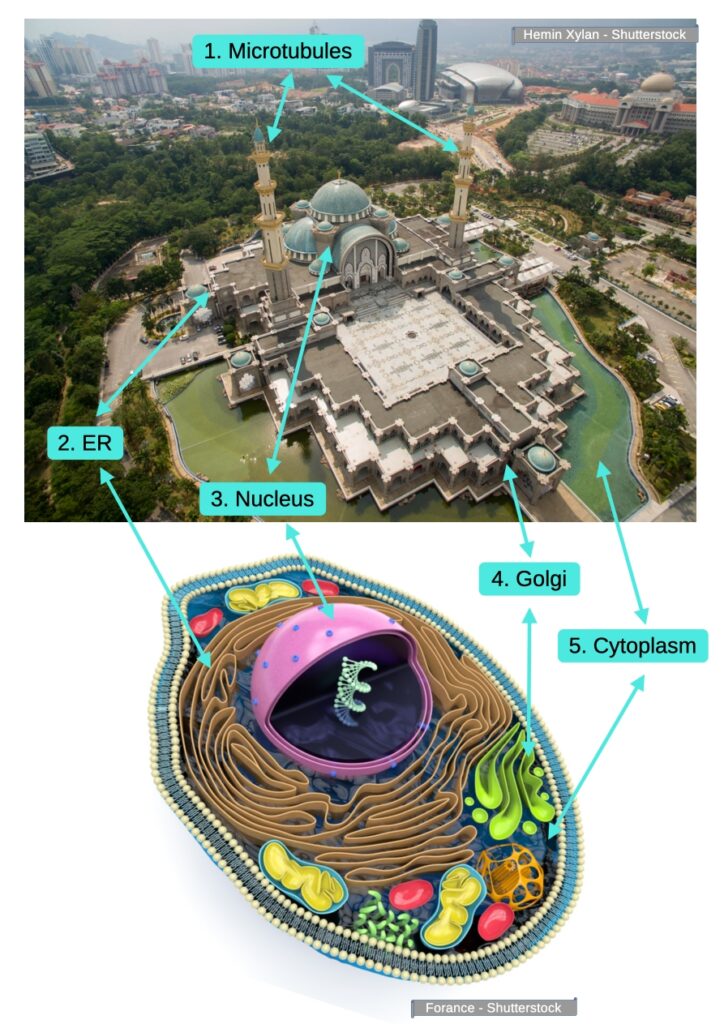
- 1. „Minarets – Microtubules of the Cytoskeleton” The two slender „minarets”, soaring skyward, resemble „microtubules” – the rigid structures of the cytoskeleton that provide shape and stability to the cell. The minarets act as pillars of faith, upholding the mosque’s spiritual framework. Their vertical lines draw the gaze upward, just as microtubules define transport pathways within the cell. The call of the „muezzin” echoing from their heights is like a chemical signal traveling along these „biological highways.”
- 2. „Symmetrical Wings – The Endoplasmic Reticulum” Flanking the dome are „elegant, symmetrical wings, forming a network of corridors and prayer halls. This structure evokes the „endoplasmic reticulum” – the cellular canal system responsible for protein synthesis and transport. In the mosque, these „passageways” serve the faithful, facilitating the flow of people, prayers, and knowledge, much like the reticulum ensures communication within the cell.
- 3. „The Main Dome – The Cell Nucleus” The grand, azure dome, rising proudly above the mosque, serves as the „cell nucleus” – the command center of the entire structure. Just as the nucleus stores DNA and directs cellular functions, the dome symbolizes the „heart of faith”, the focal point of spiritual energy.
- 4. „Courtyard and Arcades – The Golgi Apparatus, Small Domes as Secretory Vesicles” The central „courtyard surrounded by arcades” functions like the „Golgi apparatus” – the organelle that sorts, modifies, and distributes proteins. Here, worshippers pause before prayer, clearing their minds and preparing to meet the Divine. The „scattered smaller domes” can be likened to „secretory vesicles” released by the Golgi – each one symbolizing a prayer, an act of kindness, or a thought ascending to the heavens.
- 5. „Pools and Gardens – The Cytoplasm” Surrounding the mosque are „crystalline pools and lush gardens”, comparable to the „cytoplasm” – the fluid medium in which cellular organelles are suspended. The water symbolizes purification and life, while the plants represent growth and renewal. This is the space where all elements of the sanctuary coexist in harmony, much like the components of a cell working together to sustain existence.
The Masjid Wilayah Persekutuan is not merely an architectural marvel – it is a physical manifestation of divine precision, bridging the visible and microscopic worlds. Its cell-like structure suggests that faith and science are not opposing forces, but two languages describing the same universal order.„We will show them Our signs in the horizons and within themselves until it becomes clear to them that it is the truth.” (Quran 41:53)
2. „The Dome of Federal Territory Mosque: Where Sacred Architecture Mirrors Cellular Biology”
Beneath the soaring grandeur of Masjid Wilayah Persekutuan in Kuala Lumpur lies an astonishing architectural marvel—its central dome. But this is no ordinary ceiling; it is a spiritual nucleus, intricately designed to mirror the very structure of a cell’s nucleus. From its ornate arabesques to its geometric precision, every element reflects a profound biological analogy, merging architecture with molecular biology in a breathtaking symphony of faith and science.
photo description: KUALA LUMPUR, Malaysia – FEBRUARY 11, 2019 : The interior of the Federal Territory Mosque or Masjid Wilayah Persekutuan, a major mosque in Kuala Lumpur.
illustration description: nucleus, nucleolus, pore complexes and dubble nuclear membrane 3d illustrator.
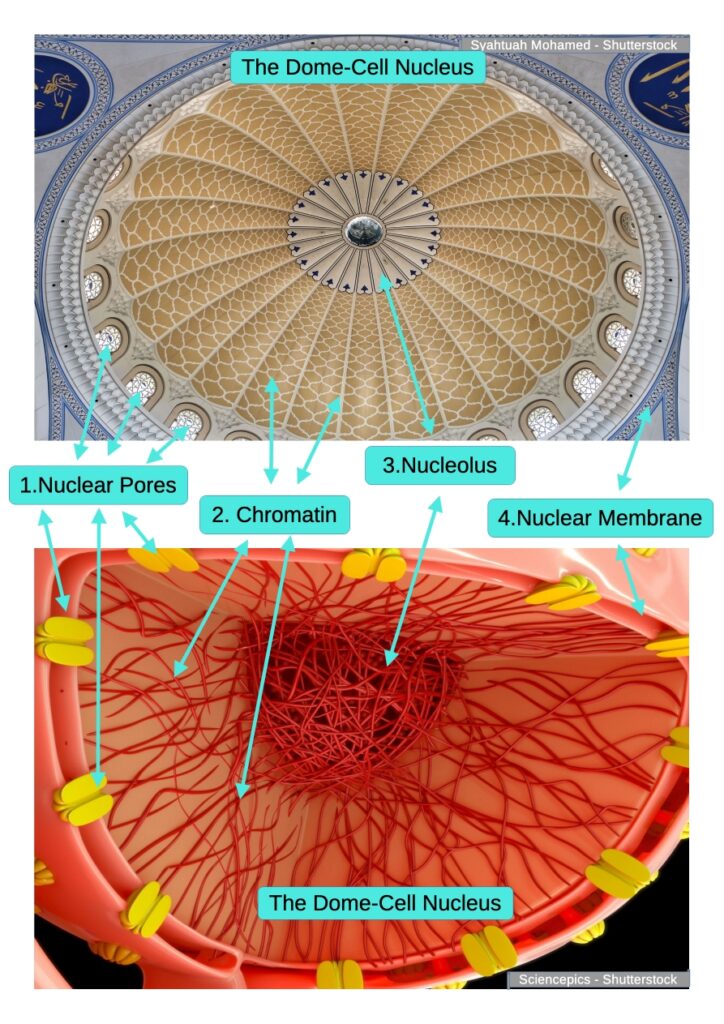
- „The Dome as the Cell Nucleus” The mosque’s grand dome, majestically rising above the prayer hall, resembles the „cell nucleus”—the control center of the entire structure. In a cell, the nucleus stores crucial genetic information, just as the dome symbolizes the spiritual heart of Islam, encompassing both holiness and knowledge. Its rounded shape and convex form evoke an organic, almost biological structure, as if the architecture itself were a living organism.
- 1. Stained Glass as Nuclear Pores Along the base of the dome, delicate stained-glass windows allow light to filter into the sacred space. They function analogously to „nuclear pores”—structures that facilitate the exchange of information between the nucleus and the cytoplasm. In the mosque, the light passing through the colored glass symbolizes divine enlightenment, which—like molecular signals—reaches the worshippers, inspiring prayer and reflection.
- 2. „Geometric Patterns as Chromatin” The interior of the dome is adorned with intricate „geometric designs”, characteristic of Islamic sacred art. These repeating motifs resemble „chromatin”—the tangled threads of DNA that store the code of life within the nucleus. In the mosque, these patterns are not merely decorative; they carry deeper meaning, representing the divine order and mathematical precision that govern both the material and spiritual worlds.
- 3. „The Heart of the Dome as the Nucleolus” At the very center of the dome, where all lines and patterns converge, lies its „symbolic heart”—the equivalent of the „nucleolus”, the structure responsible for producing ribosomes and synthesizing proteins. In the context of the mosque, this central space embodies the pure essence of faith, the birthplace of spiritual energy that nourishes the entire community of believers.
- 4. „Arabesques as the Nuclear Membrane” The „arabesques”—flowing, interlacing designs surrounding the dome—evoke the „double nuclear membrane”, which protects and separates the nucleus from the rest of the cell. In the mosque’s architecture, these decorations serve a similar purpose: they delineate the boundary between the sacred and the profane, between heaven and earth, while simultaneously uniting both realms in harmony.
The Federal Territory Mosque is not just a place of worship but also a work of art that mirrors the fundamental structures of life. The dome as the nucleus, the stained glass as pores, the patterns as DNA—all of this reveals that architecture and molecular biology speak the same language of symmetry, function, and beauty.In Islam, faith and science have never been opposites. A mosque that resembles a cell is a perfect example of this. Is this not proof that divine order manifests itself both in the microscopic structures of life and in the monumental works of human hands?
„He is the One Who gave everything its form, then guided it.” (Quran, 20:50)
3. „The Rehal and Quran Under the Dome: A Molecular Theology of Divine Expression”
Beneath the grand central dome of Masjid Wilayah Persekutuan in Kuala Lumpur, an intricate dance of sacred knowledge unfolds—one that mirrors the most fundamental processes of life itself. The rehal (Quran stand) holding the Holy Quran, placed upon the mosque’s prayer carpet, is not merely an object of ritual. It is, in a profound analogy, the „chromosome” within the „nucleus” of this divine cellular space, where the „Word of Allah” functions as „DNA”, guiding the spiritual and metaphysical expression of life.
photo description: August 12, 2017 – KL, Malaysia.Interior of MASJID WILAYAH in Malaysia which is decorated with traditional design and shelf of al quran as well as facilities.
vector description: Chromosome structure and organization. From cell nucleus with chromatin to Chromosome and DNA double helix with Histones and Base pairs. Vector illustration for education
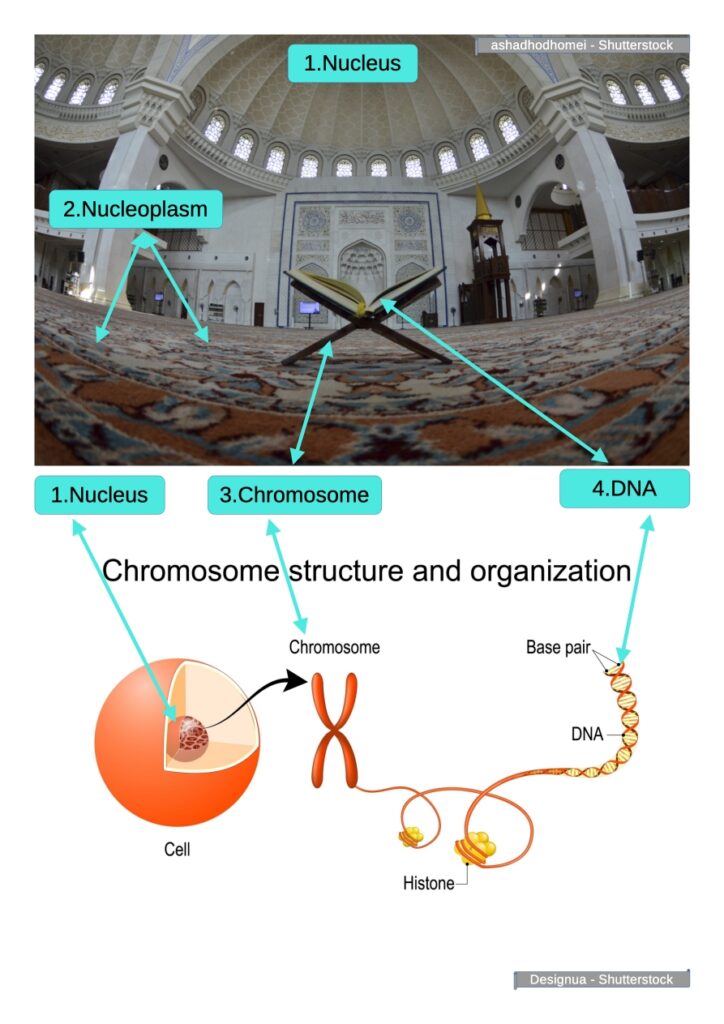
- 1. „The central dome”, arching overhead like the protective membrane of a nucleus, encloses a space where spiritual transcription occurs. Here, the words of the Quran are not merely recited but actively expressed and translated into the lived experience of the faithful, much like genetic information being transcribed into functional proteins.
- 2.”Beneath this sacred arrangement, the ornate prayer carpet spreads out like the nucleoplasm – the viscous medium that fills the cellular nucleus”. Its intricate geometric patterns resemble the complex molecular environment where chromosomes float and interact. The carpet’s repeating motifs echo the organized chaos of nuclear proteins and enzymes, creating a perfect environment for the „genetic material” above it to function.
- 3. „The X-shaped rehal supporting the Quran immediately calls to mind the familiar form of a chromosome”. Like its biological counterpart, this wooden structure serves as the physical framework for sacred information. Just as chromosomes carefully package and protect DNA within the cell’s nucleus, the rehal elevates and presents the divine words, allowing them to be properly „expressed” in the physical world. The similarity in form reveals a deeper similarity in function – both are essential supports for their respective codes of life.
- 4. „The open Quran on the rehal represents nothing less than the process of genetic expression”. Each Arabic letter mirrors the nucleotide bases of DNA, containing precise instructions for creation. The revealed words become the mRNA transcript, carrying Allah’s divine will from the celestial realm to earthly manifestation. This is where DNA-Allah’s wisdom becomes actionable guidance, much like how genetic information transforms into functional proteins that build and maintain life.
- „When worshippers gather for prayer, they complete this living metaphor by becoming the ribosomes of this sacred cell”. Their synchronized movements during salah mirror the ribosome’s precise translation of genetic code into proteins. Each prostration represents the physical manifestation of divine instructions, just as ribosomes transform mRNA blueprints into functional molecules. Even in their absence, the potential for this translation remains, as the mosque stands ready to facilitate this holy process of expression.
Masjid Wilayah Persekutuan unconsciously embodies one of nature’s most profound truths – that the same organizational principles govern both spiritual and biological systems. From the chromosomal rehal to the nucleoplasmic carpet, from the DNA-Quran to the ribosomal worshippers, we witness how deeply interconnected all creation truly is. This architectural marvel demonstrates that whether in the grand mosque or the microscopic cell, order, precision and purpose reign supreme under Allah’s divine design.
This analogy seeks not to reduce the sacred to the scientific, but rather to highlight the profound unity of creation. The parallels between Islamic worship and cellular biology suggest a universal language of organization that transcends scale – from the intimate space of prayer to the inner workings of life itself. In both realms, we find structured beauty serving a higher purpose, reminding us that all creation ultimately points toward its Creator.
„He it is Who gave everything its perfect form.” (Quran, 20:50)
Combining images and analysis by Tomasz Mikulski – Cell God, date: 04/2025
- Federal Territory Mosque. source. https://en.wikipedia.org/wiki/Federal_Territory_Mosque
- Anatomy and Physiology: Parts of a Human Cell, https://www.visiblebody.com/blog/anatomy-and-physiology-parts-of-a-human-cell
- The cytoskeleton, https://slcc.pressbooks.pub/collegebiology1/chapter/the-cytoskeleton/