„The Medieval Hill of Morella and an Animal Cell”
, The Spanish hill of Morella is not only a picturesque landscape but also a place rich in history, which seems to mirror the structure and functions of an animal cell. Interestingly, it appears that our ancestors, when building Morella, may have consciously modeled it after the microscopic cell. Founded in the Middle Ages, Morella was constructed in a way that resembles the shape and functions of an animal cell. Its appearance and structure perfectly illustrate how nature and human creations can intertwine. Here’s how these two worlds connect.
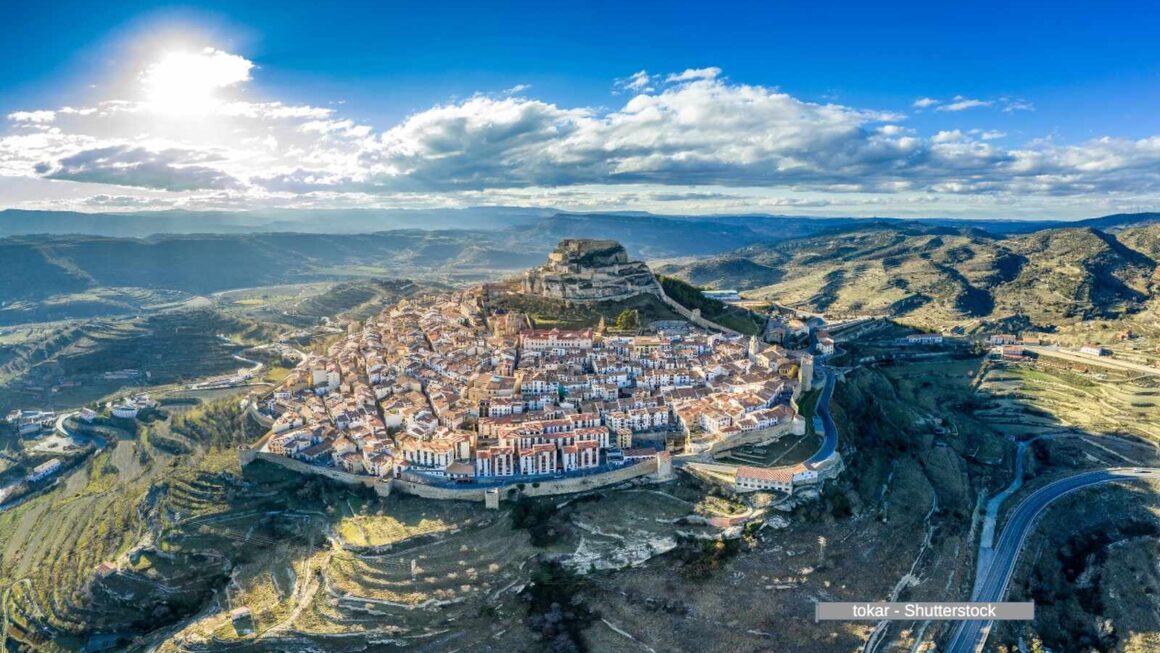
, Photo description: Aerial panoramic view of medieval walled Morella hilltop rampart and castle with blue sky in Spain.
, Illustration description: Animal cell Anatomy diagram structure of all parts of the nucleus smooth rough endoplasmic reticulum cytoplasm Golgi apparatus mitochondria membrane centrosome ribosome anatomical figure Science Education.
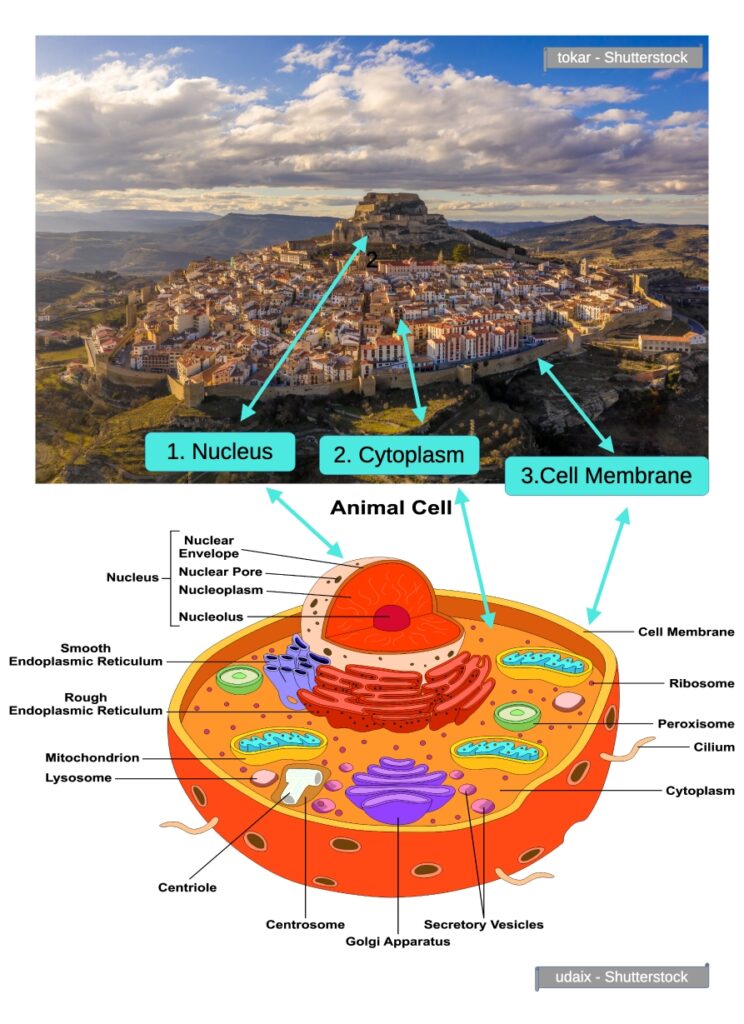
- 1. „The Castle on the Hill as the Nucleus and the Endoplasmic Reticulum (Rough and Smooth)” – „The Castle on Morella’s Hill”: Morella is famous for its imposing castle, which towers over the town. It served as the command center, controlling and protecting the area, much like the nucleus of a cell, which manages cellular processes and stores genetic information. The castle was the heart of Morella, just as the nucleus is the heart of the cell. – „Endoplasmic Reticulum”: Around the castle, numerous buildings and roads stretched out, comparable to the endoplasmic reticulum. The rough ER (with ribosomes) is responsible for protein production, just like workshops and warehouses around the castle produced essential resources. The smooth ER, involved in lipid synthesis and detoxification, resembles the quieter districts where trade and craftsmanship took place.
- 2. „Cytoplasm as the Dense Construction Within the Walls” – „Cytoplasm”: This gel-like substance fills the cell and is where numerous metabolic processes occur. It can be compared to the densely built interior of Morella’s walls, where life thrived: living, working, trading, and daily activities. – „Organelles”: Within the cytoplasm, organelles perform various functions, just as in Morella there were buildings with different purposes: churches, workshops, and residential houses. Each element had its place and role, creating a harmonious whole.
- 3. „Cell Membrane as the Walls of Morella” – „Cell Membrane”: This flexible yet strong structure surrounds the cell, controlling the flow of substances in and out. The walls of Morella served a similar purpose – they protected the town from intruders while allowing the exchange of goods and people through its gates. – „Selective Permeability”: The cell membrane is selectively permeable, just as Morella’s walls had strategic gates that were opened only for selected individuals. This combination of protection and control is crucial for both the cell and the medieval town.
, „The History of Morella and the Functions of the Cell” This town has a long history dating back to the Middle Ages. It was founded by our ancestors, who, perhaps unconsciously, modeled it after natural structures like the cell. Morella developed as a defensive, trade, and cultural center, and its structure evolved alongside the needs of its inhabitants. – **Animal Cell**: This is the basic unit of life, performing key functions: from energy production (mitochondria) to transport (Golgi apparatus). Its structure is the result of millions of years of evolution, just as Morella developed over centuries, adapting to changing conditions.
, „Conclusion” Morella is not just a beautiful hill with a castle but also a living organism that can be compared to an animal cell. Both the town and the cell have their command center (castle/nucleus), densely built interior (cytoplasm), and protective walls (cell membrane). This analogy shows how different worlds – historical and biological – can intertwine, creating fascinating similarities. Did our ancestors, when building Morella, intuitively draw inspiration from nature? Or is nature the best architect of all?
„Animal Cells in Our „Divine Bodies” – Fascinating Facts and Curiosities”
- 1. „Miniature Power Plants – Mitochondria”
– Mitochondria are the energy centers of cells, producing ATP (the energy currency).
– Fun fact: They have their own DNA (mtDNA), inherited only from the mother! This is a remnant of their ancestors—bacteria that entered into symbiosis with cells billions of years ago.
2. „The Code of Life Hidden in the Nucleus”
– The DNA in the cell nucleus, if unraveled, would stretch about 2 meters long—yet it fits into a microscopic space!
– Every cell (except red blood cells) contains the complete blueprint for the entire body, but only uses the necessary fragments.
3. „Suicide for Survival – Apoptosis”
– Cells can intentionally die (apoptosis) to allow the body to develop or fight diseases.
– Without apoptosis, we wouldn’t have, for example, gaps between our fingers during embryonic development!
4. „Cells Can „Eat Themselves” – Autophagy”
– When nutrients are scarce, the cell initiates autophagy—breaking down its own worn-out components to survive.
– This process is so crucial that its discoverer, Yoshinori Ohsumi, received the Nobel Prize in 2016 for it.
5. „Immortal Cancer Cells”
– Normal cells have a division limit (the Hayflick limit), but cancer cells ignore it—which is why tumors are so hard to stop.
– The HeLa cell line (taken from Henrietta Lacks in 1951) is still grown in labs worldwide today!
6. „Neurons – The Memory Cells”
– Nerve cells (neurons) can transmit signals at speeds of up to 120 m/s!
– Unlike many other cells, neurons hardly regenerate—which is why brain damage is so dangerous.
Conclusion: The Divine Precision of Nature.
Animal cells are living works of art, combining mechanics, chemistry, and logistics worthy of the best systems created by humans. Each one is a microcosm where processes crucial to our existence constantly unfold.
Isn’t that reason enough to call our bodies a „divine miracle of biology?
,Combining images and analysis by Tomasz Mikulski – Cell God, date: 12/2024
- Links and references:
- Morella, Spain. source. https://en.wikipedia.org/wiki/Morella,_Spain
- Facts About Animal Cell, https://www.vedantu.com/biology/facts-about-animal-cell