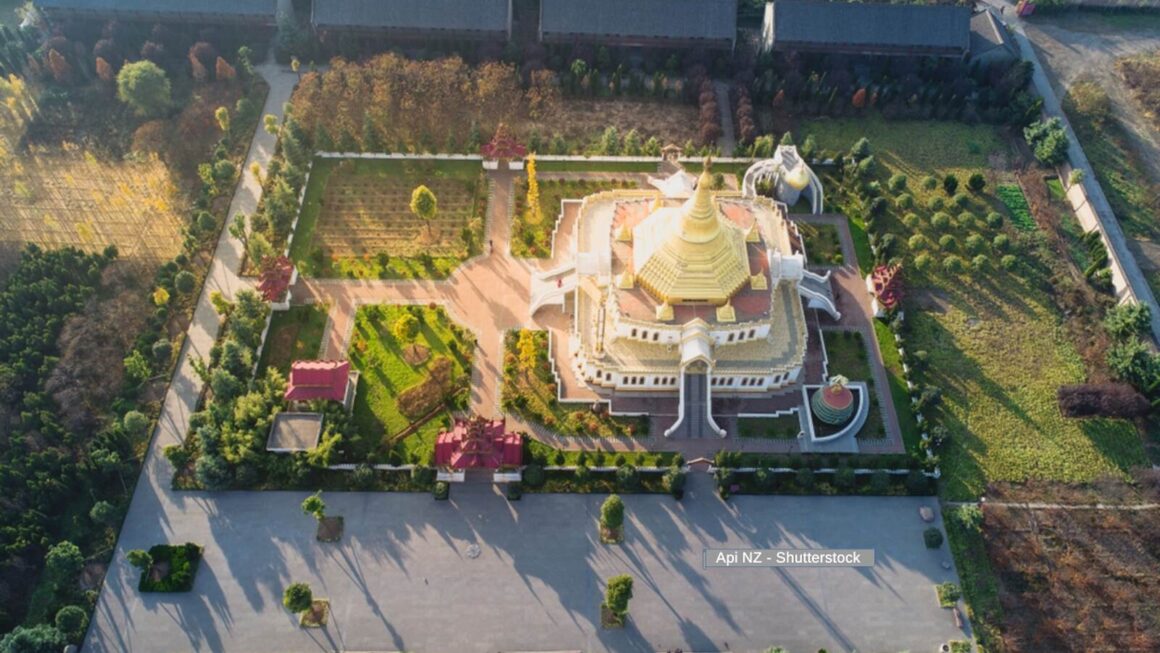
„The White Horse Temple as a Human Cell”
Did ancient architects know the microscopic world of the human body? Are monumental temples not just places of worship but also encoded maps of cellular biology? In today’s post, we’ll examine the Burmese section of the White Horse Temple in Luoyang—seen from a bird’s-eye view—and uncover its astonishing resemblance to the structure of a human cell. Every element of this sacred space has its counterpart in biology, suggesting that our ancestors possessed knowledge far beyond their time.
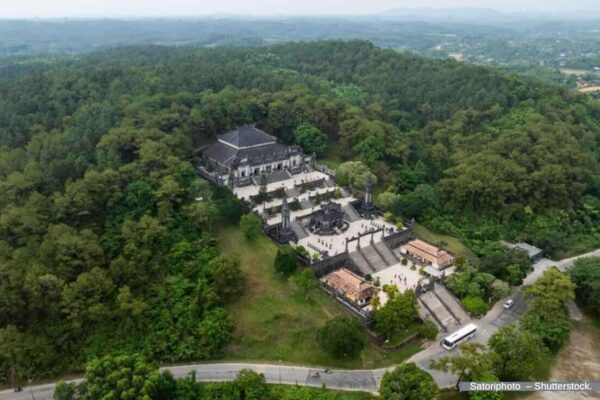
, Photo description: Aerial view of White Horse Temple Luoyang.
, Vector description: easy to edit vector illustration of human cell structure.
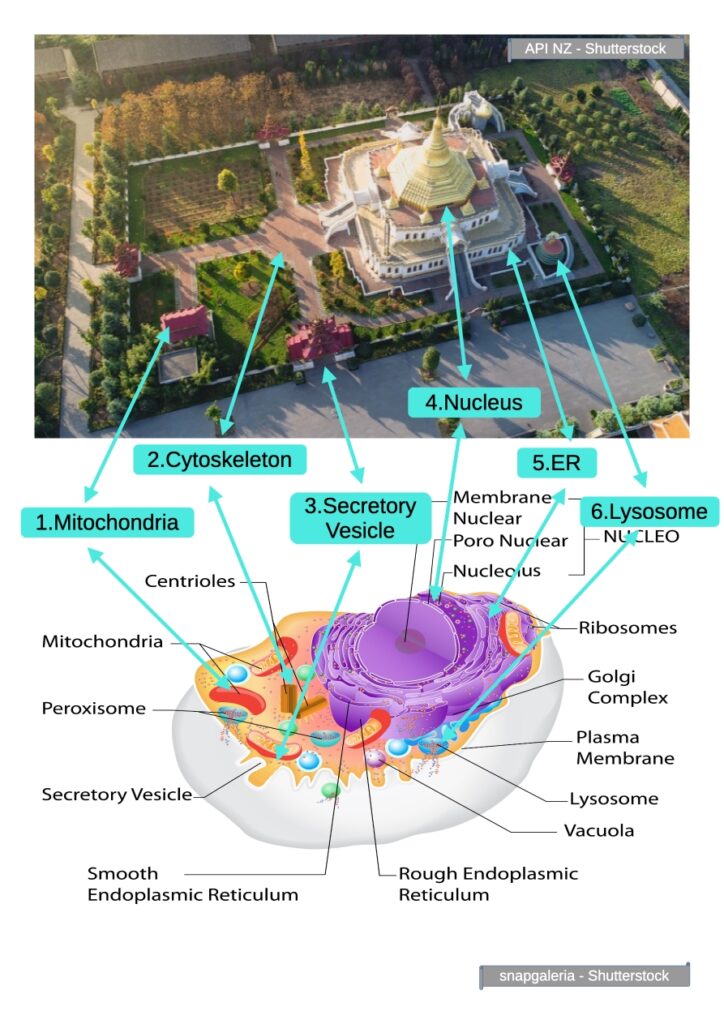
- 1. The garden pavilion is the mitochondria – This small, roofed structure, where monks rest and meditate, functions like the cell’s powerhouse. It generates spiritual energy (ATP) through rituals, just as mitochondria convert nutrients into fuel for the body.
- 2. Pilgrim paths are the centrioles of the cytoskeleton – The narrow walkways along which devotees travel form geometric patterns resembling centrioles—structures that organize the cell’s internal skeleton. They guide movement, just as the cytoskeleton shapes and orders the cell.
- 3. The entrance gate is a secretory vesicle – The temple’s main gate controls the flow of people, releasing pilgrims inward in an orderly manner, much like secretory vesicles transport substances across the cell membrane.
- 4. The golden stupa is the cell nucleus – The central, gleaming tower stores the most sacred relics (DNA), manages rituals (gene expression), and serves as the spiritual core of the entire complex, just as the nucleus directs the cell’s functions.
- 5. The zedi pavilion is the endoplasmic reticulum – This open pavilion surrounding the stupa acts like a production network: monks (ribosomes) transcribe sutras (proteins), while the passages between columns resemble the reticulum’s channels, where sacred texts (protein molecules) mature.
- 6. The Naga statue is the lysosome – The coiled serpent with its open maw serves as a „guardian of purity,” engulfing and digesting spiritual „waste,” exactly as lysosomes break down used cellular components.
The White Horse Temple in Luoyang is not just a place of prayer—it is a living model of a human cell, designed with a precision that seems to surpass the capabilities of ancient builders. Is it a coincidence that its structure so precisely mirrors biology? Or did our ancestors have access to knowledge we are only now uncovering under microscopes? If so, who were these „architect gods” really—and why did they hide this truth in stone?
„5 SURPRISING FACTS ABOUT HUMAN CELLS”
- 1. Every cell is its own city – A single cell contains as many processes as a metropolis: „factories” (ribosomes) produce proteins, „power plants” (mitochondria) generate energy, and a „sewage system” (lysosomes) disposes of waste.
2. DNA is the longest code in the universe – If you unraveled the DNA from one cell, it would stretch about 2 meters long. In the entire body, that’s over 20 billion kilometers—enough to reach Saturn and back!
3. Cells know how to sacrifice themselves – Through apoptosis (programmed cell death), cells self-destruct for the greater good of the organism—like microscopic samurais.
4. Neurons are marathon runners – Some nerve cells have axons up to 1 meter long (e.g., in the legs). If a cell were the size of a tennis ball, its „cable” would stretch 6.5 km!
5. You’re more bacteria than human – Your body contains 10 times more bacterial cells (microbiome) than human cells. Without them, you wouldn’t survive even a day.
These mind-blowing facts prove our bodies are perfectly designed „temples of life”—perhaps the very inspiration behind ancient architecture. Or maybe we’re only now uncovering the true meaning of their sacred blueprints?
,Combining images and analysis by Tomasz Mikulski – Cell God, date: 12/2024
- Links an references:
- Human Cell, https://medlineplus.gov/genetics/understanding/basics/cell/
- 10 Questions Revealing the Mysteries of Human Cells, https://chanzuckerberg.com/blog/mysteries-human-cells-revealed-faq/