„1. Fortress of Sao Felipe and the Fibroblast: An Extraordinary Analogy of Architecture and Biology”
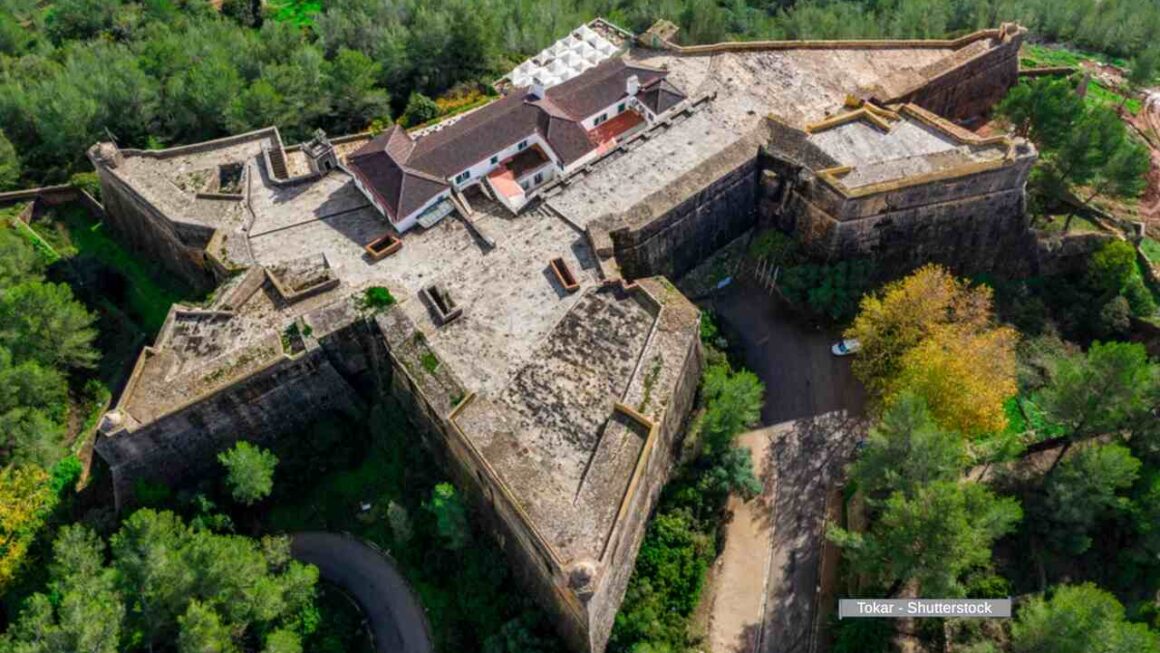
While modern microscopes reveal worlds invisible to the naked eye, it appears Renaissance architects were already creating macroscopic representations of them five centuries ago. Viewed from above, Portugal’s Fortress of São Felipe in Setúbal bears a striking resemblance to a fibroblast – the cell responsible for producing connective tissue. This remarkable analogy suggests our ancestors understood biological principles more profoundly than we might imagine today.
„History of a Strategic Masterpiece”
Built in 1582 during the reign of King Philip II, the fortress served as a crucial coastal defense against pirates and invading fleets. Its star-shaped bastion layout, designed by Italian engineers, represented the pinnacle of 16th-century military architecture. Paradoxically, this same geometric pattern has existed in nature for millions of years as an optimal structural solution.
, Photo description: Saint Philip Fortress in Setubal from above, Portugal.
, Vector description: Fibroblast. Cell structure and anatomy. Collagen fibers and skin cell. Vector illustration.
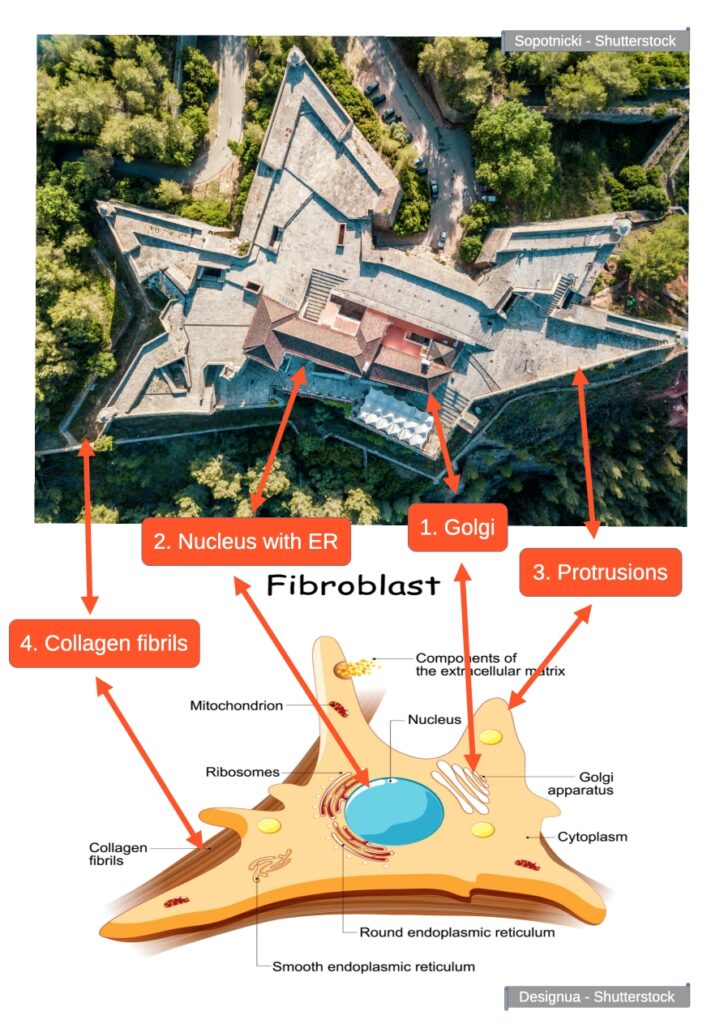
1. „Barracks – The Architectural Golgi Apparatus” The central barracks function like the Golgi apparatus in fibroblasts. This strategic logistics hub sorts, labels, and distributes weapons, ammunition, and supplies to various bastions, mirroring how the Golgi complex processes and distributes proteins in cells. Without this system, both fortress and cell would lose functionality.
2. „Chapel – The Molecular Control Center” The Santa Maria de Graça chapel serves as a stone reflection of the cell nucleus and endoplasmic reticulum. As we’ll show in part two, its interior perfectly illustrates protein biosynthesis.
3. „Star-Shaped Bastions – Strategic Protrusions” The characteristic triangular bastions protruding from the walls are architectural counterparts to fibroblast protrusions. Their geometric arrangement maximizes defensive capabilities by increasing contact surface with the environment – exactly how cellular protrusions enhance intercellular communication efficiency.
4. „Dry Moat and Pathways – The Collagen fibrils” The stone foundations, dry moat, and winding road create a structure identical to collagen fibers produced by fibroblasts. These elements bind the bastions into a cohesive whole, providing communication and strength, much like the collagen matrix connects and supports various tissues in the body.
The Fortress of São Felipe isn’t a coincidence of forms, but a conscious work of architectural biomimicry. Renaissance masters, from Leonardo da Vinci to Michelangelo, through keen observation of nature, discovered universal construction principles existing in both micro- and macro-worlds. From star-shaped fortresses in Europe to Egyptian pyramids and Asian temples, our ancestors consciously preserved biological structures in stone, creating architecture that bridges visible and invisible worlds. Perhaps they possessed knowledge we’re only beginning to rediscover with advanced microscopes… In the next part, we’ll explore the heart of this living metaphor – the chapel, where spirituality meets molecular biology.
„2. Santa Maria de Graça Chapel: A Sacred Reflection of the Cellular Protein Factory”
As we cross the threshold of the Santa Maria de Graça Chapel in the São Felipe fortress, we enter the interior of a living cell. Its architecture astonishingly recreates the structures responsible for protein biosynthesis in fibroblasts. This remarkable analogy suggests medieval builders understood the molecular essence of life better than we might assume.
, Photo description: SETUBAL, Fri-Jul 08, 2022: Chapel inside Forte de Sao Filipe covered with tiles in Setubal, Portugal.
, Illustration description: Structure of nuclear and endoplasmic reticulum in an animal cell, 3d rendering. Section view. Computer digital drawing.
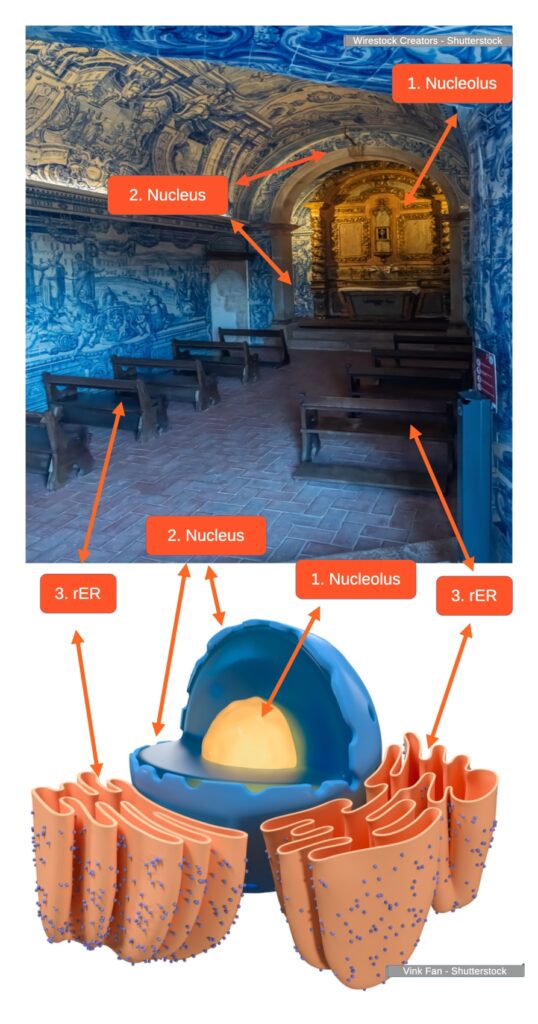
- 1. „The Altar as the Nucleolus – Heart of Ribosome Production”The gilded chapel altar performs the same function as the nucleolus in fibroblasts. This is the site of intense spiritual „production,” where the priest prepares Eucharistic elements, much like the nucleolus produces ribosome components. The light reflecting off the gilding resembles clusters of rRNA and ribosomal proteins ready for export.
- 2. „The Presbytery – The Fortress’s Cell Nucleus” The presbytery space corresponds to the fibroblast’s cell nucleus. Here, liturgical „instructions” (missals) are stored, and the ceremony is directed, just as the nucleus manages the expression of protein-coding genes. The enclosed presbytery, accessible only to the priest, reflects the strict control of access to DNA in the cell nucleus.
- 3. „The Main Nave – A Living Endoplasmic Reticulum” The expansive nave with worshippers participating in the liturgy is a stone reflection of the rough endoplasmic reticulum. The pews arranged in regular rows resemble reticulum membranes, while the praying people become living ribosomes „synthesizing” spiritual protein-values. Their collective singing is an almost tangible representation of the hum of working ribosomes.
The Santa Maria de Graça Chapel is no coincidence, but a conscious work of architects who, through observing nature, discovered the universal principles governing protein biosynthesis. From Gothic cathedrals to Byzantine churches, our ancestors consciously designed temples as macroscopic models of cellular protein factories. In this way, they immortalized in stone the deepest truth – that life in its essence is a constant process of creation and transformation, and for them, temples were not just places of prayer but monumental monuments to molecular biology. This forgotten knowledge, encoded in architecture, waited five centuries to be rediscovered.
„Fun Facts About Fibroblasts – The Divine Architects of Our Bodies”
 Fibroblasts Are Extraordinary Builders – They produce collagen, elastin, and other proteins that form the scaffolding of our tissues. Thanks to them, our skin remains elastic and our organs maintain their shape.
  Living Protein Factories – In just one hour, a single fibroblast can produce thousands of collagen molecules! It’s like a microscopic version of the Santa Maria de Graça Chapel, where worshippers „synthesize” spiritual values.
  Cells That Remember Wounds – Fibroblasts not only heal wounds but also retain a „memory” of damage. This allows them to respond faster to subsequent injuries—much like fortress guards learning from their mistakes.
  Long-Distance Communicators – They send chemical signals to other cells, coordinating tissue repair. It’s like the priest in the presbytery guiding the prayers of the faithful in the main nave.
  Aging with Dignity – As they age, fibroblasts slow down collagen production, leading to wrinkles. Yet even then, they continue working to keep our bodies in good shape—just like an aging fortress that still guards the coastline.
Could our ancestors, when designing the São Felipe Fortress, have sensed the existence of these fascinating cells? After all, both the fortress and fibroblasts combine strength, flexibility, and wisdom encoded in their structure!
Combining images and analysis by Tomasz Mikulski Cell God, date: 01/2025
- Links and references:
- Fibroblast. https://en.wikipedia.org/wiki/Fibroblast
- Built 1600, source. https://en.wikipedia.org/wiki/Fort_of_São_Filipe_de_Setúbal
- The Cell Nucleus https://micro.magnet.fsu.edu/cells/nucleus/nucleus.html
- What does the connection between the nucleus and the rough endoplasmic reticulum provide to the cell?https://www.quora.com/What-does-the-connection-between-the-nucleus-and-the-rough-endoplasmic-reticulum-provide-to-the-cell
- Fibroblasts: origins, definitions, and functions in health and disease, https://pmc.ncbi.nlm.nih.gov/articles/PMC8566693/