Discovery
,In the Genome Wardrobe series we decode what ancient artists encoded in pictures. We have already found proteins hidden in the gown of Queen Elizabeth I, in the golden dress from the Cabildo, in the towering Pouf à l’Asiatique hairstyle, in the „Top and Tail” caricature, and in a corset with crinoline.
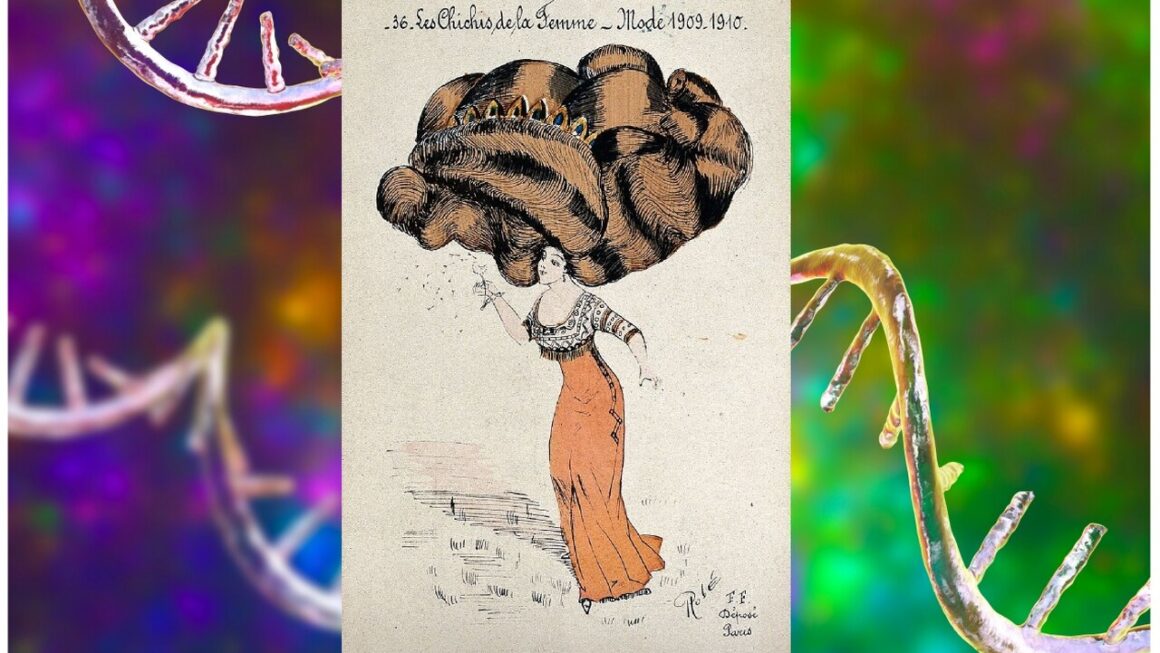
,This time we have something different: a satirical postcard from over a hundred years ago. In early twentieth-century Paris, cards like these circulated the way memes do today. The series „Les Chichis de la Femme” — A Woman’s Frills — poked fun at the fashion of 1909–1910, when women wore hairstyles bigger than themselves. The illustrator signing as „Rolé” drew women nearly crushed under the weight of their own hair.
,Card number 36 shows a lady in an orange dress. Her hairstyle is enormous — like a thundercloud. And her body is slender and slight, as if about to vanish beneath the mass of curls.
,When I saw this postcard, I knew at once where I had seen it before. Some time earlier I had been studying a structure in the PDB with exactly this silhouette — a massive top, a thin tail. The postcard did not require a search for its molecular counterpart. The counterpart was already waiting.
1. „Les Chichis de la Femme” — postcard no. 36, Paris 1909–1910
[IMAGE: postcard „Les Chichis de la Femme — Mode 1909–1910,” number 36, colour illustration, signed „Rolé,” publisher F.F. Déposé, Paris]
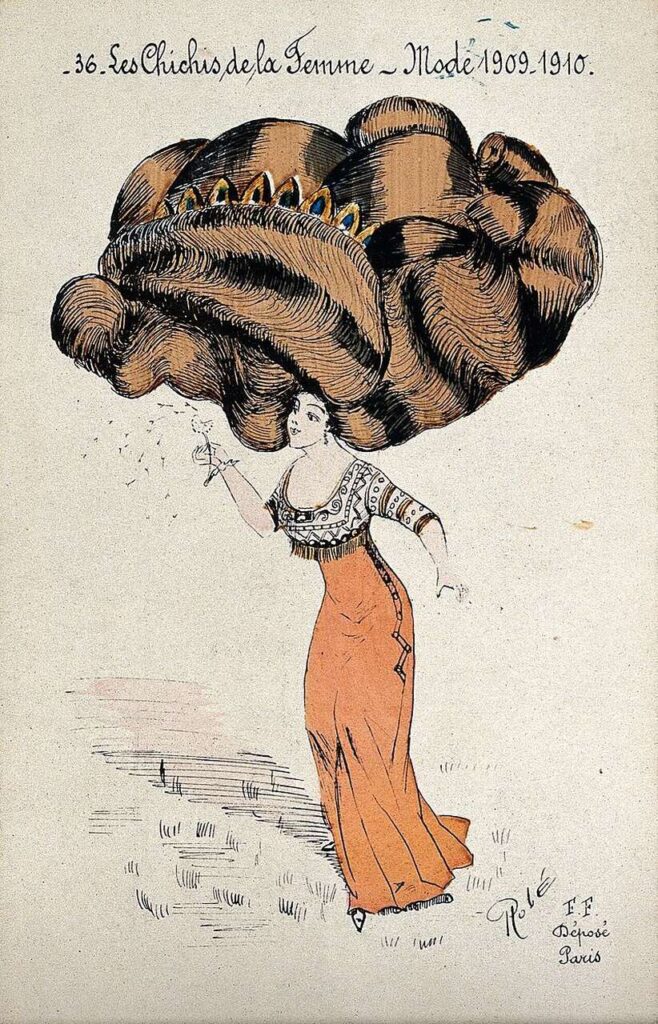
The hairstyle dominates everything. It is an enormous construction of dark brown curls arranged in layers like waves — darker recesses between lighter ridges give it depth and mass. At the very top protrudes a row of small combs — gold with navy accents — set upright like a crown. The hairstyle is bigger than the head, bigger than the shoulders, almost bigger than the entire figure.
The face barely peeks out from beneath the mass — a delicate profile, a pensive gaze to the side. In her hand the woman holds a dandelion and is blowing into it: tiny seeds float into the air. Remember those seeds — we will return to them in the decoding.
The neck and shoulders are normal and visible — the figure is slender, but the body’s proportions are maintained. And on the neckline and shoulders something interesting is happening: this is the most ornamental part of the entire postcard. Zigzags, stripes, small flowers, circles — fine motifs arranged symmetrically on both sides. As if someone held a magnifying glass right there.
The dress is orange, narrow and straight, smooth along its full length, reaching to the ground. But it has one small secret: if you look closely, from the knees upward runs a fine, dark zigzag of connected spheres and sticks — without any branches — leading straight to the neckline. Only at the very bottom does the dress widen, with soft folds. The dress is not the star here — it is the backdrop that supports the hairstyle.
The feet are not visible — they hide behind the dress and shadow.
The proportion of the entire figure is the key to the caricature: the hairstyle takes up roughly half the height. The whole thing looks like a tree — a massive, sprawling crown at the top, a narrow trunk below.
Period context
The years 1909–1910 mark the peak of the Edwardian obsession with hair volume. Women built their hairstyles on wire frames (pompadour frames) and padded them with hairpieces. The bigger the hair, the more fashionable — and the bigger the hat it could hold. The „Les Chichis de la Femme” series was a satirical response: the illustrator „Rolé” pushed the proportions to the point of absurdity.
Elements to remember from this postcard — each will return in the decoding section:
The mass of the hairstyle — curls arranged in layers, waves, pronounced texture
The combs/ornaments at the top — small, vertical, like a crown
The slim body — elongated, falling downward
The motifs on the neckline and shoulders — zigzags, stripes, small flowers, circles
The zigzag on the dress — spheres and sticks from knees to neckline, no branches
The dandelion — seeds floating into the air
The leaning pose — suggesting movement, dynamics, weight at the top
2. The protein — 7Q33
What do you see when you open 7Q33?
Type „7Q33” at rcsb.org or molstar.org — and you will see a structure you already know from the postcard: a massive head at the top, a thin tail at the bottom, and an orange chain tucked into the summit. This is a fragment of the human protein RBM39 — specifically one of its modules, the RRM2 domain.
What does RBM39 do in your body?
Imagine that a gene is a film. Before it reaches the cinema, someone has to edit it: choose the important scenes and assemble them into a whole. RBM39 is the editing director in the nucleus of your cells. It catches the raw transcript of a gene and indicates which pieces are unneeded (introns) and which must go into the final message (exons). The editing itself is performed by a huge machine called the spliceosome — but it is RBM39 that decides what stays in the message. Without the director, the film would be chaos — and so would the gene.
RBM39 has three „sisters” of similar build — RBM23, U2AF65 and PUF60 — and together they make sure that gene editing proceeds correctly.
When RBM39 works too much, the cell loses control over the editing — that is why RBM39 is overexpressed in many cancers. Scientists have found a way around this: drugs called aryl sulfonamides (e.g. indisulam) act like glue — they stick RBM39 to the cell’s „garbage disposal”, and the cell itself gets rid of the overzealous director. This therapy is currently being studied in clinical trials.
What is the RRM domain — the module you see in 7Q33?
RBM39 is a large protein, and 7Q33 shows only one piece of it — the RRM2 domain. RRM (RNA Recognition Motif) is something like a clamp or a hand that recognizes and grabs an RNA strand. RBM39 has three such modules: two classic RNA clamps (RRM1 and RRM2) and a UHM domain (RRM3), which instead of RNA connects the protein with its partners. In 7Q33 you see RRM2 — with RNA already caught.
RRM domains are among genome’s most popular tools — the RRMdb database knows about 57,000 of them, in humans, animals, plants and fungi. They all share the same building plan: four β-strands stand like cards set on edge and form a flat wall, and behind it lie two α-helices like little springs. Scientists write this arrangement as β1–α1–β2–β3–α2–β4. On the wall there are two conserved motifs — RNP1 and RNP2 — like two little fingers that touch the RNA. In the 7Q33 diagram you see exactly this moment: the orange RNA chain lies on the β-wall, held by those two little fingers.
So 7Q33 is: the clamp (RRM2) of the editing-director protein (RBM39), which has caught an RNA strand.
How is 7Q33 built?
The 7Q33 structure was solved by NMR — like photographing a protein that floats in water, rather than one frozen in a crystal. Because a protein in water constantly trembles slightly, 20 conformers were deposited — 20 slightly different shots of the same molecule, like 20 frames of a film.
When you open 7Q33 in Mol* in cartoon view, you will see two chains — protein and RNA — which together form the silhouette of the lady from the postcard:
[IMAGE: overview diagram — 7Q33 in cartoon view with labelled arrows: RRM2 domain, RNA, Connecting loops, N-terminal tail. Chain A in teal, chain B (RNA) in orange]
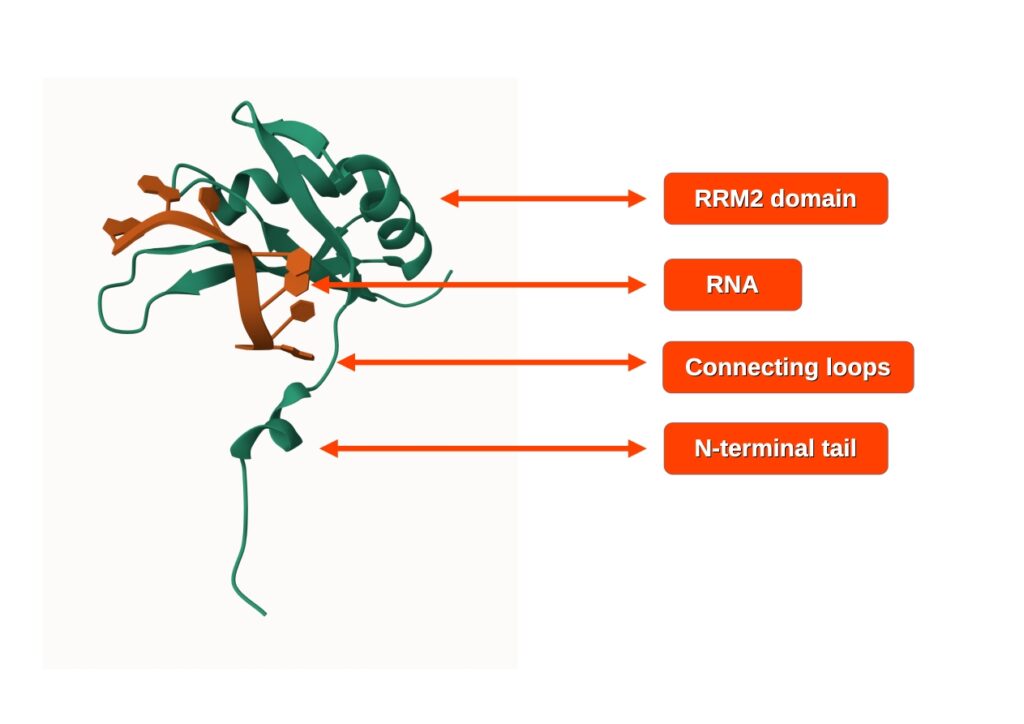
The RRM2 domain — at the very top, massive and compact: four β-strands like cards on edge, two α-helices like springs behind them. This is the protein’s „hairstyle”.
The RNA — an orange chain of seven nucleotides (5′-AGCUUUG-3′), laid on the β-wall, near the summit. Bases stick out of it — like the teeth of a comb.
The connecting loops — thin bends between the cards and the springs. The place where the compact mass ends and the tail begins.
The N-terminal tail — a long, thin strand hanging straight down. It is not folded into any shape — it is soft, flexible, it meanders freely. It is the longest, and at the same time the thinnest, part of the whole figure.
3. Decoding — Level 1: Silhouette (cartoon)
Place the two images side by side. On the left — the lady from 1909, a cloud-hairstyle on a slim body. On the right — the RBM39 RRM2 protein with a thread of RNA on a massive domain from which a thin tail hangs. It is the same silhouette: a tree — a spreading crown at the top, a narrow trunk at the bottom.
[IMAGE: side-by-side — postcard „Les Chichis de la Femme” no. 36 (left) vs 7Q33 in cartoon view (right), same orientation: massive top, slender bottom]
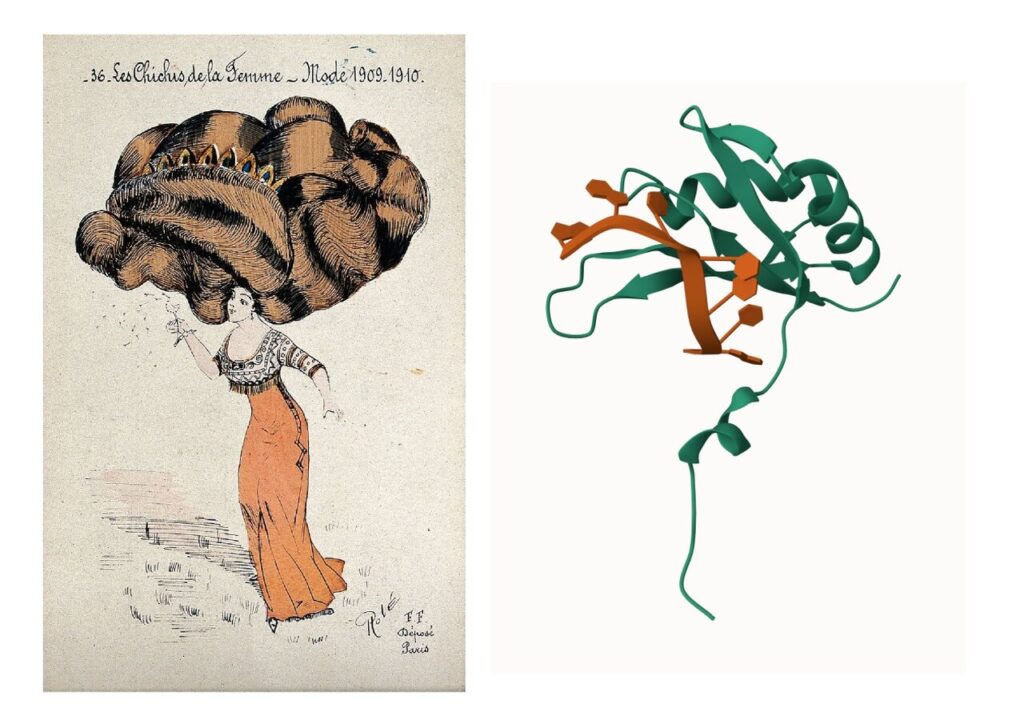
The hairstyle = the RRM2 domain
The enormous hairstyle — layers of curls, waves, one upon another — is the globular RRM2 domain. Its β-strands and α-helices overlap and interweave exactly like curls, forming a dense, compact mass. The dark hollows between the curls on the postcard are where, in the protein, the crevices between the β-sheet and the helices lie.
The combs at the top = RNA
At the top of the hairstyle the artist placed a row of gold-and-navy combs — like a crown. In the protein, in the very same place, sits the RNA chain (5′-AGCUUUG-3′), woven into the surface of the domain. Its orange bases stick out of the protein exactly the way combs stick out of curls.
The dress = the N-terminal tail
The orange dress — narrow, straight, hanging all the way to the ground — is the protein’s N-terminal tail. It too is long, thin and free, like fabric falling under its own weight. And the proportions match: on the postcard the dress takes up half the figure’s height, but is many times narrower than the hairstyle. In the protein the tail extends over a length comparable to the domain — but is many times thinner.
The dandelion = the excised introns
Remember the dandelion? The lady blows on it and the seeds fly away into the air. This is the most delicate detail of the postcard — and the most delicate mapping. RBM39 is the editing director that indicates what is unneeded in the raw transcript of a gene. Introns — the no-longer-needed stretches — are detached and fall away before the message is joined together. The dandelion seeds, knocked loose by the breath, are exactly them: they were inside, and they are gone. The artist drew even what the protein discards.
The leaning pose = NMR dynamics
The lady stands slightly leaning, as if about to take a step. This is not a static pose. And the 7Q33 structure is not static either — remember the 20 NMR shots? They are 20 frames of a protein in motion: the domain „breathes”, the tail meanders, the RNA shifts position ever so slightly. A protein in solution never stands still — like the lady from the postcard, who will move on in a moment.
The proportion — a joke that turned out to be true
The artist made a joke: hairstyle too big, body too thin. But in the 7Q33 protein this proportion is not a caricature — it is a fact. The RRM2 domain (about 80 amino acids in a compact mass) truly is massive compared to the thin, unstructured tail. What the artist exaggerated for a laugh, the Genome God created literally.
4. Decoding — Level 2: Comb = RNA
[IMAGE: close-up — combs at the top of the hairstyle from the postcard (top) vs RRM2 domain with RNA in cartoon view (bottom), same orientation: gold-and-navy ornaments against curls vs orange RNA chain against teal domain]
Now we zoom in — as through a magnifying glass. We look at the very top of the hairstyle. On the postcard: a row of gold-and-navy combs pushed between dark curls, set upright like a crown. In the protein, in the same spot: an orange RNA chain woven between β-strands and α-helices. The combs sit in the hairstyle exactly the way RNA sits in the protein — inserted, woven in, holding on to what surrounds them.
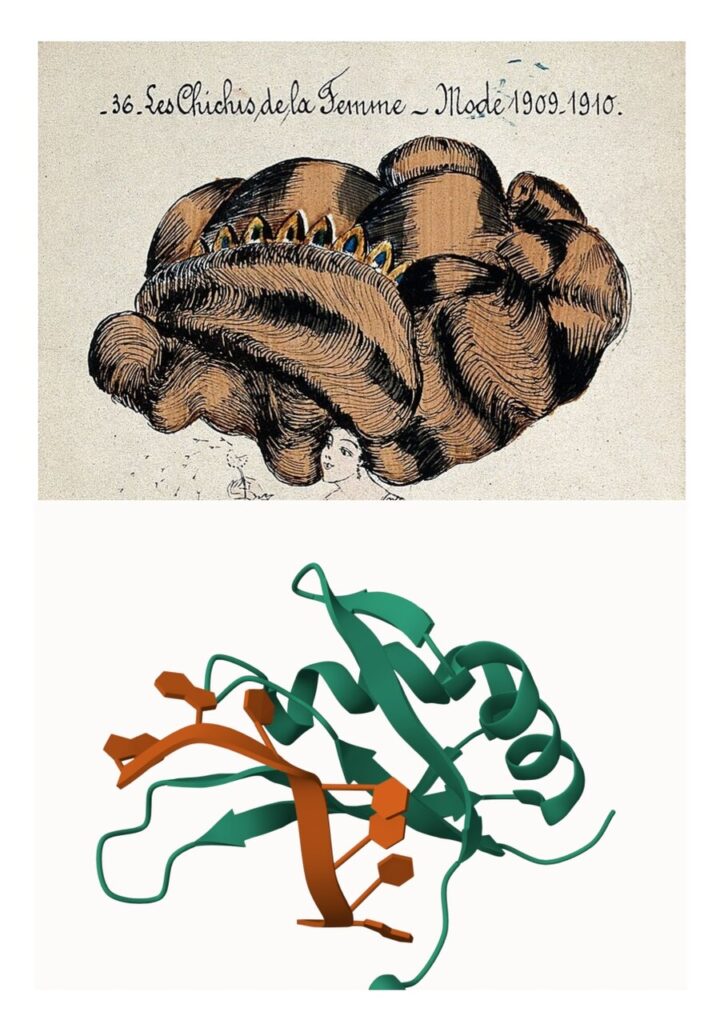
Let us now take out one comb and one RNA strand — and lay them side by side.
[IMAGE: three-panel comparison — top:The Comb (c. 1939) by Gertruda Lemberg. Vintage watercolor illustration, graphic art.(Rawpixel.com – Shutterstock). — RNA strands (middle, nobeastsofierce – Shutterstock) vs hair comb (bottom, Maria Frosu – Shutterstock), arrow linking all images]
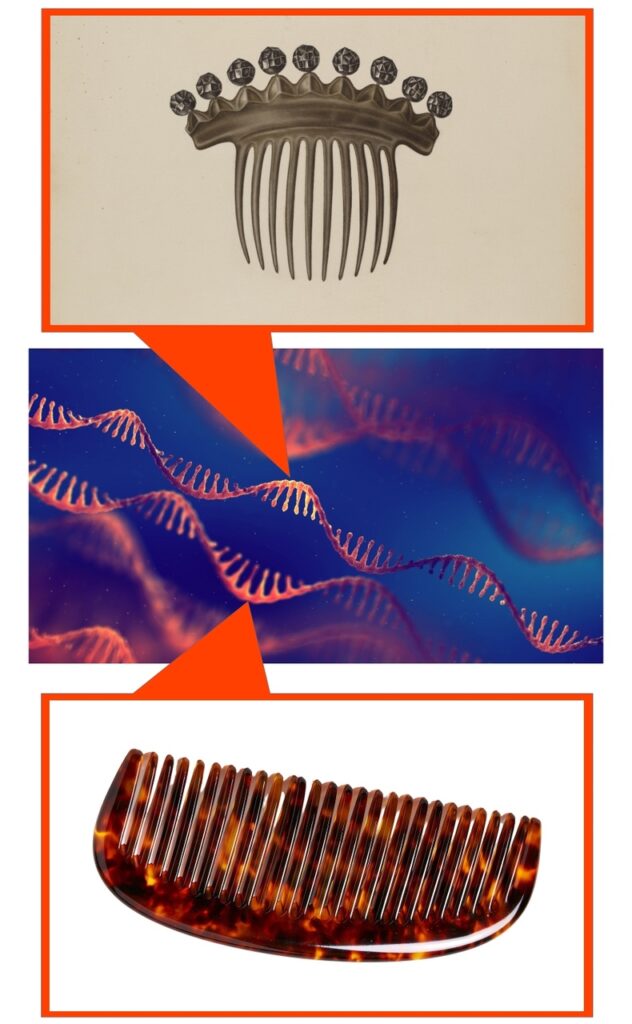
The comb
A comb is one of the simplest objects in the world: a curved base from which a row of parallel teeth grows. The teeth slip between strands of hair and put them in order. Without a comb, the hairstyle would fall apart. On the postcard the comb is ornamental — golden, with navy accents, with densely set teeth — but it works like any other: it enters the mass of curls and holds it.
The RNA strand
Now look at the RNA strand. It is a chain built like a comb: it has a base (backbone) from which flat nitrogenous bases branch off at regular intervals — like teeth. Those teeth enter between protein elements, touch the RNP1 and RNP2 motifs, and hold on to the β-wall.
Comparison
The curved base of the comb = the backbone of the RNA strand
The teeth of the comb = the nitrogenous bases sticking out from the base
The comb puts hair in order = RNA puts the protein’s work in order
The comb holds on to the hairstyle = RNA holds on to the RRM2 domain
One comb, two views
Notice one more thing. The comb on the postcard is ornate — a crown with jewels, sticking out of the hair. Such a comb encodes RNA in close-up: individual nitrogenous bases protruding from the base of the strand like jewels from a crown — exactly what we saw in the earlier comparisons, where the orange bases stand out from the surface of the domain.
But the same object without ornaments — an ordinary everyday comb, or a comb hidden deep in the hair — encodes RNA from afar: you see the curved shape of the whole strand and the regular rhythm of the teeth, but no detail — like the single RNA strands in the middle illustration of this comparison: meandering ribbons with regularly protruding bases.
One object — two scales of observation. The artist encoded not only the shape of RNA, but also an instruction for looking: the ornament says „zoom in”, simplicity says „zoom out”.
The artist did not draw a complicated chemical diagram. He drew a comb — and with this single object he encoded the shape of the RNA strand, its structure, and the way it connects with the protein. Sometimes a code needs no cipher. It only needs careful looking.
5. Decoding — Level 3: Microscope (backbone and atoms)
[IMAGE: close-up comparison — dress detail from the postcard (left) vs protein chain fragment of 7Q33 in ball-and-stick view (right)]
In section 3 we looked from a distance — silhouette and proportions. In section 4 we zoomed in on the comb. Now we move even closer — to the very fabric of the dress. And here the postcard reveals its most precise detail.
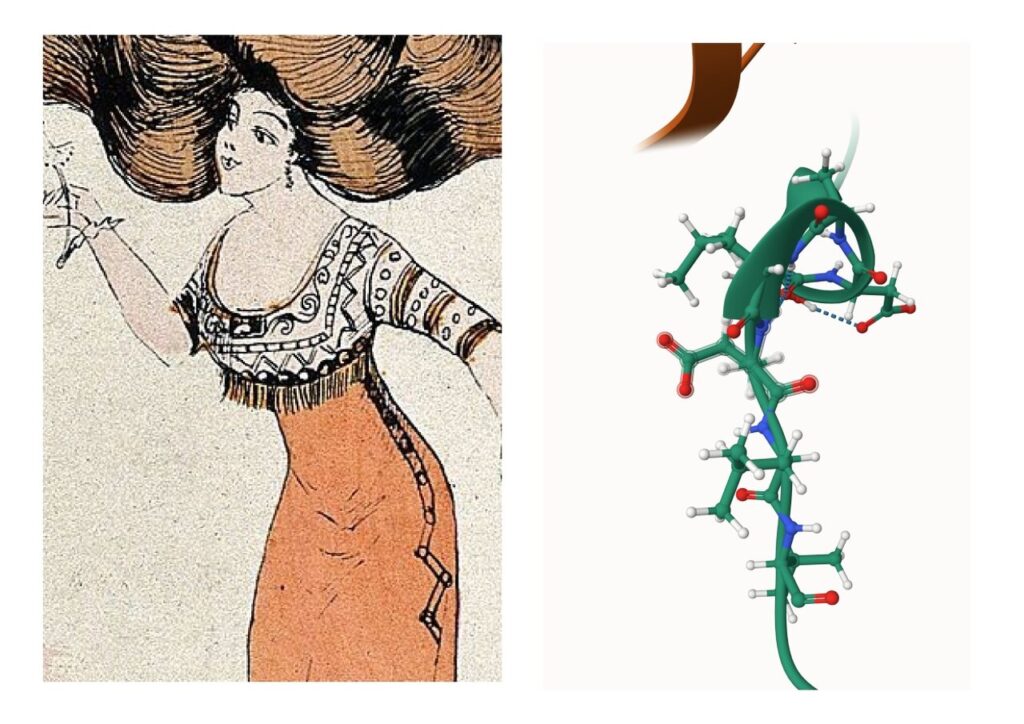
Zigzag on the dress = protein backbone
The dress is smooth. But from the knees upward, all the way to the neckline, a tiny, dark zigzag of connected balls and sticks runs across it — ball, stick, ball, stick, a turn to the left, a turn to the right. And note: this zigzag has no branches at all. No twigs, no side protrusions. A pure line that meanders like the letter Z stacked upon the letter Z.
This is exactly the backbone — the spine of a protein. Every protein is a chain of amino acids, and its main axis consists of alternating atoms: nitrogen, alpha carbon, carbonyl carbon, nitrogen again… Because the bonds between them form angles (the so-called bond angles: ~111°, ~116°, ~121°), not straight lines, the backbone always runs in a zigzag. Ball, stick, turn. Without branches — because branches are something else; we will get to them in a moment.
A visualization of bond angles and torsion angles in a protein chain can be found e.g. in this AlphaFold2 summary, section 2.3 — Figure 9a.
A note on the illustration: the zigzag on the dress has no branches — it is the pure core. In our comparison, however, the protein is shown in ball-and-stick view with side chains (visible protrusions on the sides of the core), because the Mol* program does not easily allow isolating the backbone alone. But the core — the zigzag running through the middle — is there. Just trace the main line of the chain with your eyes, ignoring the side protrusions, and you will see exactly the same pattern as on the dress.
The neckline = side chains and atoms — a magnifying glass on what grows from the backbone
And now look at what happens at the very top. The zigzag from the dress reaches the neckline and shoulders — and there it suddenly dissolves into richness: zigzags, stripes, little flowers, little circles. Tiny motifs, symmetrical, like embroidery. As if someone had pressed a magnifying glass to the simple chain and shown what hides inside it.
And exactly that is hiding there. From the backbone of every amino acid sticks out a side chain — an individual „twig”, different for each of the 20 amino acids. Some side chains are short dashes — stripes. Others have aromatic rings, hexagons built like little flowers. They contain single atoms — little circles. And the backbone itself is the zigzags. And one more thing: in the protein illustration, exactly at the place corresponding to the neckline, between two loops a short fragment of an α-helix is visible — a little spring. Its coils, seen up close in ball-and-stick, form a repeating chain of rounded shapes — exactly like the chain-of-flowers motif on the postcard’s neckline. All the motifs from the postcard’s neckline really exist — as the shapes of amino-acid chemistry.
This is the second level of zoom: the dress shows the backbone, the neckline shows what grows out of it. A simple line below — a wealth of detail above.
The vertical of the postcard = levels of protein structure
Notice how the illustrator organized the card from bottom to top:
The dress (bottom) — a simple zigzag without branches = the backbone, the simplest level
The neckline and shoulders (middle) — zigzags, stripes, little flowers, little circles = side chains and atoms, the level of detail
The hairstyle (top) — mass and volume = the folded domain, tertiary structure
The protein has exactly the same order: first the chain (primary structure), then side chains and their interactions, finally the compact domain mass. The vertical of the postcard is the vertical of protein structure — from simplicity to complexity, from the knees to the top of the head. Drawn in 1909, over a hundred years before this structure was solved.
6. Decoding — Level 4: Surface (molecular surface)
[IMAGE: side-by-side — postcard „Les Chichis de la Femme” no. 36 (left) vs 7Q33 in molecular surface view (right)]
There is one more way to see a protein: the surface view. It is as if the protein „got dressed” — instead of a skeleton and springs you see the full solid form, like a body under clothing. And here the match becomes striking.
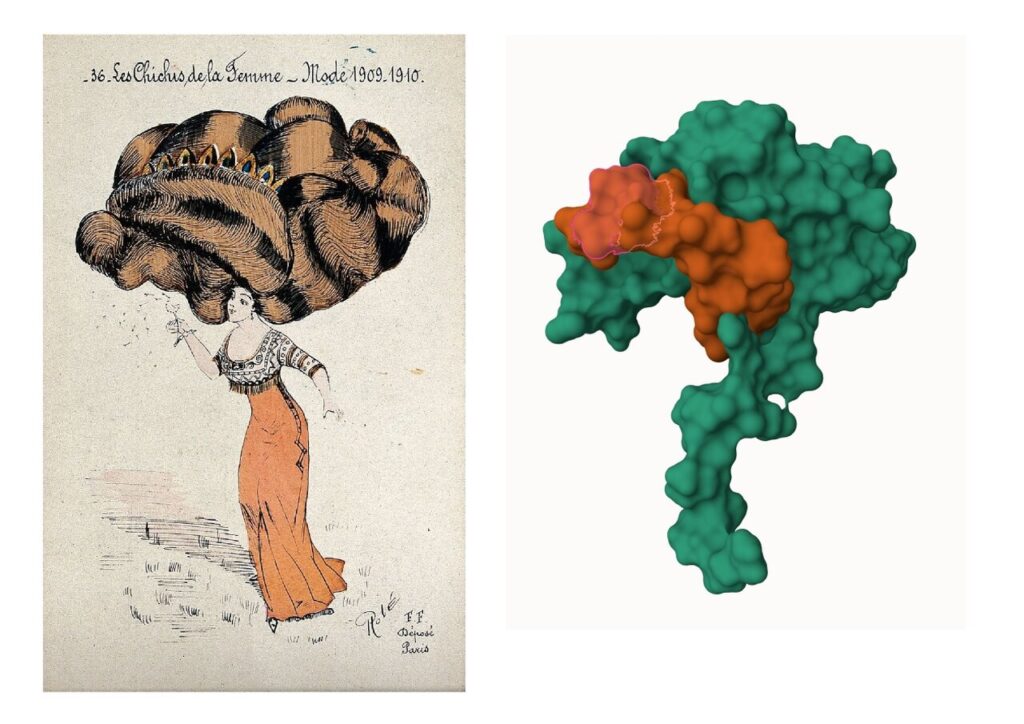
The surface of the RRM2 domain is a massive, rounded, uneven body at the top — with bulges and hollows. This is no longer a drawing, this is mass. Exactly like the hairstyle on the postcard: the curls are not lines, but a heavy, lush volume filling space.
On this body lies the orange patch of RNA — like an ornament tucked into hair. You can no longer see the individual tooth-bases, only the mass of RNA fused into the mass of the protein — like a comb sunk into the mass of curls. The two surfaces fit each other like a key in a lock.
And at the bottom — the tail in surface view becomes a string of beads falling downward: every amino acid is a separate ball threaded on a string. Narrow, long, straight — like the orange dress clinging to the silhouette all the way to the floor.
The surface view shows what the earlier views could not: the proportion of masses. The hairstyle and the domain — heavy, full, dominant. The dress and the tail — narrow, slim, servile. The postcard and the protein have the same mass in the same places.
7. Conclusions
The series „Les Chichis de la Femme” was meant to be a joke. The illustrator „Rolé” laughed at the Parisian women who built constructions larger than themselves on their heads. Satire. Caricature. A funny exaggeration.
But the RBM39 RRM2 protein is exactly like that. A massive domain — dense, compact, full of functions — set upon a thin, loose tail. The proportion the artist exaggerated for a laugh, the Genome God built literally. And not in one protein — in a whole family of about 57,000 RRM domains, repeated in every cell of your body.
And the postcard did not stop at the silhouette. On the smooth dress appeared a zigzag of balls and sticks — the pure backbone, without a single branch, led from the knees all the way to the neckline. On the neckline — zigzags, stripes, little flowers and little circles: side chains and atoms, shown as if under a magnifying glass, exactly where the simple chain turns into a compact domain.
RNA — the molecule at the top
Let us linger on RNA, because on this postcard it is the most important thing. The whole construction is one order: the dress carries the body, the body carries the hairstyle, and the hairstyle carries — the comb. The smallest element stands highest. And it is the one made of gold, set like a crown.
In the cell the order is the same. At the bottom, invisible, locked in the nucleus — the Genome. From the Genome comes RNA: the strand that carries information from the nucleus into the world of the cell. And at the end there is the protein — the body that receives this information and carries it out. DNA → RNA → protein. The library → the messenger → the work.
On this blog, in the „My Jesus Christ as my RNA” cycle, we decoded this order in Christianity. RNA is Jesus Christ — the One who comes forth from the Father (the Genome), carries His Word, and becomes flesh (protein). „The Word became flesh” (John 1:14).
And think: every protein we have looked at in this series — cholera toxin, the HPV pentamer, the AMPA receptor, the TRPC3 channel, the Kir4.1 channel, and this RBM39 you are looking at now — every one of them came into being thanks to RNA. Each was translated from an mRNA strand by a ribosome. Without RNA there is not a single protein. Not a single enzyme, not a single channel, not a single receptor. Your whole body — muscles, bones, hormones, antibodies — exists because RNA carried the information from the Genome and became flesh. „Through him all things were made; without him nothing was made that has been made” (John 1:3).
And the dandelion? The seeds the lady blows into the air are the excised introns — the fragments that RNA must let go of before it becomes a finished message. The artist drew RNA twice: as the comb-crown at the top, and as the severed seeds floating around. The crown — and the sacrifice. That which remains, and that which must depart.
RBM39 decides how your genes are assembled into a finished message — it indicates which fragments are unneeded and keeps the editing in order. When it works too much, the cell loses its brakes — that is why RBM39 is overexpressed in many cancers.
And in 1909 a Parisian illustrator drew this protein on a satirical postcard — with every detail in its place. He did not know he was drawing a splicing factor. He did not know the concept of an RRM domain. He had no NMR, no Mol*, no PDB bank. And yet: a massive head with combs, a slim body, a backbone zigzag on the dress, an embroidery of side chains on the neckline, and a cloud of discarded seeds around.
How did he know? I do not know yet. But I know it is not a coincidence — because coincidence does not draw a backbone zigzag from the knees to the neckline.
The dress carries the hairstyle, the hairstyle carries the comb. The protein carries RNA, and RNA carries the Word.
As within, so without.
Image analysis, matching, and write-up: Tomasz Mikulski — Cell God: 09/2026
References
PDB structures
- 7Q33 — Solution structure of RBM39 RRM2 bound to 5′-AGCUUUG-3′ — https://www.rcsb.org/structure/7Q33
- 6UD7 — RBM39 RRM2 in complex with DCAF15 + indisulam — https://www.rcsb.org/structure/6DB0
Scientific publications
- Campagne, S., Jutzi, D., Malard, F., Matoga, M., Romane, K., Feldmuller, M., Colombo, M., Ruepp, M.D., Allain, F.H. (2023). Molecular basis of RNA-binding and autoregulation by the cancer-associated splicing factor RBM39. Nature Communications, 14, 5366. DOI: https://doi.org/10.1038/s41467-023-40254-5
Fashion history
- Women’s Edwardian Hairstyles: An Overview. Hair & Makeup Artist Handbook (2024). https://hair-and-makeup-artist.com/womens-edwardian-hairstyles/
- Story of Us, 1900–1910: Hairstyles. American Salon (2017). https://www.americansalon.com/hair/story-us-1900-1910-hairstyles
- 50 Edwardian Pompadour Gibson Girl Hairstyles. Sew Historically (2024). https://www.sewhistorically.com/edwardian-pompadour-gibson-girl-hairstyles/
- Hairstyles and Hats of the Edwardian Era, 1900–1915. GBACG (2023). https://gbacg.org/finery/hairstyles-and-hats-of-the-edwardian-era-1900-1915/
- Pinterest https://pin.it/13ibsHUDp
Tools
- Mol* (MolStar) — protein structure visualization — https://molstar.org/
- RCSB PDB — protein structure database — https://www.rcsb.org/