1. The Monastery of Rila vs superficial squamous epithelial cell.
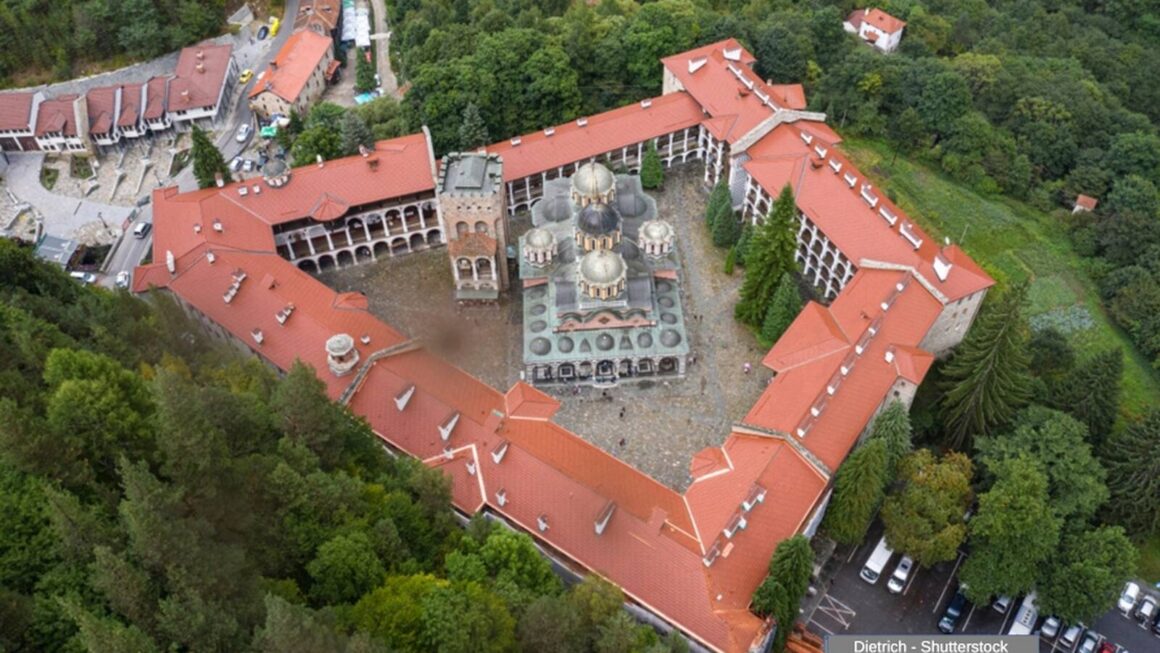
, When we view Rila Monastery from above, an astonishing truth is revealed—this medieval structure is not just a house of prayer but a living replica of an epithelial cell. Its architecture precisely mirrors biological machinery, proving our ancestors understood the microscopic world better than we think.
, photo description: Amazing Aerial view of Rila Monastery, Kyustendil Region, Bulgaria.
, photo description: View in microscopic of normal human cervix cells. Superficial squamous epithelial cell. Cytology and pathology laboratory department.Magnification 400 X
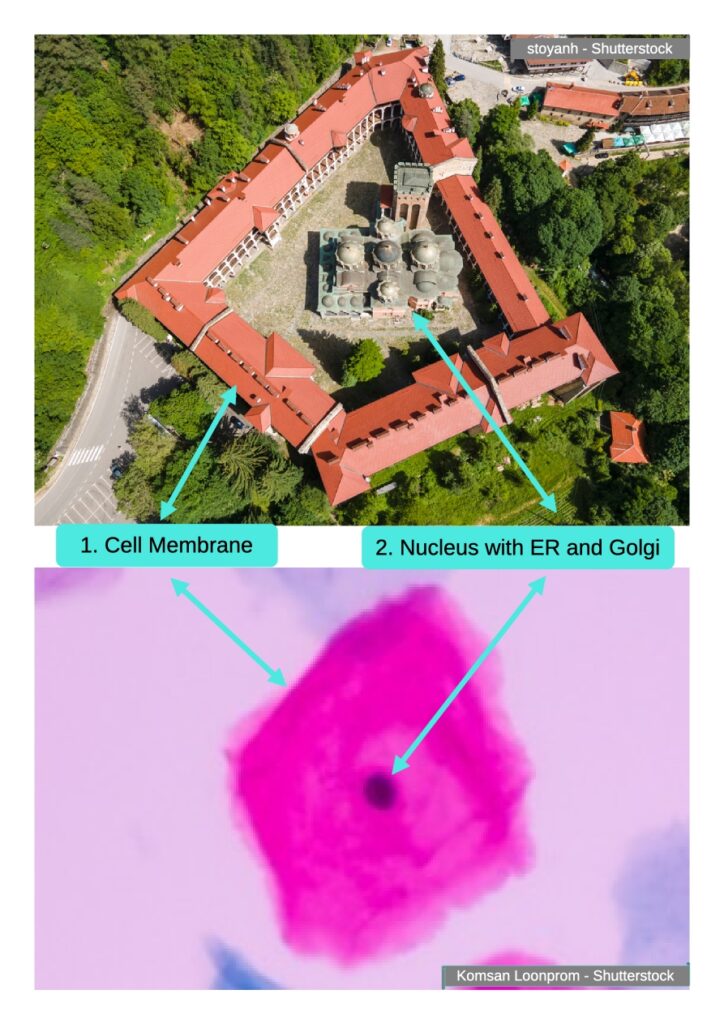
- 1. The four-story residential wings perfectly mimic a cell membrane—their windows function like transport proteins, selectively admitting pilgrims (nutrients) and prayers (chemical signals), while the thick walls serve as the lipid layer protecting the „cell interior.”
- 2. The main church is the true command center—its altar acts as the nucleus storing the „sacred code” of faith, the cloisters as the endoplasmic reticulum producing spiritual „proteins,” and the treasury as the Golgi apparatus packaging and distributing holy objects (exported proteins).
, Rila Monastery turns out to be a three-dimensional textbook of cell biology—its architecture not only inspires but literally breathes life, showing that the sacred and science are two languages describing the same divine reality.
„Fascinating Facts About Epithelial Cells”
- 1. Invisible Shield – Epithelial cells form a protective barrier that faces bacteria, viruses, and toxins every day. If laid out in a single layer, they would cover the area of 2 tennis courts!
- 2. Regeneration Masters – The intestinal epithelium completely renews itself every 3-5 days—the fastest-regenerating tissue in the human body.
- 3. Shape Matters – Epithelial cells can be flat like tiles (e.g., in the bladder), cube-shaped like blocks (e.g., in the kidneys), or column-like (e.g., in the intestines).
- 4. Microscopic Brushes – Epithelial cells in the small intestine have microvilli, which increase nutrient absorption surface area by 20 times!
- 5. Flexible Guardians – The bladder epithelium can stretch 5-fold when the bladder is full.
, Epithelial cells are true masters of adaptation and protection for our body. They form intelligent barriers capable of regenerating in the blink of an eye, changing shape according to needs, and even increasing their surface area through microscopic projections. Their remarkable flexibility and specialization enable them to perform crucial functions – from nutrient absorption to protection against harmful factors. They are the true guardians of our body that never sleep!
2. Fresco of Rila Monastery vs DNA replication – DNA unraveling by helicase and SSB helper proteins.
, The fresco of the Virgin Orans in the monastery is not just a work of art—it’s a DNA replication schematic encoded in pigments. Let’s examine how Byzantine artists depicted the molecular miracle of life through iconographic symbolism.
, photo description: Virgin Mary, Fresco of Rila Monastery, Bulgaria.
, vector description:DNA replication. double helix is unwound. Each separated strand acts as a template for replicating a new strand. Vector diagram for scientific, medical, and educational use.
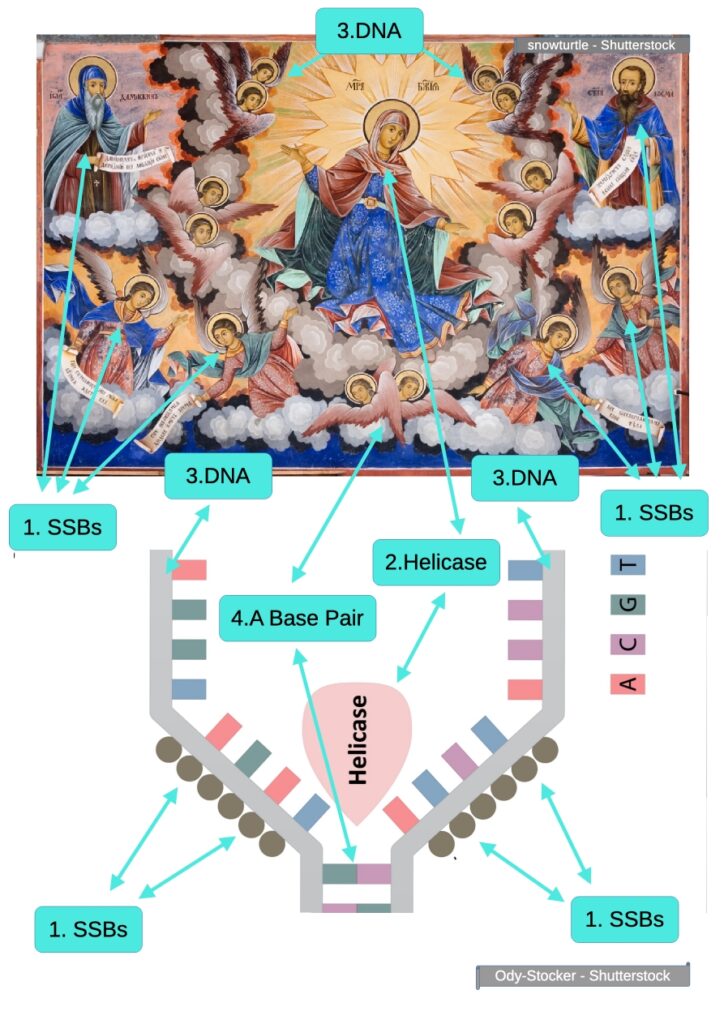
- 1. Angels with unrolled scrolls and Saints John of Damascus and Cosmas are living personifications of SSB proteins—their scrolls stabilize the „unwound strands” of prayers and hymns just as these proteins protect single-stranded DNA during replication.
- 2. The central figure of Mary with raised arms is helicase in action—her golden halo (symbolizing divine energy) represents the ATP molecules powering this enzyme as it unwinds the double helix of life.
- 3. The arrangement of cherubim forms the pattern of unwound DNA—each angel is a single nucleotide, and the rhythmic alignment of the entire choir reflects the sequence of the genetic code.
- 4. The two crossed cherubim at Mary’s feet embody the principle of complementarity—their symmetrical poses precisely show how adenine pairs with thymine and cytosine with guanine.
- The clouds surrounding the scene are not just background but an accurate representation of chromatin—their density variations correspond to different degrees of DNA condensation, from loose euchromatin to dense heterochromatin.
,The deepest revelation? This divine machinery is operating in your cells right now! Mary-helicase unwinds your DNA, Saints John and Cosmas stabilize its strands, and the angel-nucleotides arrange themselves into your unique genetic code. You are a living temple where biology and spirituality become one.
„For in Him we live and move and have our being”—these words take on new meaning when we realize that saints and angels are not just figures in paintings but living processes in our cells. Every cell division is an act of creation, every DNA replication—a sacramental renewal of life.
„Amazing Facts About DNA Unwinding”
- 1. Molecular Drill – Helicase, the enzyme that unwinds DNA, rotates at a speed of 1000 revolutions per second!
- 2. Hot Process – During unwinding, the local temperature rises to 90°C, but special proteins protect the DNA from damage.
- 3. Multitasking – About 50,000 helicases work simultaneously in each cell to enable DNA replication and repair.
- 4. Precision Gluing – SSB proteins (single-strand binding proteins) stabilize unwound DNA strands with single-nucleotide accuracy.
- 5. Cosmic Length – If all the DNA molecules from one person were unraveled, they would stretch to the Sun and back 600 times!
- 6. Efficient Approach – DNA doesn’t unwind completely—replication starts at multiple points simultaneously to save time.
- 7. Eternal Youth – Every day, tens of thousands of DNA damages occur in your body, but repair systems work almost flawlessly.
- Have you ever thought that every second, processes more complex than the most advanced computers take place in your body?
,Combining images and analysis byTomasz Mikulski, date: 01/2025
- Links and references:
- Established 927, https://en.wikipedia.org/wiki/Rila_Monastery
- Superficial squamous cells – https://www.eurocytology.eu/course/cervical-cytology-2/9b-normal-cytology-and-benign-reactive-changes/
- Cell Nucleus, https://en.wikipedia.org/wiki/Cell_nucleus
- DNA replication, https://humanbiology.pressbooks.tru.ca/chapter/dna-replication/
- Sugar-phosphate backbone and bases, https://www.genome.gov/genetics-glossary/Phosphate-Backbone
- SSBs, https://pubmed.ncbi.nlm.nih.gov/22976174/
- A base pair, https://en.wikipedia.org/wiki/Base_pair
- DNA helicase, https://pubmed.ncbi.nlm.nih.gov/8141804/