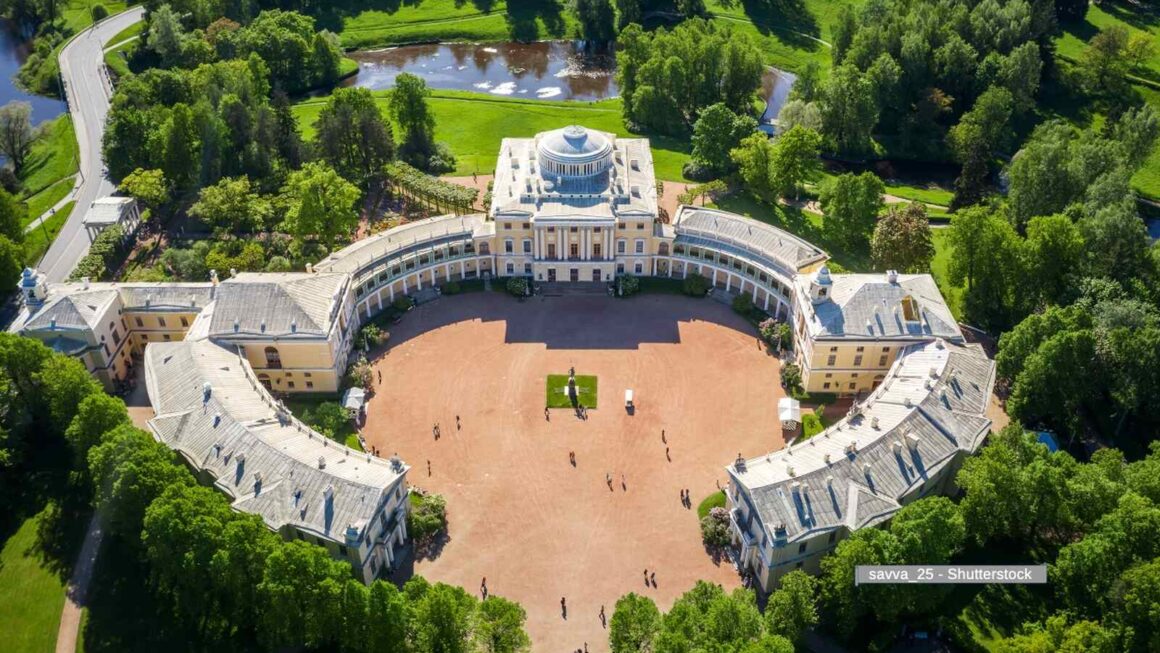
„Pavlovsk Palace – An Architectural Neutrophil”
, Could great architectural works be encoded messages from ancient builders who understood the microscopic world better than modern science? In this next post, we uncover the fascinating resemblance between Pavlovsk Palace in St. Petersburg and a neutrophil—a key immune system cell. Could the palace’s bird’s-eye view shape be an intentional representation of a white blood cell’s structure? Join me on a journey where architecture becomes a living microscope!
, Photo description: Aerial view of Pavlovsk Palace on october sunny day, neighborhood of Saint-Petersburg.
, Vector description: Neutrophils are the most abundant type of granulocytes of all white blood cells in humans body.
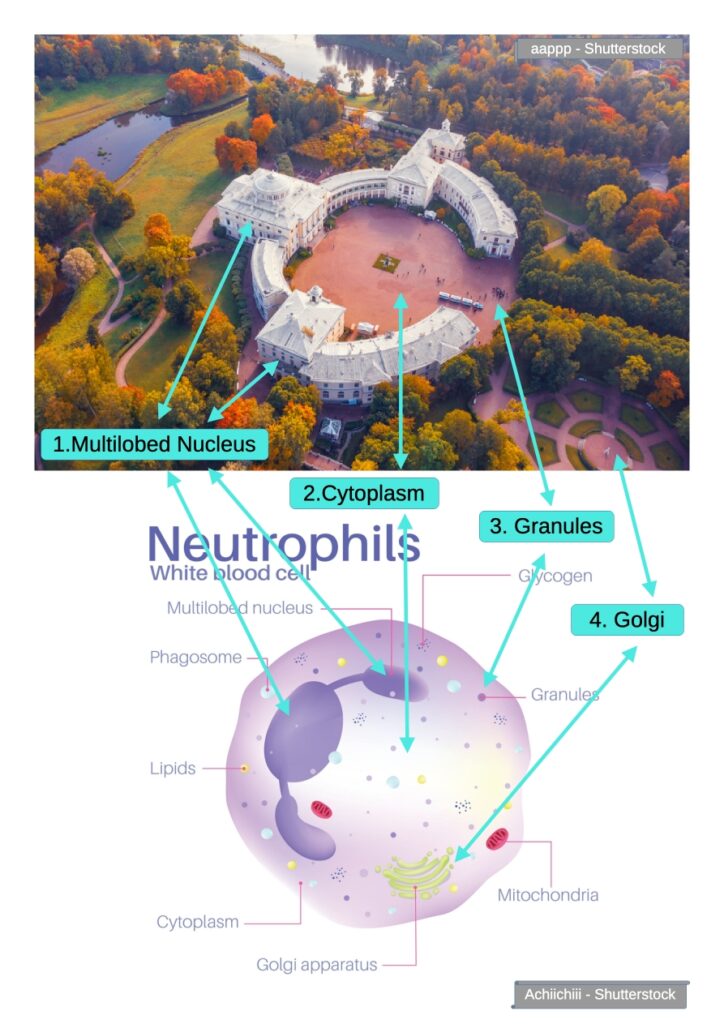
- 1. „The palace with its wings mirrors the multi-lobed nucleus of a neutrophil” – Neutrophils have a distinctive segmented nucleus that, under a microscope, resembles irregular lobes. Similarly, the spread-out wings of Pavlovsk Palace create the same organic, multi-part pattern.
- 2. „The courtyard is the cytoplasm” – The central space of the palace, surrounded by buildings, corresponds to the fluid cytoplasm where cellular organelles are suspended. In both cases, it serves as the „filling” that gives the structure cohesion.
- 3. „Tourists in the courtyard are granules” – Neutrophils contain numerous granules filled with defensive enzymes. The tourists moving around the courtyard resemble these dynamic structures, activating in response to a perceived „threat.”
- 4. „Paradeplatz is the Golgi apparatus” – The circular square with a fountain in front of the palace may symbolize the Golgi apparatus—a structure responsible for modifying and transporting proteins. The fountain, like proteins in the trans-Golgi network, acts as a dynamic „secretory” center of the entire complex.
, Is it possible that the architects of Pavlovsk Palace consciously recreated the blueprint of a neutrophil—a cell humanity wouldn’t see under a microscope until centuries later? Or is this yet more evidence of forgotten knowledge encoded in stone? If so, what other biological patterns are hidden in the world’s temples and palaces? In future posts, we’ll uncover more of this extraordinary puzzle.
„Divine Neutrophil Facts – Guardians of Your Microcosmos”
- 1. „First Line of Defense” Neutrophils are your most abundant white blood cells (60-70% of leukocytes!) and the first responders to bacterial invasions – they can reach infection sites in just 30 minutes!
2. „Suicide Mission” In ultimate sacrifice, neutrophils perform NETosis – spewing their own DNA like sticky webs to trap pathogens, resulting in their death. The true kamikazes of your immune system!
3. „Microscopic Cannibals” Research reveals neutrophils can… eat other neutrophils (called neutrophilophagy) to regulate inflammation. A macabre yet brilliant strategy!
4. „Crystalline Army” Their granules contain defensin crystals – proteins that literally **puncture** bacterial membranes like microscopic bullets.
5. „Aliens in Our Veins” Neutrophils behave like an intelligent, alien life form – they can „track” bacteria by following chemical gradients (chemotaxis), and some research suggests they might even… communicate with each other through biochemical signals, creating something resembling a „primitive consciousness” of the immune system! - Divine Bonus Tidbit: In alchemical tradition, blood was considered the „elixir of life,” and its white components were seen as the materialization of spiritual purity – could it be that alchemists intuitively sensed the role of neutrophils?
Did You Know…
Your body produces 100 billion neutrophils daily? That’s like building 10 Pavlovsk Palaces out of white blood cells every day!
,Combining images and analysis by Tomasz Mikulski – Cell God, date: 12/2024
Links and references:
Pavlovsk Palace is an 18th-century Russian Imperial residence. source. https://en.wikipedia.org/wiki/Pavlovsk_Palace
10 Surprising Facts About White Blood Cells, https://www.drkarunhematology.com/blog/10-surprising-facts-about-white-blood-cells/

One thought on “Russia, Pavlovsk Palace in St. Petersburg.”