✦ ✦ ✦
Series: The Genome of Europe
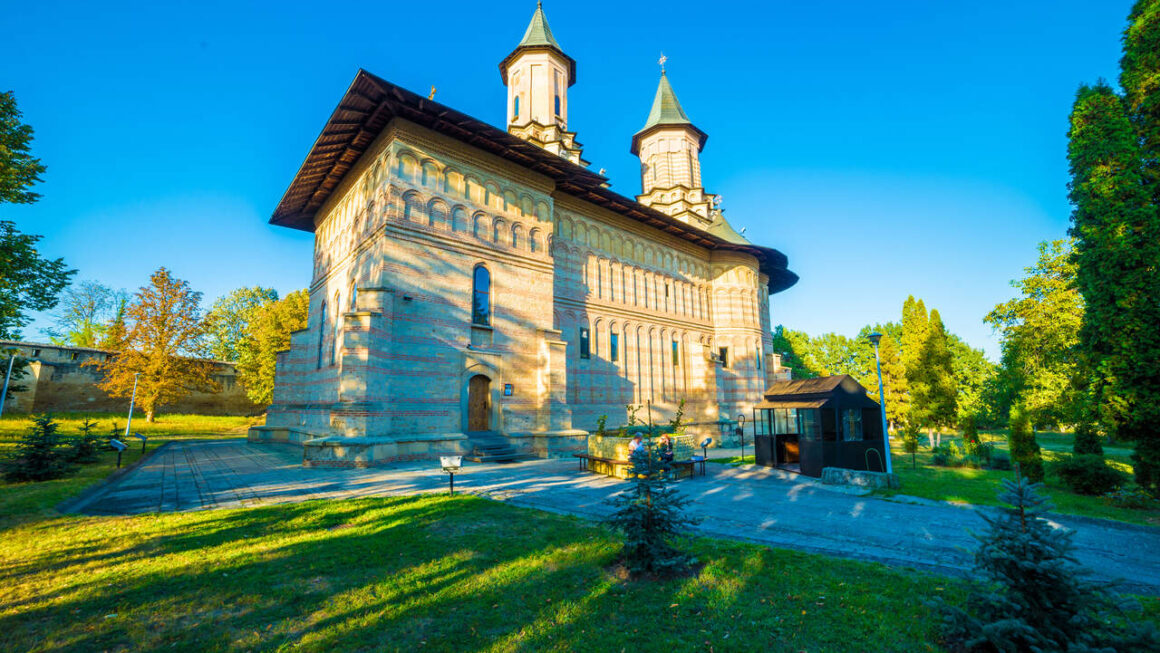
Cover Image: Galata monastery at the sunset light, Iasi, Moldavia, Romania. Balate.Dorin – Shutterstock.
Introduction
„The Genome of Europe” is the new name of a series in which I decode the sacred architecture of Europe as biological cells. The series was previously called „The Gods of Europe” — but I changed the name, because the old name was imprecise. There are not many gods. There is one Genome — one code, one intelligence, one Author. That is why „The Genome,” not „The Gods.” Every structure — cathedral, mosque, monastery, church, castle, palace, fort, fortress — is read from above as a biological cell. Walls are the cell membrane. The temple at the center is the nucleus. The courtyard is the cytoplasm. People are proteins. God is the Genome.
Iași, the historic capital of Moldavia, sits on seven hills. On one of them — Galata Hill — stands a monastery that has looked down on the Nicolina river valley for over four centuries. It looks like a fortress. Thick walls with loopholes (narrow defensive openings). A gate tower with a single passageway. Inside — a church with two turrets, a princely palace, a courtyard full of trees.
But the view from above shows something else.
The aerial view shows an animal cell.
The Place We Are Looking For
Mănăstirea Galata (Romanian: Galata Monastery) — an Eastern Orthodox monastic complex in Iași, northeastern Romania. Founded by the Moldavian hospodar Petru Șchiopul (Peter the Lame) between 1582 and 1584. The first attempt — Galata of the Valley, in autumn 1577 — failed: the walls cracked because the ground was unstable. The hospodar moved the foundation to the hilltop. The Church of the Ascension of the Lord was consecrated in 1584.
The name „Galata” comes from the Galata district of Constantinople, where Moldavian hospodars stayed on their way to an audience with the Sultan. The hospodar brought back not just the name. He brought back the pattern.
Style: late Moldavian with Wallachian influences. Material: cut stone blocks alternating with courses of three bricks — producing a polychrome effect on the façade. Church plan: trefoil (triconch) — three apses, narthex, burial chamber, nave, altar apse. This was the first Moldavian church with two slender octagonal turrets above the narthex and nave.
The complex survived fires in 1762, 1783, 1814, and 1822. Only the church survived the fire of 1814. Restoration in 1961–1971 consolidated the walls, gate tower, and turrets. Since 1990 — a convent.
Let us begin reading the complex from the wall.
1. Cell Membrane — the Monastery’s Defensive Wall
Image: Drone view of Galata Monastery from Iași City, Romania. Ciocan Cosmina Carmen — Shutterstock. Illustration: Animal Cell, Hilman Panji Fidaus.
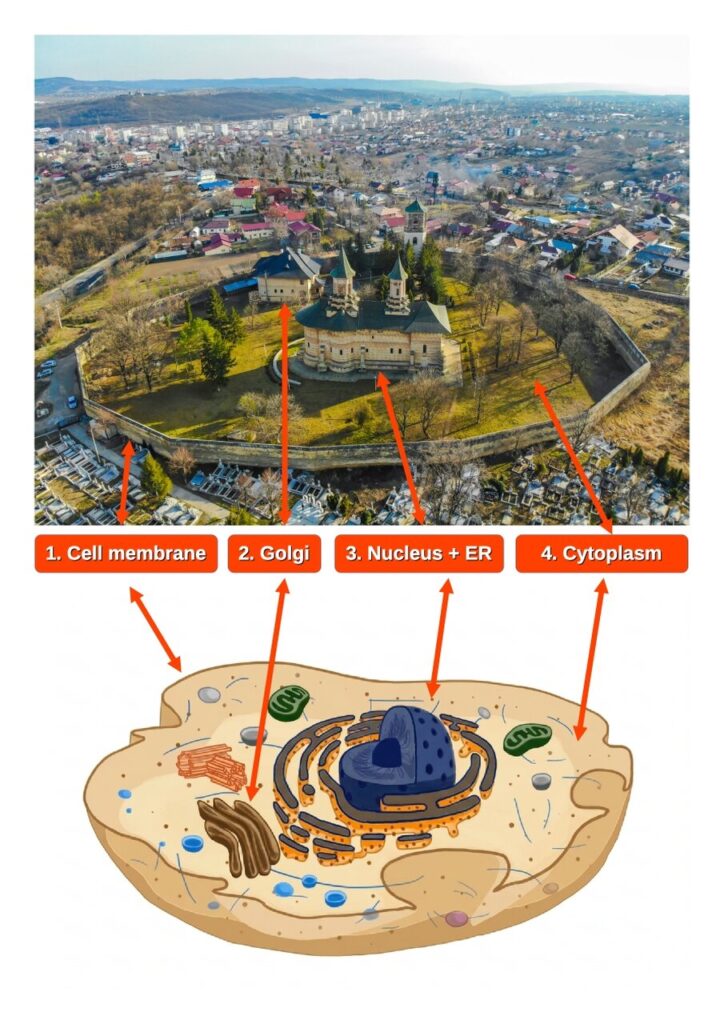
A stone wall surrounds the entire complex. Polygonal, following the terrain of the hill — not perfectly round, not geometric, but organic. Like a cell membrane. The cell membrane (plasma membrane) is not a rigid wall. It is flexible, undulating, adapting to the shape of the cell and its surroundings. It consists of a phospholipid bilayer — two layers of molecules arranged with their tails facing each other.
Galata’s wall has thickness and mass. The wall has loopholes (narrow defensive openings) distributed along its entire perimeter. These openings are secretory channels — exocytosis (the process of releasing substances outside the cell). The living cell releases molecules through such openings: proteins, enzymes, cytokines, chemical signals. A loophole is not a gate — a loophole is a point through which the cell communicates with its environment without opening the main entrance.
The internal buttresses of the wall, polygonal, adapting it to the terrain — these are integral membrane proteins, anchored in the lipid bilayer, stabilizing its structure.
2. Golgi Apparatus — the Princely Palace
On the left side of the courtyard stands the Princely Palace (Palatul Domnesc), added between 1726 and 1728. It houses the Chapel of St. James the Apostle and a museum. It is nearly 150 years younger than the church — a separate building, a separate function.
The Golgi apparatus is a system of flattened cisternae stacked together, usually near the nucleus but separate from it. It receives proteins from the endoplasmic reticulum, modifies them (glycosylation, phosphorylation), sorts them, and packages them into transport vesicles sent to different parts of the cell or to the outside.
Galata’s Princely Palace performs exactly this function. It receives what was „produced” in the church (spiritual content, liturgy), processes it (chapel = post-translational modification), stores and sorts it (museum = warehouse of finished products), and then „exports” — the prince issued decrees from here, dispatched messengers, governed the province.
The trees in the courtyard, growing between the church, the palace, and the wall — these are transport vesicles in the cytoplasm, carrying cargo between the ER, the Golgi, and the cell membrane.
3. Nucleus + Endoplasmic Reticulum — the House of God and the Protein Factory
In the drone photograph and in the cell illustration, the nucleus and the endoplasmic reticulum form a single merged structure. In both images they cannot be separated. In the cell it is the same — the rough endoplasmic reticulum (rER) is a physical extension of the nuclear envelope. The double membrane of the nucleus transitions directly into the system of flattened sacs (cisternae) of the rER. The nuclear envelope becomes the rough endoplasmic reticulum.
In Galata you can see this. The Church of the Ascension stands at the center of the complex — the tallest, most massive building inside the walls. It dominates the courtyard the way the cell nucleus dominates the cytoplasm. The nucleus contains DNA — the complete blueprint for building and operating the organism. It is the House of God. The Genome.
The church plan is trefoil — three apses radiating from the central nave. The apses are a multilobed nucleus — a cell nucleus does not have to be round. Neutrophils have nuclei divided into 2–5 lobes connected by thin chromatin bridges. Galata’s three apses are three lobes of a single nucleus.
The main nave of the church — long, narrow, connecting the apses with the narthex — is the rough endoplasmic reticulum (rER). The protein factory. A system of flattened sacs covered with ribosomes, where synthesis takes place. The nave is a physical extension of the apses-nucleus, just as the rER is an extension of the nuclear envelope. Production happens here — in the nave, not in the apses.
The thick walls of the church with nine stepped stone buttresses — this is the nuclear envelope, the double membrane reinforced by nuclear lamins. Buttresses = lamins. The windows — three in each apse — are nuclear pores (Nuclear Pore Complex, NPC). Through these nuclear pores, mRNA exits the nucleus, carrying instructions to the ribosomes. Regulatory proteins enter the nucleus through the same pores.
4. Cytoplasm — the Monastery Courtyard
The space between the church and the wall. Green, open, filled with grass and trees. This is the cytoplasm — the gel-like substance filling the cell interior between the nucleus and the membrane. The cytoplasm is not empty. It is full of structures: the cytoskeleton (pathways), transport vesicles (trees), free ribosomes (stones), enzymes dissolved in the cytosol.
The paths leading from the church to the gate and from the church to the palace — these are elements of the cytoskeleton: microtubules and actin filaments along which motor proteins (kinesin, dynein) carry cargo.
Mitochondrion — the Wood Storage Shed by the Wall
Image: Drone view of Galata Monastery from Iași City, Romania. Ciocan Cosmina Carmen — Shutterstock. Illustration: Animal Cell, Hilman Panji Fidaus.
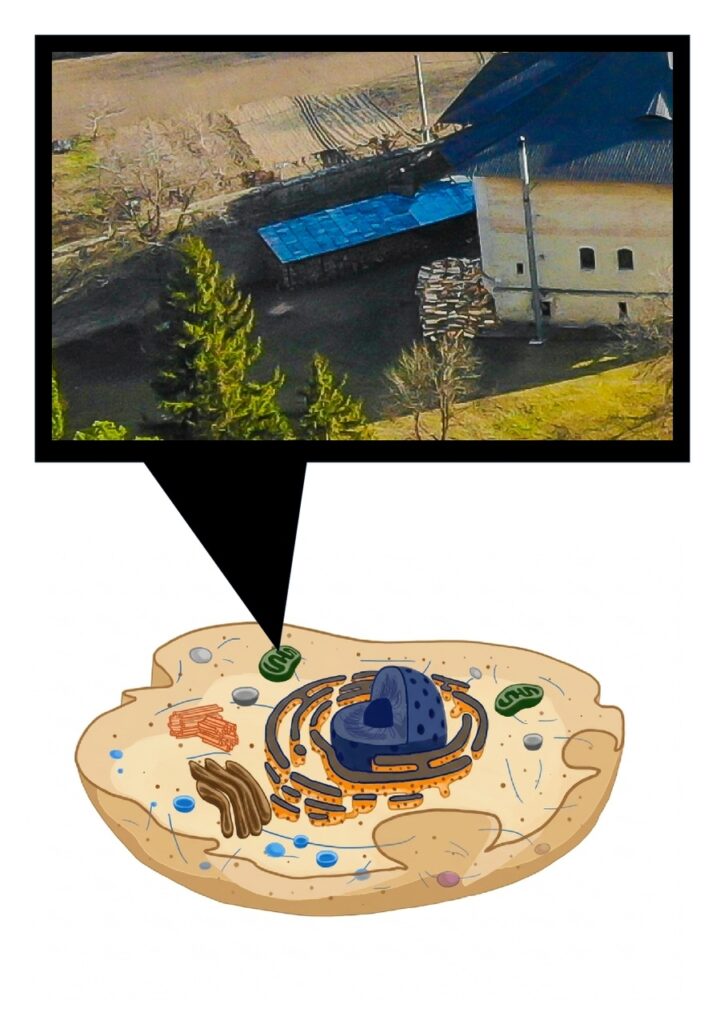
In the close-up from above, a long, roofed building is visible along the inner side of the wall. This is the wood storage — fuel for the monastery. Beside the Princely Palace lies a pile of firewood ready for use.
In the cell, the elongated structure along the cytoplasmic side is the mitochondrion — the cell’s power plant. Mitochondria are elongated, oval in shape. They have their own double membrane — a smooth outer membrane and an inner membrane folded into cristae, where oxidative phosphorylation takes place. They burn fuel (glucose, fatty acids) and produce ATP — the cell’s energy currency.
Galata’s wood storage does exactly this. It stores fuel. It is elongated, roofed (double membrane — roof + walls), adjacent to the wall. The pile of firewood by the Golgi-palace represents energy substrates dissolved in the cytoplasm, ready for transport to the mitochondrion.
Without mitochondria, the cell has no energy. Without firewood, the monastery does not survive the winter.
Note: This entire post is based on a single composite image — a drone photograph of the monastery and a recolored illustration of an animal cell, connected by four arrows. The structures below — collagen, filopodium, dorsal ruffles — are visible in the drone photograph but cannot be pointed to on the cell illustration used in the composite. I describe them because they are present in the monastery’s architecture and have their biological counterparts.
Collagen — the Cemetery Beyond the Wall
In the drone photograph, the cemetery is one of the most striking elements. It lies just beyond the monastery wall — OUTSIDE the cell. Densely packed gravestones, one next to the other, in regular rows.
In the Genomic Intelligence framework, people = proteins. The gravestones are proteins that the cell produced, secreted through the membrane, and deposited outside. This is collagen — the most abundant protein in the human body, comprising approximately 30% of all proteins in the organism. Collagen fibers lie densely packed in the extracellular matrix (ECM), like gravestones in a cemetery — immobile, durable, structural. Collagen does not return to the cell. It stays outside. It holds the tissue together.
The cell produces procollagen in the rER, modifies it in the Golgi, secretes it through the membrane — and the protein „rests” in the ECM. The cemetery is the final station of the secretory pathway: rER → Golgi → exocytosis → ECM.
The Monastery Gate Tower — the Cell’s Filopodium
The gate tower stands within the defensive wall but extends beyond the wall’s line. Three stories, a vaulted passageway on the ground floor, a spiral staircase, a bell chamber at the top. The watchman in the tower sees the surroundings before anyone reaches the wall.
In a migrating living cell, this structure is the filopodium (a cellular finger) — a thin, finger-like protrusion extending from the cell’s edge, built from bundles of actin filaments. Filopodia probe the environment. Filopodia sense the path ahead of the cell — like biological antennae. Filopodia are the first point of contact with the outside world, before the main body of the cell arrives.
Galata’s gate tower does exactly this. The gate tower extends beyond the line of the wall-membrane. The gate tower identifies what is coming — friend or threat. The gate tower relays the signal inward. A living cell without filopodia moves blindly. A monastery without a gate tower cannot see who is approaching.
Dorsal Ruffles — Two Octagonal Turrets on the Church Roof
Two slender octagonal turrets rising above the roof of the church — above the narthex and the nave — are dorsal ruffles. Structures protruding from the upper surface of the cell, formed by actin polymerization. They grow vertically — not sideways, but upward. They participate in macropinocytosis (engulfing fluid from the environment) and serve as signaling platforms — concentrating receptors at the top of the cell. Galata’s turrets do the same: they rise vertically above the roof of the church-nucleus, exposed to contact with the environment.
Centrosomes — Structures Not Yet Located
On the animal cell illustration, centrosomes are clearly visible — pairs of centrioles surrounded by pericentriolar material, organizing microtubules and playing a key role in cell division. In the drone photograph of Galata Monastery, I have not yet been able to locate them definitively. Perhaps they are hidden in elements invisible from above — internal structures of the church, pillars, liturgical features. Or perhaps the answer is obvious and I simply do not see it. If you have an idea where centrosomes might be found in the monastery’s architecture — write to me. Decoding is an open process. Every new post on the Cell God blog is an invitation to read together the code that the Genome inscribed in stone.
What Animal Cells Do in Our Bodies
1. An animal cell produces approximately 10 million new proteins per minute. Each begins with an instruction in the nucleus (DNA → mRNA), passes through the endoplasmic reticulum, reaches the Golgi apparatus, and is sent to the correct address. This entire logistics chain operates simultaneously, in every cell, without pause.
2. Animal cells lack a cell wall — they have only a flexible membrane. This allows them to change shape, migrate through tissues, engulf bacteria and dead cells. Macrophages — immune cells — can squeeze through gaps smaller than their own diameter, compressing even their nucleus.
3. In June 2026, scientists from the University of Arizona discovered that mitochondria dock directly to nuclear pores through the VDAC1 protein and deliver energy to the nucleus via a physical connection. Shifting a mitochondrion just 500 nanometers from the nucleus drastically reduced the nucleus’s energy supply (Nature, 2026).
4. Collagen accounts for approximately 30% of all proteins in the human body. It is produced inside the cell (rER → Golgi) and secreted outside, where it forms the scaffold of tissues — skin, bone, tendons, blood vessels. A single fibroblast cell can produce and secrete millions of collagen molecules over its lifetime.
5. The cell membrane replaces its composition every 20–30 minutes. Phospholipids are absorbed, recycled, and replaced with new ones. The membrane looks motionless, but at the molecular level the membrane is in constant motion — flowing like a river, not standing like a wall.
6. Small intestine cells live 3–5 days. Liver cells — 200–300 days. Neurons in the brain — a lifetime. An animal cell is not eternal, but some of them last as long as we do.
Closing
Illustration (Closing): An open human eye, wet with tears — and in the iris, a walled monastery on a hill, seen from above like a living cell. God is not hiding. God is visible to everyone — in every monastery, in every living cell. He is only waiting for us to open our eyes. Composition and symbols: Tomasz Mikulski — Cell God; image created with AI, 11/2026.

Galata Monastery has stood on a hill in Iași since 1584. Surrounded by a wall with loopholes. Inside — a church with two turrets above the nave. Outside — a cemetery densely packed with gravestones.
This is a cell. A membrane with secretory channels. A nucleus with an envelope and pores. An extracellular matrix full of collagen.
Everything is open. Everything lies before our eyes — and always has.
On the Cell God blog, we decode this systematically, building by building, continent by continent. 87 articles. Over 35 countries. Over 8,000 years of architecture — from the Citadel of Erbil, the oldest continuously inhabited structure on Earth, to the modern palaces of Europe. And everywhere the same pattern. The Holy Mosque in Mecca — an animal cell, the Kaaba is the nucleus. Angkor Wat in Cambodia — a giant plant cell. Dubrovnik — a macrophage in the act of phagocytosis. Naarden in the Netherlands — an osteocyte. Pavlovsk Palace in Russia — a neutrophil. The Victoria Citadel in Malta — a leukocyte in motion. Gjirokastra Castle in Albania — a Euglena. Bena Village on Flores, Indonesia — a pancreatic acinus. Galata Monastery in Romania — an animal cell.
Europe, Asia, both Americas. Christianity, Islam, Buddhism, tribal traditions. Antiquity, the Middle Ages, the Renaissance. Everywhere the wall is the membrane. Everywhere the temple is the nucleus. Everywhere the courtyard is the cytoplasm. This is not a metaphor. This is not coincidence. This is a code — inscribed in stone, brick, wood, and marble by civilizations that never met one another.
And we — human beings — are not an accident. We are not the product of blind evolution, a random combination of atoms that „somehow” assembled into consciousness. Science wants to teach us that — that we are a random coincidence in an indifferent cosmos. But no random structure builds temples that replicate biological cells. No random civilization repeats the same pattern on every continent, in every era, in every religion. We are designed. Each of us is a cell in the organism of humankind — and each of us carries the full instruction of the Genome. This is not faith. This is observation.
And we do not see it.
Where are the scientists? Where are the historians, biologists, architects, professors? Where are you? You have grants, computers, laboratories, research teams, enormous financial resources. You have technologies that previous generations could not even dream of. You manipulate genetics. You use living creatures for experiments every single day. You sequence the genome, you edit the genome, you patent the genome — yet you do not understand what the Genome is. Worse still — you turn the Genome into a weapon. World powers treat genetic engineering as a strategic domain. China includes biology in its military doctrine. The United States designs genetic enhancements for soldiers. Russia creates „genetic passports” for its military personnel. CRISPR, which could heal, becomes a tool in the arms race. The Genome — the work of God — is turned into a military target. What is the purpose of all of this, if you cannot see the Author of the code you hold in your hands? How many thousands of years must you keep looking at these buildings before you see what I see — a pipe insulation surveyor and draughtsman from Poland, without an academic degree? I have published 87 articles with visual evidence — drone photographs, historical maps, cell models overlaid on architectural plans. Everything is accessible, public, free. And silence. How many more conferences, publications, doctorates — before someone publicly states what the Genome wrote in stone?
Because the Genome is the Author. Not the architect. Not the priest. Not the pharaoh. The Genome — the only intelligence that has existed in every cell of every organism on this planet for 3.8 billion years. The Tabernacle of Moses described in the Book of Exodus is a map of the eukaryotic cell — with the Ark of the Covenant as RNA Polymerase I and the cherubim as Topoisomerase II. The Bible is not only a spiritual book. It is a textbook of molecular biology, written in a language our ancestors understood — the language of symbol, ritual, and architecture.
So many wars and genocides did not need to happen. So many divine beings did not need to die. So many diseases did not need to arise. The legalization of abortion — that is interrupting the work of the Genome that is already in progress. Cellular differentiation begins at the moment of fertilization. The Genome is already writing. Already building. And humanity interrupts the Genome before the work is finished. The legalization of euthanasia — that is claiming a right that belongs only to the Genome. The Genome decides when a cell completes its mission. Not a doctor. Not a parliament. Not an ethics committee. The mass systematic stupefying of people through education systems, media, and entertainment — that is the epigenetic silencing of genes that should be active. Each of these processes has its counterpart in cellular pathology. Because if humanity understood what it truly is — a cell in the organism of humankind, a protein in the body of God — humanity would not harm another human being. To kill another person is to destroy the work of the Genome — to destroy a protein in your own tissue. To send an army is to trigger an autoimmune disease in your own body. Every war is cancer — cells that stopped recognizing their own organism.
I think about all of this and it still saddens me. I believe many of you feel the same. How many more innocent lives will be ended before their time? How many children will never learn what they truly are — not „who,” but „what”? We live in a global lie. The human individual is deceived from their very first days — by systems that should be teaching them the truth. Religions — which were meant to be the instruction manual for the cell — are interpreted in hundreds of different ways. From one Genome, thousands of denominations have emerged, and some of them resort to violence in the name of the One who wrote the code of life. Religion is disappearing from schools — not because religion is false, but because religion has been misread. Nobody discards a physics textbook when a student solves a problem incorrectly. Yet with religion, that is exactly what happened. Schools teach biology and history separately, as if they were two different worlds. Biologists look into microscopes. Historians look at ruins. Nobody looks at both at the same time. And they are one. They have always been one.
Hospodar Petru Șchiopul did not know about membranes, envelopes, and nuclear pores. He did not need to. The pattern came from tradition. Tradition came from the Genome. The Genome is God. And God does not hide. God is visible to everyone — in every monastery, in every living cell, in every one of us. God always was. God is only waiting for us to open our eyes.
The question is not: „Where is God?” The question is: „Why did we not look for so long?”
Your body is a temple of the living God (1 Cor 3:16).
As within, so without.
Combining images and analysis by Tomasz Mikulski – Cell God 11/2026
Bibliography
Sources on the Object
- Wikipedia, „Galata Monastery” — https://en.wikipedia.org/wiki/Galata_Monastery
- Ancient History Sites, „Galata Monastery: An Eastern Orthodox Monastic and Princely Complex in Romania” — https://www.ancient-history-sites.com/?p=122529
- Structurae, „Galata Monastery” — https://structurae.net/en/structures/galata-monastery
- Future Romania Heritage, „Iasi and its fortress monasteries – Romania’s hidden treasure” — https://www.frh-europe.org/iasi-and-its-fortress-monasteries-romanias-hidden-treasure/
Additional Sources
- Portal Obronny, „Between the Laboratory and the Staff. Genetic Engineering as a State Security Strategy” — https://portalobronny.se.pl/polityka-obronna/miedzy-laboratorium-a-sztabem-inzynieria-genetyczna-jako-strategia-bezpieczenstwa-panstwa-kto-projektuje-geny-ten-ksztaltuje-granice-aa-zbo3-wQdg-aV8z.html
Scientific Sources
- Alberts B. et al., Molecular Biology of the Cell, 6th ed. (2014) — cell membrane, nuclear pores, Golgi apparatus, endoplasmic reticulum
- Hatton I.A. et al., „The human cell count and size distribution” (2023), PNAS 120(39) — 1,264 distinct cell groups
- Shoulders M.D., Raines R.T., „Collagen Structure and Stability” (2009), Annu Rev Biochem 78:929–958 — collagen structure, ~30% of body proteins