1. The Wen Wu temple vs Cell structure.
The Wen Wu temple as cell: architecture and biology in harmony. Temples are not only places of worship, but also works of art that often hide deeper meanings. The Wen Wu temple, one of the most beautiful buildings of traditional Chinese architecture, can be seen as the living cell. Its structure, full of symbolism and details, resembles a cellular organization, where each element performs a specific function. Let’s take a look at this fascinating analogy!
,Photo description: Nantou, Taiwan – September 11th, 2019: aerial view of famous landmark of Wenwu temple in Sun Moon Lake, Nantou, Taiwan.
,Vector description: Graph Biology Classification Animation Scheme. Vector illustration.
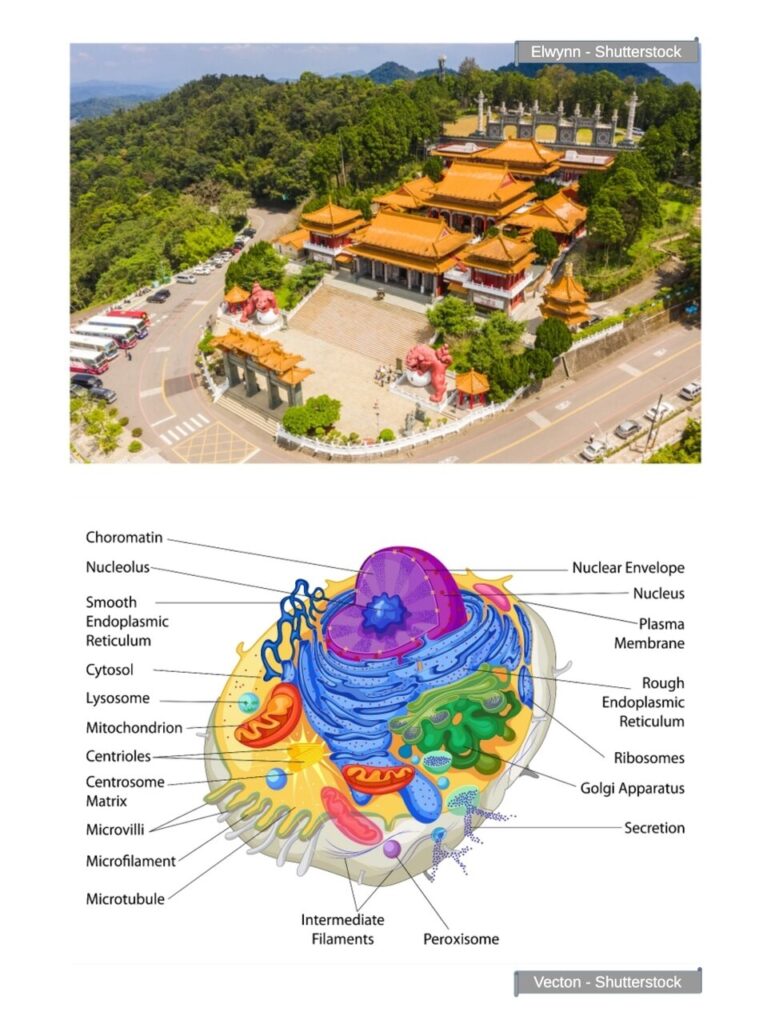
- The main entrance, decorated with an impressive gate, can be compared to microvilli – tiny protrusions on the surface of cells that increase their absorbent surface. The main gate symbolizes the first contact with the outside world, just as microvilli allow the cell to interact with its surroundings. This is where the „dialogue” between the sacrum and the profanum begins, between the cell and its environment.
- Front hall as Golgi apparatus after crossing the gate, we enter the front hall, which resembles the Golgi apparatus – the Center for sorting and modifying proteins in the cell. In the temple, this space serves to prepare the faithful for further travel, just as the Golgi apparatus prepares substances for transport into the cell or outside. It is a place where everything is organized and directed to the right places.
- The back Hall of the temple, often full of nooks and crannies and additional altars, resembles the rough endoplasmic reticulum – a labyrinthine structure in the cell responsible for the synthesis of proteins. This is the place where the „production” of spiritual and material goods takes place, just as the rough endoplasmic reticulum is the place of intensive metabolic work.
- The back wall of the temple, supported by powerful columns, can be compared to the smooth endoplasmic reticulum – the structure responsible for lipids synthesis that gives the cell its shape and stability. .
The shape and structure of the Wen Wu temple clearly shows the structure of the Cell.
, Video YouTube, A tour of the beautiful Wenwu Temple, overlooking Sun Moon Lake in Nantou county, Taiwan. https://youtu.be/TB8T5ckQ9KU?si=tDYChEaJmR_JpWRS
2. The Lions vs Lysosomes.
,Photo description: Wen Wu temple panorama.
,Vector description: Lysosome Hydrolytic enzymes, Membrane and transport proteins, science and medical use, Vector Illustration.
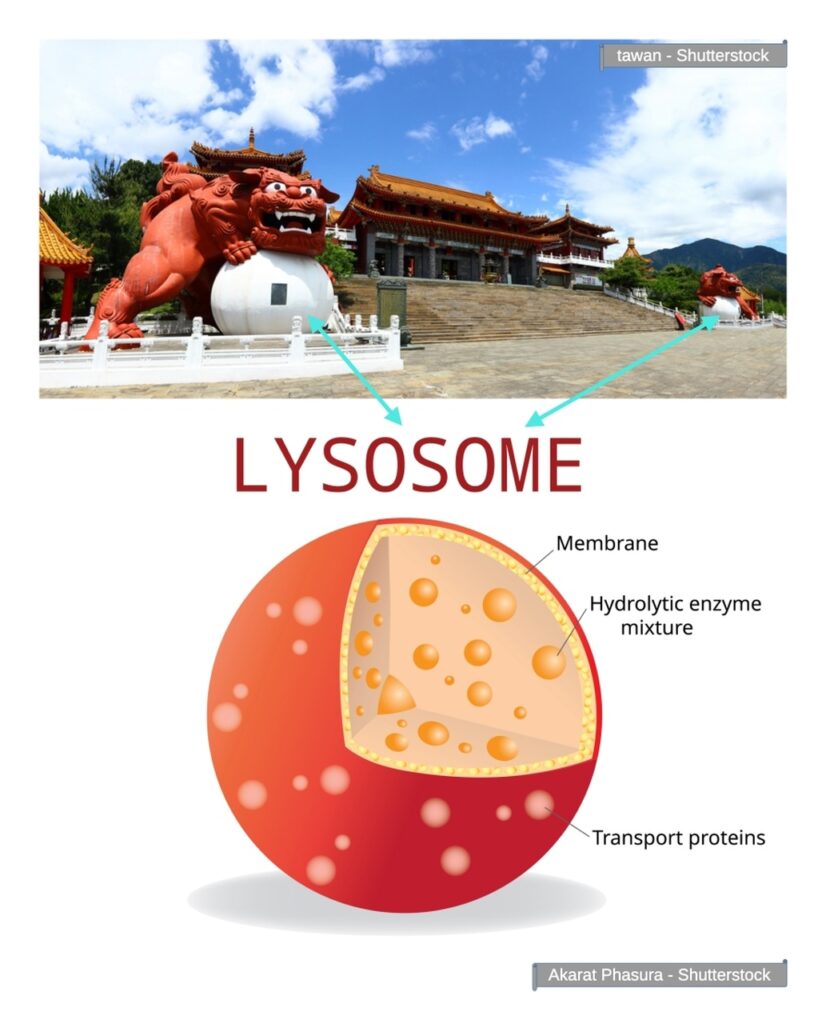
„Lions as lysosomes” at the entrances to the temple often stand stone lions, Guardians of the holy space. They can be compared to lysosomes – cellular organelles that perform the function of” guards”, digesting the spent elements of the cell and protecting it from harmful substances. Lions protect the temple from evil, just as lysosomes protect the cell from degradation.
3. Wish wall vs phospholipid bilayer.
,Photo description: Nantou, Taiwan – December 9th, 2019: wall of wish in Wenwu Temple near Sun Moon Lake at Yuchi, Nantou, Taiwan, Asia.
,Illustration description: Illustration of Phospholipid bilayer membrane (3D Render).
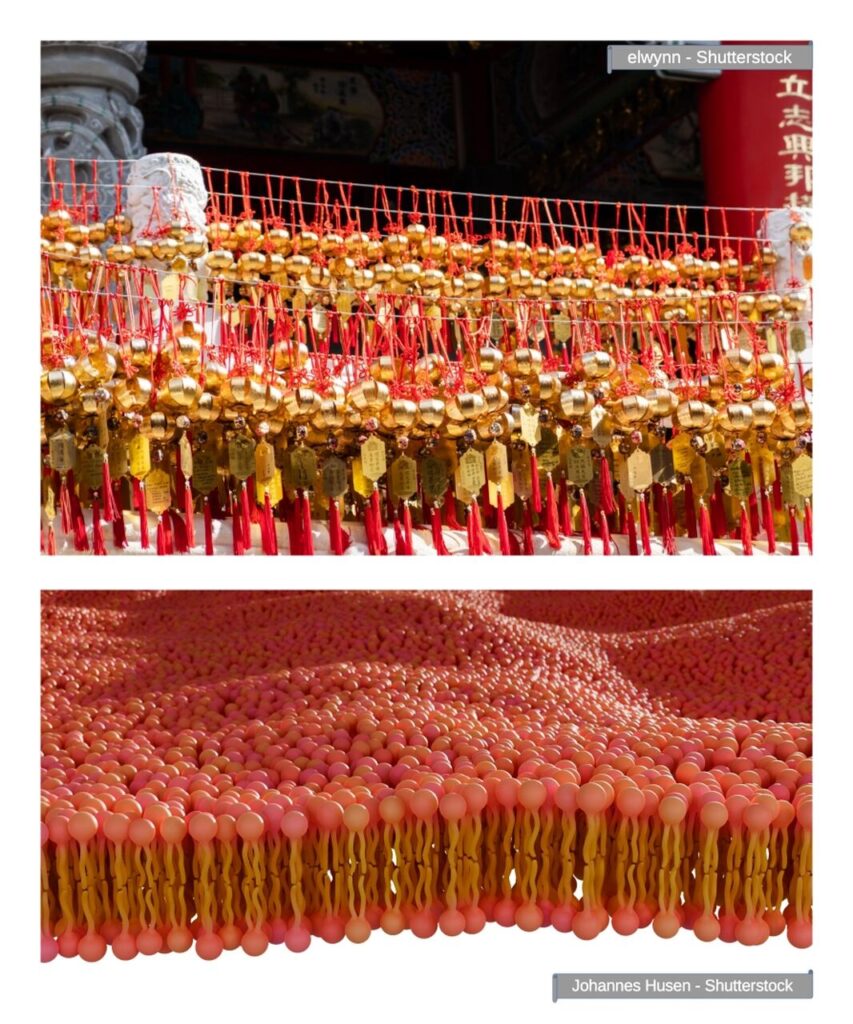
- Wish wall and Phospholipid bilayer: structure and function. Hanging bells, arranged in regular rows, resemble lipids that form the phospholipid bilayer. Each Bell is like a single lipid molecule-an independent but integral part of a larger whole. Bells, like lipids, form a layer that not only performs a protective function, but also allows communication. In the case of the wish wall, this is the communication between people and the spiritual world, and in the case of the cell membrane – between the inside of the cell and its surroundings.
The wall of Wishes is not just an ornament – it is a place where people leave their dreams, prayers and hopes. Similarly, the Phospholipid bilayer is not just a barrier – it is an active participant in the life of the cell, responsible for transport, signaling and protection. Both structures, though so different, act as mediators-connecting the Internal with the external.
4. Interior of the temple vs structure of nucleus and nucleolus.
The heart of the temple is the Central Hall, which corresponds to the cell nucleus. It is here that the most important altar is located, the place of concentration of energy and spiritual power. The cell nucleus is the command center where DNA is stored-the source of genetic information. In the temple, the Central Hall symbolizes holiness and wisdom, just as the nucleus is the source of cell life.
,Illustration description: Interior of the Wenwu Temple at Sun Moon Lake, Taiwan, astounds with its grand architecture, vibrant colors, and sacred aura. Yuchi, Taiwan – August 07, 2023.
,Vector description: Nucleus structure vector. Nuclear membrane, Chromatin, Nucleolus and Nuclear lamina.
,Photo description: NANTOU, TAIWAN – MARCH 18 2019. The scenery and building interior of famous landmark of Wenwu temple in Sun Moon Lake, Nantou, Taiwan
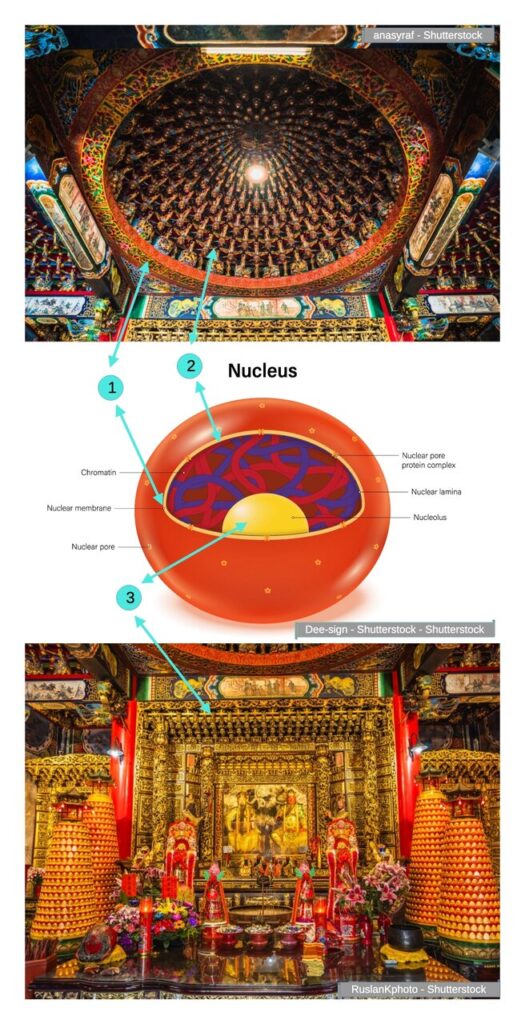
- 1. The Dome – Nucleus – The nucleus is a highly specialized organelle that serves as the information processing and administrative center of the cell. This organelle has two major functions: it stores the cell’s hereditary material, or DNA, and it coordinates the cell’s activities, which include growth, intermediary metabolism, protein synthesis, and reproduction (cell division).
- 2. The Lamins as Dome structure – While the nuclear membrane system has a functional role, it cannot provide mechanical strength and shape determination. Instead, a fibrous meshwork of nuclear lamins is formed just underneath the, and lamins are the main constituent of the nuclear lamina. source. https://febs.onlinelibrary.wiley.com/doi/10.1002/1873-3468.14750
- 3. The Altar – Nucleolus – is a membrane-less organelle within the nucleus that manufactures ribosomes, the cell’s protein-producing structures. Through the microscope, the nucleolus looks like a large dark spot within the nucleus. A nucleus may contain up to four nucleoli, but within each species the number of nucleoli is fixed. After a cell divides, a nucleolus is formed when chromosomes are brought together into nucleolar organizing regions. During cell division, the nucleolus disappears.
- source. https://micro.magnet.fsu.edu/cells/nucleus/nucleus.html
Inside this temple, as well as in every other, the altar represents the nucleolus and all these decorations and ornaments of the altar play the role of proteins involved in the processes inside the nucleus such as rRNA synthesis, the production and assembly of ribosomes needed to produce proteins for Your Divine Body.
„Summary” Wen Wu Temple, with its harmonious architecture and symbolic details, perfectly reflects the complexity and beauty of the cell. Each element of the temple has its counterparts in biology, which shows how deeply nature and culture are interrelated. It’s a reminder that at both the micro and Macroscale, everything is connected – from cells to temples, from science to spirituality. Isn’t it fascinating how the world of nature and the world of culture can penetrate? I encourage you to reflect on these analogies during your next temple visit – or during your biology class! 🌿🏯
Combining images and adding a description details of images made by Tomasz Mikulski – Cell God, date: 02/2025
,Sun Moon Lake Wen Wu Temple. source. https://en.wikipedia.org/wiki/Sun_Moon_Lake_Wen_Wu_Temple