„Košljun Island as a Fat Cell – A Journey into Biological Architecture”
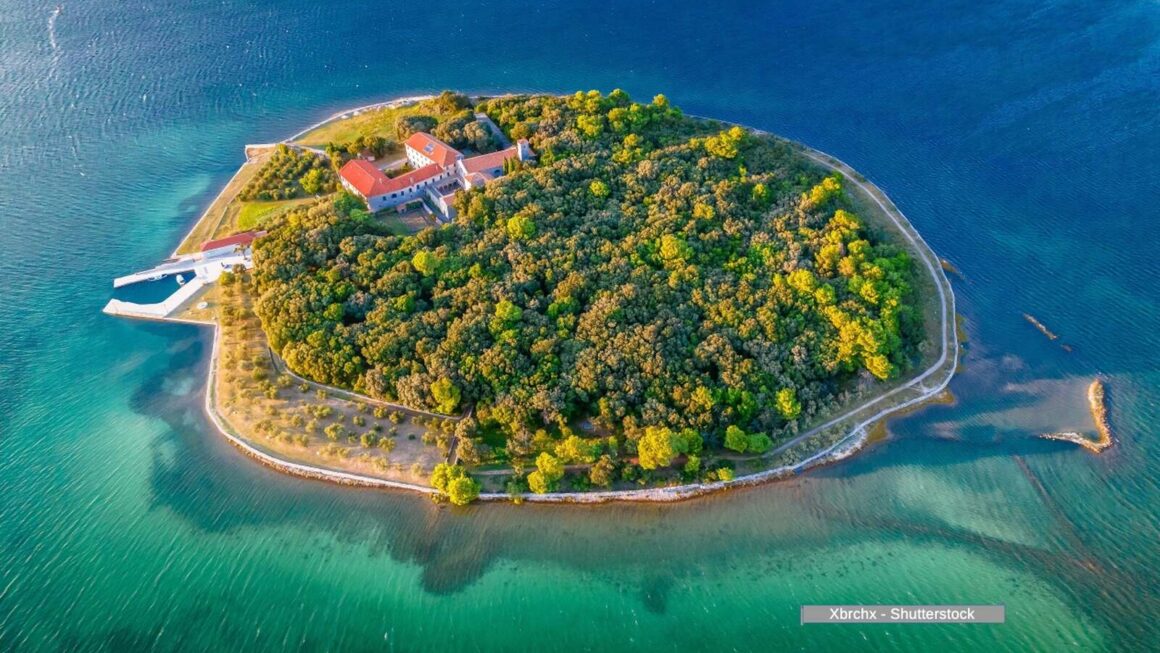
, Croatia’s Košljun Island is a place where nature intertwines with history, creating a landscape so harmonious that it resembles… a perfectly designed cell. When viewed from above, its structure strikingly mirrors that of a white adipocyte—the fundamental energy-storing unit in our bodies. The church becomes the nucleus, the monastery—the endoplasmic reticulum, and the lush vegetation is nothing other than a lipid droplet of life. Join me on an excursion where architecture meets cytology!
, photo description: Kosljun. Adriatic island of Kosljun in Punat bay aerial view, Island of Krk, Kvarner bay of Croatia
, illustration description: Fat Cell, white Adipocyte.
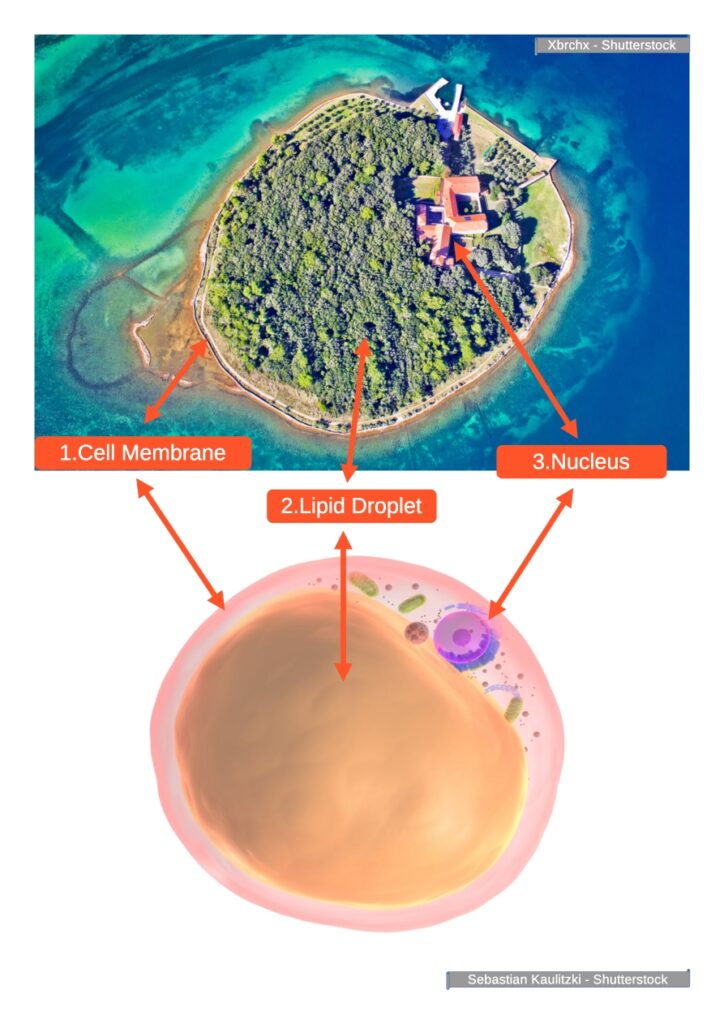
- 1. „The Coastal Path – The Cell Membrane” The narrow, rocky path encircling the island and separating it from the sea functions as the adipocyte’s cell membrane. It defines Košljun’s boundaries, controlling what enters (e.g., tourists like nutrients) and what stays outside (saltwater like metabolic waste). In some places, shallow water forms „receptors”—sandbanks that allow you to almost „diffuse” inward, much like membrane proteins.
- 2. „Vegetation – The Lipid Droplet of Life” Košljun’s dense pine and olive groves are the island’s equivalent of an adipocyte’s lipid droplet. This green mass, covering most of the surface, stores the island’s „energy”—providing oxygen, shelter, and beauty, just as fat stores metabolic energy. The deeper you venture into the vegetation, the more it resembles the densely packed triglycerides filling a cell.
- 3. „The Church – The „Nucleus” of the Island” At the heart of Košljun stands the Church of the Assumption of Mary, functioning like a cellular nucleus that governs the island’s spiritual and cultural order. Here, the most precious „information” is stored—historic books and artworks, much like DNA in a cell’s nucleus. The Franciscan monastery, embracing the church, acts as the endoplasmic reticulum—a place where „ideas” (prayers, education) are „synthesized,” while the small museum with its exhibits serves as the Golgi apparatus, where history is sorted and „packaged” for visitors.
, Košljun is not just an island—it’s a vivid metaphor for biology. Its architecture mirrors an adipocyte’s structure with uncanny precision. The church-nucleus, monastery-reticulum, museum-Golgi, vegetation-lipid, and path-membrane create a miniature universe where rocks and sea speak the language of cells. Perhaps fat tissue isn’t just an energy reserve but also… the body’s tiniest Franciscan monastery?
„Adipocytes – Microscopic Energy Stores”
- What are adipocytes? Adipocytes are specialized fat cells that make up adipose tissue (Latin: adipositas). They are true masters of energy storage – capable of increasing their volume up to 20 times!
- Where do they originate? They develop from mesenchymal stem cells, which differentiate into: – preadipocytes (immature forms) – mature adipocytes (fat-storing cells) This process occurs primarily during fetal development and puberty, though to a limited extent in adults as well.
- Types of adipocytes:
- 1. White adipocytes (WAT – white adipose tissue) – Store energy as a single large lipid droplet. – Secrete hormones (e.g., leptin). – Provide thermal insulation and cushion organs.
- 2. Brown adipocytes (BAT – brown adipose tissue) – Contain multiple small lipid droplets and mitochondria. – Burn fat to generate heat (thermogenesis). – Primarily active in newborns and during cold exposure .
- 3. Pink adipocytes – Emerge during pregnancy and lactation – Secrete milk components.
- Functions of adipose tissue: – Energy reservoir (1 kg of fat ≈ 7,000 kcal) – Thermoregulation – Mechanical protection of organs – Endocrine role (hormone secretion e.g., leptin, adiponectin) – Immune function (cytokine production)
- Fun fact: In whales, adipose tissue can comprise up to 50% of body mass, serving as both insulation and buoyancy!
,Combining images and analysis by Tomasz Mikulski – Cell God, date: 01/2025
- Links and references:
- Croatia, Kosljun. https://en.wikipedia.org/wiki/Košljun_(island)
- White adipose tissue, https://en.wikipedia.org/wiki/White_adipose_tissue